In which Wistric gets tempo. No really this time.
Fencing has been touch-and-go the past couple of weeks due to work. I made it out Thursday of this week, but hadn’t been out since Tuesday the week before. Damn our American dedication to over-productivity. No wonder French have more alcoholics and better food, they have more time to drink and cook.
Experiments with Italian Rapier
Following the entire month of February during which, apparently, Dante was snowbound and had nothing better to do than instant message about Italian rapier technique, his particular approaches to the fundamentals of combat have been kicking around in my head.
At the last Tuesday practice I made, Benjamin (who’s been working through Fabris for two years now, off-and-on) switched to fighting from Fabris’s second (and then one of the tiercas). With my deep knowledge of Fabris (“I’ve looked at a couple of the pictures”) I countered, and we fought a few passes that way. As shallow as the “looking at the pictures” study of Fabris is, it still reveals some obvious principles of his strategy: Minimize your target area and put it behind your guard and offhand, and strike either with force in a lunge, or with a void.
After the fight, we got to talking about Fabris (with Benjamin getting the book out of his car, which led to Roz and Gaston reminiscing about the days when HMA was “somebody knew somebody who’d read a tertiary source in a library once”) and especially plate 5:
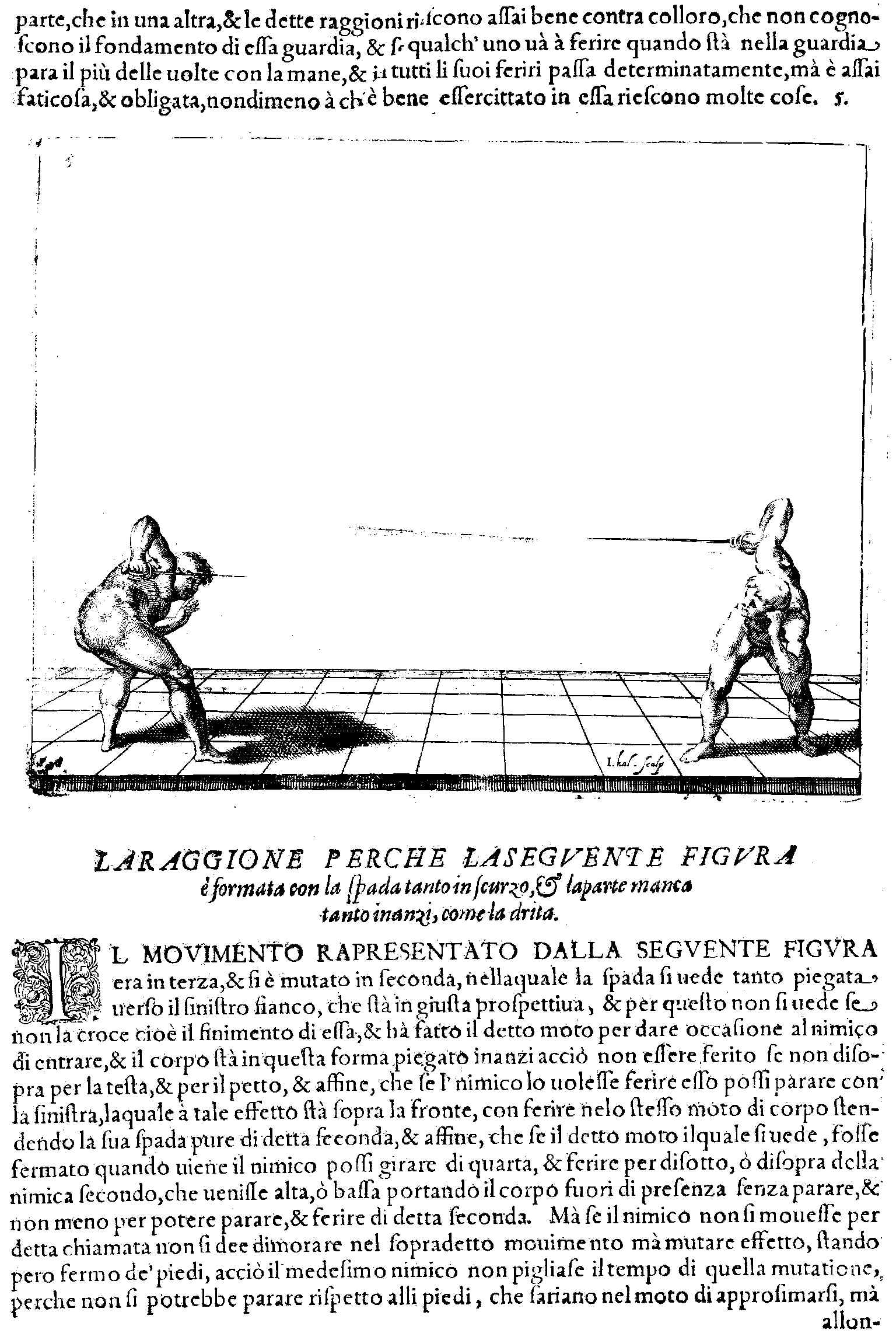
Thank you, ARMA, for feeding our fencer porn jones

Ben and I have, apparently, both been shown by Dante the same video of two fighters practicing this guard and its associated attack. Ben pointed out “Well, except they’re doing it wrong.” Which led to an “O?” His reading of Fabris leads to the conclusion that the fighters in the video are going far too slow in all aspects, and mostly because they’re in Modern American Shape, not the zero-body fat perfection of the professional duelists depicted (or, at least, independently wealthy gentlemen with nothing else to do except train all day). Ben, of course, DOES have the zero-body fat perfection of a professional duelist.
What this means, though, is that whereas most fighters approach Fabris from a form perspective, Ben is approaching it from a tempo perspective: His goal is to be able to strike in the time it takes me to tense my arm to start bringing my sword up from Lazy Man’s Guard. And he actually did it once during our fight that night. But instead of changing my entire strategy towards fighting Ben to “shoot him from fifty feet away, go pet his doggies”, which would probably be wise, I started thinking through the tempo strategy we had discussed, and how to achieve it in my own form, and defeat him. Yes, he’s faster than me, but I’m not the slowest person in Atlantia by a long shot.
When this Thursday rolled around, then, I put it to practice. I noticed Letia hated having my blade on the outside of hers, and would disengage almost immediately. I did this twice to confirm, and as she started her third disengage I struck. I did this attack three times in succession, and the dawning light of epiphany glowed through me (or maybe it was the glare from the halogen lights). I’ve read the phrase (on salvatorfabris.com) “strike in the tempo of his cavazione”, and I’ve read Dante’s discourses on closing the line, but have never come across a clear description of the sythesis of the two into a strategy of attack.
What I found fighting Letia, though, and then Jauma and Joe, was a straightforward way to actually apply the disparate concepts of Italian Rapier normally presented in isolation. I would close the line as I entered range, forcing Letia to either withdraw from range or cavazione to a new line, and as she performed the cavazione I’d strike, positioning my blade so it kept the line closed. Fighting Joe, his preferred counter to the closed line was an agressive counter-bind, which again created a tempo during which I could disengage and strike.
All of this is pretty straightforward, mind-numbingly so, even, and has always seemed so for me before (“The tempo is the time it takes to perform an action; therefore, a bind has a tempo”, well duh). What was missing, and what I never would have picked up from the Italian Rapier manuals, was a deeper understanding of what occurs in each action. That came from Stephen J. Pearlman’s Book of Martial Power, where he talks about the focus of the mind: When Letia was disengaging from my closed line, her mental and physical attention were focused on the disengage, while my mental and physical attention were already on the lunge. When Joe was aggressively binding, his mental and physical attention were on the bind, while mine was on the disengage-and-attack. When my arm tenses, my mental and physical attention are on contracting my muscles to bring my sword up, not on Benjamin’s lunge to my shoulder. I think there’s a contrast between this and the drilled-in, instinctive auto-parry most experienced fighters have developed (you touch my guard, and my guard moves your tip offline without me thinking about it).
Having realized all of this two minutes earlier, when Letia then asked “so, at Ymir people were telling me to capture the blade, and close” I then launched into spurting back my great epiphany, which led to her having a great epiphany (fencing: never in any way suggestive. At all). She’d always understood capturing the blade as “circle bind it to immobilize” which led to some large motions and unstable attacks. So the rest of the night she worked on the same strategy I was working on, “finding the sword” without necessarily binding it, and closing, and ended up with some bee-yutiful touches.
As I told her, at the end of it, now we just need to drill for the next 10 years to build up our ability to act instantaneously upon the opponent’s reactive attention shift. So that’s going to be my Wednesdays from now on (thank you, Drill of the Week).
Agrippa was there, too
The first thirty minutes of so of practice will, I think, now be permanently dedicated to HMA, and for the time being we’re working through book 2 of Agrippa chapter-by-chapter. Since we’d done three chapters (1, 8, and 9) last time, we reviewed them on Thursday. Next Thursday, we’ll do Chapter 2.
Pingback: Dante di Pietro
Pingback: wistric
Pingback: Dante di Pietro
Pingback: wistric
Pingback: Dante di Pietro
Pingback: Staffan
Pingback: David Twynham
Pingback: Dreya
Pingback: wistric
Pingback: Dreya
Pingback: Dominyk
Pingback: Staffan
Pingback: Staffan
Pingback: Dreya