Ed. This week Iskender discusses how to live forever, or at least the best approximation you can get.
Once, I knew a gentleman in Falcon Cree named Monsieur Jacques Abaran. Monsieur Abaran was the fifteenth White Scarf in the Academie d’Espee. He was not a garrulous man. Rather, he possessed a quiet, humble dignity. He wasn’t studied in the manuals. He did not even possess an outstanding technique for offense. Monsieur Jacques Abaran shined in two ways – 1. His defensive technique was impeccable and 2. He could, quite literally, fight continuously for an hour or more.
For you see, Monsieur Abaran in the modern world had completed multiple marathons. He could run for hours. His cardiac capacity was boundless. He used this to win swordfights – he’d simply outlast his opponent. He would parry until his opponent could barely stand – then he would merely walk up to them and stick them in the chest. Problem solved.
Cardiac capacity, for the purposes of this article, is made up of two parts. Aerobic capacity and anaerobic capacity. We will discuss aerobic capacity.
Aerobic capacity can be characterized at how long you can fight at an elevated heart & respiratory rate. This can also be termed as ‘wind’. Factors like this come into play during large melee events such as the major wars, as well as individual combats such as regenerative melees (res battles) and limited front/low mortality engagements, bridge battles. If, after five minutes of fighting, you are gasping for air and experiencing discomfort that causes you to retire from the fighting line or call a break in practice, then you need to work on your wind. As I write this on July 25th, 2014, many of you are leaving for Pennsic – presumably you will have just returned from Pennsic, and perhaps realize that aerobic conditioning may prove to be of some benefit.
The downside to putting in effort towards developing your cardiac capacity is that it is unsexy, unmotivating, and time-consuming. Until your body acclimates to the activity that you’ve chosen, it will take an amount of determination to push through the adjustment period. This is a widely understated phenomenon among many fitness professionals. To put it plainly, no coach or trainer will verbalize the understanding that in the beginning, running* sucks. They, and I, want you to push through the initial period of suckage until you get to the part where you start to feel like a gazelle. And trust me, if you stick with it, you will get to that point.
There are a number of methods that you can use to elevate your cardiac capacity; running, cycling, swimming, jumping rope, using an elliptical trainer, dancing… there are a variety of activities which you can undertake; the key is to choosing one that you will be motivated to undertake. Many of them have low equipment thresholds, making them easy to access. Whichever one you choose, it’s important to approach it in a structured way. This will help you mark your progress, keep you motivated and challenged.
Just starting out
“I can’t run*.”
Of course you can’t! Nobody can! Running as a sport is like anything else – it’s a learned skill. Running because the apocalypse has come and zombies are chasing you down the street is much different from running because it will improve your fitness – although I urge you to remember Rule #1.
But no matter how fat, out of shape, clumsy, or even lacking in legs you are, you have it within you to improve your cardiac capacity. Dame Margaret Cameron of the Barony of Caer Mear suffered a stroke when in her mid-50’s. Since that time, she has completed several 5k races and one 10k. Additionally, the oldest triathlete in the world is a gentleman named Mr. Arthur Gilbert of Portsmouth, Hampshire, in England. At the age of 90, he completed his 41st triathlon in approximately 2 1/2 hours. The author of the online blog The Athena Diaries began her journey weighing over 200 lbs at 5’6″, and now runs for 100 kilometers at a stretch. And Mr. Scott Rigsby, of Atlanta, GA, in 2007 became the first double amputee to complete the Ironman Triathlon. So don’t tell me you can’t. Nobody can at first – we all learn to.
Proper equipment
It’s widely understood among experienced combatants in the Society, in any discipline, that new fighters will spend some time fighting their armor & weaponry rather than their opponents. This is because armour is ill fitting, you don’t know how to wear it, there is a flood of new sensations to process – this process is no different when undertaking a new cardiac discipline. Careful attention must be paid to the equipment you’re using, in order to maximize the effort you’re putting in as well as to prevent injury. If you choose to take up running, go to a running store and get fitted properly for shoes that will match your gait. If you choose to take up cycling, go to a cycling store and make sure that your bicycle is in good running order and is appropriately adjusted to your stature. If you choose to take up swimming, make sure you have the right swimwear, and that it’s not too tight or too loose. You get the idea. With the possible exception of cycling, any type of cardiac activity you choose to take up is not going to cost you a fortune in equipment. And having equipment that doesn’t match your gait, body, or activity may not harm you at first, but can easily lead to injury on down the road.
Pain
In previous articles, I discussed being knowledgeable enough about your body to know the difference between pain and injury. That difference is going to become critical when undertaking a cardiac activity. As your body adjusts to the new regime you are putting it through, you’re going to experience some discomfort. This is natural. Be careful to note what can be characterized as soreness from adjusting to a new activity and the sensory input that accompanies injury. If you are merely experiencing pain, treat the symptoms and push through. If you are experiencing injury, STOP and see a medical professional immediately.
Structure
It is unwise, within your first week of picking up a Society weapon, to attempt to authorize & enter a tournament. No good will come of it, and it will probably be painful either to your body or ego. Possibly both. The same is true for training aerobic capacity – if you just put on a pair of athletic shoes and take off running up the street, or you hop on your bicycle and find the nearest big hill, no good will come of it. Gradually acclimating your body to greater and greater effort will go a long way in ensuring that you can increase your cardiac capacity in a smart way. The best structure, in my mind, is Cool Running’s Couch to 5k running program, which is widely available in a number of formats.
Examining this program, we see that it takes approximately nine weeks to complete, working out for approximately twenty to thirty minutes per session, three times a week. I encourage you to put in a rest day between each workout – knocking out three days right in a row when you’re starting out will not be fun. The keys to completing those workouts, amazingly enough, is simply following those instructions. When it’s time to walk, walk; briskly. When it’s time to run, run; and do not, under any circumstances, stop running. This is where grit & determination matter – not just once, but over and over again. Learning to discipline your body also requires you to discipline your spirit; that is how heroes are formed. Don’t ever stop or skip a workout, even if you choose to repeat a workout. There is nothing wrong with repeating a workout or even an entire set of workouts.
This program can also be translated to any aerobic activity you want to take up. Take out the word ‘walk’ and put in ‘pace yourself slowly’. Take out the work ‘jog’ and put in the words ‘fast pace’. By doing that, you can translate Couch-to-5K to any aerobic activity; jumping rope, swimming, cycling, racewalking, prancercise, whatever you like.
The Finish Line
Most reputable training plans out there, including Couch-to-5k, have a completion point. There comes a point in your training when you cross the finish line. However, the finish line is a lie. You don’t finish. The finish line is truly a gate that you move through; it is an achievement, and should be celebrated! But aerobic capacity degenerates over time – if you don’t use it, you lose it. If you are a habit-based person, then you must remember to continue. But if you’re a goal-setter like me, then you already need to be thinking about leveling-up. Don’t stop.
Been doing cardio a while, but want to get better
There are two theories on improving your aerobic capacity. One theory is called LSD – Long Slow Distance. Simply put, find an easy pace you can maintain, and work to increase the amount of time you maintain that pace. A good rule of thumb is to increase the time you put into aerobic conditioning by 10% per week. For some people, this will work. The drawback to this method is that the amount of time you will need to spend working on your cardio may increase beyond the point where it becomes adjunctive to improving your fighting, and becomes an activity itself. It’s not hard to work yourself into doing cardio for literally hours a day. If your goal is to complete a marathon, a 25km swim, or a cycling century, then this is necessary and admirable. However, that is not the goal of this article. If you become excited enough to pursue these activities on their own, I do advise you to seek out training plans that are geared specifically to those activities.
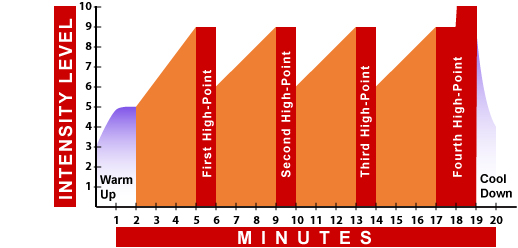
My preferred method of improving aerobic capacity as an adjunct to fighting involves utilizing the structure reflected in this chart –
I personally went from running a 5k in 35 minutes to under 25 minutes in one summer using this method.
If you read this chart carefully, you will see that the bar on the left looks remarkably like the subjective effort scale I talked about in earlier articles on weightlifting. Bearing in mind the key word, ‘subjective’. There are, of course, some objective markers which you can use to keep yourself honest. Your intensity level of ’10’ is an all-out effort, but make an important distinction. 10 is not only how hard you can go, but how hard you can maintain for the time period required. If you are working so hard that you can only maintain that level of work for 30 seconds instead of a minute, you’re overdoing it. Back it off a little. Continuing to train your aerobic capacity is an endeavor that requires you to constantly challenge yourself, and adjust your workouts in order to meet those challenges.
This chart, like other workout regimes, should be a guide. However, it isn’t one that should be followed religiously. You should mix it up. If you are executing an aerobic session at least three times a week like you should, this should be at least one of them – if you are doing an activity that provides relatively low strain on your joints, such as cycling, trail running, or swimming, feel free to increase the number of times you perform that workout. However, if you are banging on your joints a bit with something like jumping rope or road running, then you should mix it up with some other structure for your workout.
If you have done cardio for a while, then you have a sense of how long you can maintain a certain level of aerobic activity. This can be termed your ‘base pace’, however you choose to measure it according to the activity. Within the time constraints of a normal everyday working joe or jane, increasing the amount of effort you can do within your workout can be a good measure of the increase in your aerobic capacity. In other words, if you plan a 30 minute workout where you ride your bicycle at approximately 12 mph, and can do that repeatedly, that’s your base pace. If, after doing the workout listed in the chart above for a few months, you can ride at 14mph for the same amount of time, that can be reasonably considered an increase in your aerobic activity – when it’s time to put that practice into performance, most people find that an increase in the level of effort within a certain time frame can translate into being able to maintain a lower level of effort across an expanded time frame.
To put it simply, if you can go from 12mph to 14mph in 30 minutes on a bicycle over the course of a summer, then going to a daylong melee event is going to be less taxing than it was. So it’s important to periodically measure your base pace. Just get out there and see how much effort you can put in, during a given amount of time. This does require a level of self-honesty, if you are performing these workouts alone. Push yourself.
Similarly, occasionally seeing how long you can maintain a certain level of effort (i.e., the LSD I posted above) is also a good way to test or train your aerobic capacity. LSD takes time, but a mix of LSD, body-for-life cardio training, and testing your base pace can be a good mix of options to keep you engaged and challenged to increase your aerobic capacity.
Conclusion
Developing your aerobic capacity is the single hardest element to improve in your bodily fitness, because there is no immediate payoff. It will take weeks or months of solitary work to see improvement, and the initial improvement may not be commensurate to the amount of effort you put in. But stick with it, because the payoff will surprise you. It will surprise you when the person you’re fighting at practice calls for a break in combat and you’re barely winded. It will surprise you when one day you realize that you don’t feel like a shambling zombie, but like a gazelle. It will surprise you when you complete a two-hour resurrection battle, pack out the entire camp, and have everything in the laundry by 3pm on Sunday after the event. It will surprise you when putting on your suit of armour isn’t nearly the work it used to be.
Fighting is work, and don’t let anyone tell you different. It might be fun work, it might be rewarding work, but it’s still work. It’s still effort that you have to put in. I have always been a fan of working smarter, rather than harder. The effort to work smarter will require mental determination; grit. And the capacity to become more than you are now, no matter where you start from, is something that lies latent within everyone. Including you.
* = or cycling or swimming or zumba or rowing or whatever.
” So how many kills did you get in the Warpoint? ”
I hate this question. Look, I understand why you’re asking it, I’ve got an anthropologist on standby who’s literally working on a documentary about it, the bonding and bragging and no really, I get it.
But I hate this question.
Because I’m going to admit, the answer for me is almost always going to be lower than the answer for other people ‘at my level’. I’m a good fighter, but I’m not the type of hotstick who can go out there and just decimate everything I run into. I’m in shape, but I’m not the kid who can run the length of the field back and forth like a deranged bunny rabbit for the full hour ( you know who I’m talking about… ). And in static line battles like the Ravine at Gulf Wars, there’s a reason why the swords keep getting longer and longer, and I’m not going to pretend that I’m tall or that I’m going to go buy/use a five foot monstrosity for a single battle a year. ( Yes, there are other ways to be deadly, and I’m well aware of many not-that-tall fighters who are absolutely fabulous melee fighters. Shh. I’m posting here. 🙂 )
So no, my number isn’t going to be high as I might wish it was, and I’ve got enough pride that I don’t like that.
The question I wish you’d ask is ‘ How many kills did you help get in the warpoint? ” , because that’s what I’m doing in something like the Ravine battle: tangling blades, distracting enemies, being the ‘parry’ to someone else’s ‘riposte’. Similarly, you could ask ‘ How many of your guys did you keep alive so they could kill someone? ‘ — for me, a lot of the time it’s the same thing. I have memories of Fort Battles spent standing behind the shoulder of a legged man with tremendous reach. He would have been a mini slaughter by himself, but likely killed off within a few minutes ; with two of us, we reached massacre level, because tanks are fun and I could keep him alive.
I’m not likely to ever be the guy who comes off the field with 50 dead to my name. I am likely to come off the field as the guy who kept my three gunners alive long enough for them to get 50 kills ( WoW boat battle, the story is actually hilarious ). I’m likely to be the person who notices that somehow there’s no one in command of the line in the ravine, and there really, really needs to be because instead of filling gaps those four guys are staring at the ceiling and wondering what to do ( or better, trying to fill in the six inches between two people who need those six inches for their elbows, thank you very much ), and honestly, I’m okay with that.
In contrast to all the other off-hands, Giganti treats the cloak as not just like a dagger. The obvious reason being it’s not rigid. He advises not to use a cloak made of silk or other lightweight material. These are useless, and in his words “I consider the sword along better than the sword with a silk cloak”. Which sounds pretty familiar to anybody exposed to the bulk of the cloak instruction in Atlantia (since in the SCA the bulk of our rapier cloaks are really little capes. Instead he prescribes a cloak made of “cloth”. We can guess he meant something wool or cotton.
He instructs to hold the collar, let it fall over your arm up to the elbow, and wrap it around your arm either once or twice, which drives its tactical use.
The cloak wrapped once around the arm and extended forward blocks access to your left flank. With the sword held against the edge of the cloak (he says “on” but illustrates it as next to), he then considers attacks will only come above your arms, all of which are blocked with your sword while keeping the cloak against it, and below your cloak (cuts to your legs) which you can bat aside with the cloak while stabbing your opponent. Also, he notes you can throw the cloak on his weapon and stab him while he’s entangled.
The cloak wrapped twice around the arm (so there’s very little left over) becomes a rigid parrying device, and is now just like a dagger. He recommends this for use against opponents who like to cut, and “Since most men don’t know how to fence they attempt a lot of cuts.”
Really, I’m just going to let that quote sit there for a minute. Men who don’t know how to fence attempt a lot of cuts. Heh. Hehehehehehe.
Anyway, with the double-wrapped cloak you can parry high and middle cuts, but not cuts to the leg. These you parry with your sword, just like with sword and dagger. Thrusts also get parried with the sword. In all cases, thrust in the same tempo as your parry.
A few years ago, when I was lamenting the repeatedly unbalanced state of the melees I was attending, I decided to develop a method for dividing sides so that they would be equal in practical terms, and not merely on paper. Merely alternating White Scarves can sometimes work out OK, but that can also create some very uneven skill distributions. If you want uneven teams, go to Pennsic; when I’m RMICing something, I want the teams to be balanced so people can fight without the frustrations of a lopsided drubbing.
The way this works is that everyone forms a line, and then takes one step forward each time something in the list applies to them. At the end of the list, the RMIC starts at the forward-most person and moves down the group, assigning people as necessary. Usually, the RMIC needs to pay attention to balancing the first six to eight people (1, 4, 6, and 7 versus 2, 3, 5, and 8, for example) and everyone after that can be divided randomly. Those first 20% are usually the impact players, and stacking the two highest “scores” on the same team can be significant.
Here’s the list:
Baronial Rapier Champion (per year)
Kingdom Rapier Champion (per reign)
Baronial Fighting Award
AoA Level Fighting Award
Free Scholar/Closed Order of l’Academie d’Espee
Shark’s Tooth (per)
Vexillium Atlantiae (per)
GoA Level Fighting Award
PoA Level Fighting Award
5+ years of SCA rapier experience
10+ years of SCA rapier experience
Won a tournament
Won 10+ tournaments
Won 50+ tournaments
Won the Atlantian 5-Man Melee (per)
Run a mile in 10 minutes
Run 5K in 30 minutes
Feel good enough to run another 5K afterward
5+ years of a mainstream sport that involves field awareness (soccer, field hockey, not cross country)
I’ve added in some commentary below as to how I came up with these. Obviously, several of the items are kingdom-specific, so make whatever changes will make it work for you.
I included these because, while they are not strictly based on skill, they do indicate a degree of investment in fencing that not everyone demonstrates. Not all champions are world-beaters, but all champions are reasonably prominent members of the community who have some renown.
Baronial Fighting Award
AoA Level Fighting Award
Free Scholar/Closed Order of l’Academie d’Espee
Shark’s Tooth (per)
Vexillium Atlantiae (per)
GoA Level Fighting Award
PoA Level Fighting Award
These are all more or less prowess awards, each representing either individual skill, team skill, or a propensity to do very noticeable, heroic things. They seemed like an obvious inclusion, but as I said before, these alone will not make balanced teams.
5+ years of SCA rapier experience
10+ years of SCA rapier experience
Experience counts for a lot. No one tracks the number of melees they’ve been in, but everyone knows their join date. Time with a sword in hand is irreplaceable.
Won a tournament
Won 10+ tournaments
Won 50+ tournaments
Won the Atlantian 5-Man Melee (per)
Tournament performance is an undeniable and objective metric of skill. If you win things, you’re at minimum good enough to win them, and everyone else wasn’t. Again, obvious, but a meaningful point nonetheless. I stopped at 50 because while I can name a few people in the 50+ realm, myself included, it would be all the same people taking any further steps forward at 75 or 100. If you’ve won 50, you’re consistent enough.
Run a mile in 10 minutes
Run 5K in 30 minutes
Feel good enough to run another 5K afterward
All else being equal, cardio is king. A lower skilled group of athletes will destroy a superior force of fat smokers if the battle lasts long enough.
5+ years of a mainstream sport that involves field awareness (soccer, field hockey, not cross country)
It’s safe to say that most of my field awareness came from 10 years of soccer, and not so much from practicing or participating in SCA melee.
Every time I have used this method of dividing teams, fights have been as close as numerically possible given whatever scoring system is in place, so if your objective is to make sure that people have a good, competitive fight, I strongly recommend it.
Giganti introduces his defensive secondaries (buckler, targa, and rotella) by saying there’s no difference between them and dagger. “Anything you have learned with the sword and dagger can be accomplished with the sword and rotella/targa/buckler.” Which means if you’re using them differently, you’re doing something wrong. Probably, you’re thinking you can offend with the dagger when it really is just a narrow, highly mobile shield until you’re standing face-to-face. And at that range, you can also offend with a buckler rather effectively if striking the face or hands.
Starting with the rotella, the large, circular, strapped-to-the-arm shield. Two guards are illustrated. The first, high guard, is with the sword in prima protecting the face and the rotella defending the torso. The second, low guard, is with the sword held withdrawn and the head and upper torso behind the rotella.
As you’d expect, it protects the inside line best, deflecting or blocking damn near anything so long as it’s held extended in front of you to close the lines. To summarize his instructions: Anything coming from the left you block or deflect with the flat of the rotella; anything froom the right you block with the edge of the rotella, or the sword. The more it drifts back towards your body, the more exposed you are. Though Giganti does take care to instruct to hold it with your fist upward so that your arm doesn’t tire as quickly and so you can carry it where it doesn’t block your vision, which does limit the range of your extension.
Also, he likes it for night melees, which should really be a thing for the SCA, because I have health insurance.
For the targa, the wavy rectangular-ish shield, the instructions are largely the same: Keep it extended but angled so it doesn’t block your vision, anything from the inside is blocked or deflected with the flat, and anything from the outside (he also includes thrust to the inside, though I suspect he means between your sword and your targa in this case) is deflected with the edge. He points out that the rectangular shape, and the folds in the metal, catch blades very well. Other than that, use it as you would a dagger.
At this point you can surmise his instructions for the buckler.
You are all wrong when you say there is no crying in fencing!
It’s tough. There is crying and hard work and disappointment and heartache and frustration and confusion and anger and a myriad of other emotions that come with learning something challenging, competitive, and without a single “right” path.
(I say this with a love of the game and the challenges it bring, but let’s look at reality: it is a lot of hard work.)
I cry a lot….
Frustration, adrenaline, confusion, anger, extreme happiness: all of these things make me tear up… but I don’t have to be what is traditionally thought of as “upset”. If I am frustrated with my fight or hit too much adrenaline my eyes turn into friggin’ geysers. Then I become frustrated that I am crying, which adds exponentially to the frustration. Suddenly, I am a pitiful, useless mess. UGH!
But crying comes in many forms. Mine is super obvious because there are tears flying out of my eyeballs. Sometimes it comes in the form of anger, some people shut down, some build walls, some cling to old habits, some make excuses, some seek out injustices, some get “smart” or defensive. We all express emotions differently and “cry” in some form when we are learning difficult and frustrating things.
Fencing is at times frustratingly unpredictable (because anyone can win any bout), difficult to know you are on the right path, confusing and gosh darn it sometimes it just doesn’t seem fair.
I can’t tell you the number of times that I have upped the time I regularly practice and study to get beat by someone that I STARTED TEACHING! The even more frustrating is that in some cases, I knew I had better technique! …or thought I did, until I lost like a chump and questioned whether or not that was true. It’s a situation where I should not lose, but did anyway.
This is a game that it is easy to slip into questioning yourself while playing.
And yes, it shouldn’t matter, but guess what… it does. Sometimes when you lose it sucks. It matters because it is confusing. It matters because it makes you question why you woke up extra early to practice before work 3 times a week for months. It makes you question how you can work so hard and not get an easy win. It makes you question if a whole lot of time got wasted. It is confusing which causes frustration. It’s HARD. Sometimes it is hard to keep in perspective it is how you fight not who you beat.
A friend of mine once said: “It’s easy; you just move your body in 8 different non-natural positions at the same time.”
We act like it is easy, but that is because we forget how hard it is to learn. These are not natural motions. I think fencing may be like learning a new language. We have to teach our bodies how to hear the rolled rs then, say the rolled r, then to say them at the right time, then say them naturally and correctly at the right time. People with movement backgrounds such as dancing, martial arts, or other sports may already know how to understand or be able to create unusual motions the same way that a French speaker may pick up Italian faster than a Chinese speaker.
It is not easy, and often upsetting because it seems like it is to some, or should be. These are hard actions for your body and mind to coordinate, and then to try to coordinate in a the split second of an opponent’s opening….
To top things off… there is not one “right” paths to fencing or thinking about fencing. There are as many “right” ways to fence as there are different ways to express emotions. There are a million opinions on where to put your foot, sword, hand, dagger, head, eyes, brain, butt… you name it, and there are 5 clashing opinions on it. (Except the pointy end goes in the other person; that one is kinda universal, but where that point starts is another plethora of opinions).
All of these things can add up to be ridiculously frustrating.
Personally, I have realized that I have to just let the damn tears happen and accept that it is hard and frustrating. I accept that that is how I process frustration (even though it sucks). If I ignore the fact there is water on my face I can be frustrated without being frustrated that I am frustrated. If I can accept that I am frustrated because fencing is hard (instead of being frustrated that I am not doing it right), I can prevent it from spiralling out of control.
This shit we do is hard. It’s ok to be frustrated. Do not add to frustration by feeling it should not be or feeling you “should be better”. Fencing is hard: let it be hard.
Unsurprisingly, it turns out that Bruce Lee might have been on to something here, so today we’re going to take a look at the idea of training a minimalist style with the goal of being highly specialized in one or two areas.
This methodology is one geared toward people who are still starting out and have not yet become experienced or adept enough to really branch out into the sort of things that make a well-rounded fighter; this is for someone who still maybe needs to work on their lunge, or has decent-but-not-good timing, measure control, or whatever else might be lacking after only a few years of practice. The idea here is to eliminate as much from the decision making process as possible so that what is left comprises only the barest essence of your fencing: form and judgment. By eliminating everything else from your mind except for a minimalist strategy, you reduce the number of variables to contend with and can have greater gains faster.
To accomplish this, pick one versatile guard and begin there, always. It might be the only guard in Thibault, terza in Capoferro, the extended quarta in Fabris, or the Iron Gate in Meyer. Whatever else is available, ignore it for the time being. The next step is to realize that having one good response for attacks to the inside and one good response for attacks to the outside are really all you “need” in the strictest sense.
As an example, I present to you Mirko Filipovic, one of my all-time favorite fighters:
“Cro Cop” was a terror in his day, but he used a fairly basic strategy to accomplish a very dominant run: he threatened his opponent’s right side with punches to the head and body, and then landed a brutal kick if he had the opening. If you protected your head, your ribs took the damage. Once your hand dropped to protect your ribs, your head opened up as a target. If you thought too much about your right side, you were kicked from the left. I’m grossly oversimplifying here, but the fact of the matter is that you don’t end up with 13 T/KO wins via kick by accident. Doing one or two things sublimely well can get you very, very far if your strategy is to make the circumstances happen where you can do whatever it is you do well.
If you’re a fish, make sure that all your fights happen in the water. Don’t accept a challenge to a footrace.
Using the example of the Fabris extended quarta, we see that there is a clear “ocean” and a clear “footrace” dynamic at play. From that guard, you would need to have a clean lunge, a clear sense of measure, and the ability to take the tempo offered when an opponent steps into measure. You would also need to have the patience to wait for them to offer it, and the will to act decisively as soon as an opportunity arises.
What you can’t do from there is pick and snipe, or hop around. If you’re looking for something more movement-oriented with (debateably) lower-risk/lower-reward targeting, then do something else. Don’t run on fins. Invite your opponent for a refreshing swim, drag them out into deep water, and drown them.
After enough time, if you’ve adopted the extended quarta as your base, you’ll have good timing, good measure, good form on the lunge and pass, good blade mechanics, and a really good sense of your body and how it moves from that position. If you went with Capoferro’s terza, then you’ll be good at some of the same things, but you’ll probably trend as I did into being more of a counterattacker because that was my initial base. With Thibault, you should develop an excellent tactile sense of your opponent’s blade, quick feet, and superior fight geometry. It doesn’t matter which base you establish, simply that you have one before you branch out into things that are too complicated for you right now. Feeling overwhelmed is discouraging, and I’d rather that you enjoy successes while still learning rather than learn through failure alone, especially since the latter option will take longer since there’s more information to work through after each fight. With a set plan, you can look to see where your plan failed rather than try and figure out whether it was your measure that failed you, or if you simply didn’t pick the right counterposture. Eliminate variables.
Don’t stop here, though. This is for intermediates to hone their skills. If you want to reach the next level you will have to eventually become good at everything, or nearly everything. Few people can skip steps, and you’re probably not one of them, and the people who are one of them usually spent years doing something else that allowed them to skip steps in the first place. When you have a solid base and you keep adding to it, you can reach a point where you have an answer for everything.
The real beauty of being exceptionally skilled at a minimalist strategy is that while some people may complain that you lack diversity, you may have much more in your arsenal than you even need to be victorious. If you can land one or two shots over and over, and no one can stop you, that is a failing on their part, not yours. It’s even better if you develop depth, because then the first person to solve what everyone believes is your entire skill set will be sorely mistaken and unpleasantly surprised when they realize that they’ve only dodged the tip of your iceberg and they’re taking on water anyway.
Ibrahim, Gaiwn, and myself squeezed into Gawin’s hatchback and drove out to rural Virginia. At one point we stalled out on a gravel mountain road and had to push. It was that kind of day.
The Site
Chantilly Festival Farm only opened a little over a year ago, and the place is beautiful – 90 acres of more-or-less gently rolling hills and woods. It provides a scenic view of the Appalachians, and at night you can see the Milky Way. The site’s still developing its infrastructure but was quite sufficient to our needs. It’s out in the middle of nowhere, but could probably host a war. Only downside is that the hills get a bit tiring after a day of fighting. It was a bit unfortunate that turnout was middling. I hope to see more events at this place.
Friday
The schedule had interesting rapier things starting early, so we arrived early, noonish. Nobody else seemed to be as enthusiastic. Getting people to come out on Fridays seems like it’s always going to be a challenge … thoughts?
Eventually we were able to round up five other fencers and fought a few impromptu melees of little note. At the end, I requested Windmasters vs The World; Aldemere was happy to oblige. Arrayed against the Windy Kitties were six: Ragnar Ribcracker, Lily, Colin of Black Diamond, Hector (aka Former Cornerback, Ballet, and Destreza Guy – one to keep an eye on), and two recent auths.
They came at us in three pairs; we split. Ibrahim led Hector and a new auth around the field in a big, slow circle while I kept Lily and Colin occupied. When Gawin killed off Ragnar I cheated over towards him; we ended up swapping and I stabbed the new auth before running to Gawin’s aid. I was in a wonderful position to DFB Colin when Gawin lost his footing (running backwards downhill will do that) and a hold was called. Blech. Colin got me and lost an arm for his trouble, while Lily and Gawin doubled. Ibrahim, unable to delay any longer, managed to take one more before being overwhelmed.
Thus was Windmasters’ arrogance checked. But I believe that if there’d been no hold, we’d have won that.
Saturday – Woods
Caitlin was leading activities, and Pennsic conventions (i.e. tip cuts) were in effect. A couple Aethelmearcians had traveled down from Pittsburgh to observe the vaunted Atlantian melee tactics, and their attempts to show us what tip cuts felt like went mostly ignored through the day. Turnout was about 20.
Melees began with a 10-minute rezzing woods battle, with three flags across the middle. Three-dimensional slopes are difficult to explain without pictures. Relevantly, Red rez was on higher ground than Blue rez; one flag, “top”, was an uphill climb from each, though closer to Red; one, “bottom”, was downhill from each but closer to Blue; and the “middle” flag was equidistant from the two but fairly close to the “top” flag.
The first run-through was Black Diamond vs Everyone Else. Black Diamond naturally included a lot of their locals and Scholars, while Everyone Else included the kind of people who will drive several hours to an event. Needless to say, although I was in command of Everyone Else, I didn’t have to do much.
For the second run-through, a couple of the senior fighters swapped sides. Everyone Else was outnumbered by two or three, and more evenly matched in skill; to make matters worse, we were using the Blue rez point this time. I tried to get us to focus on the top flag, but we had a lot of difficulty with it. Because we were outnumbered I was forced to fight instead of simply commanding from afar, and we did not move or engage as well. We never had any flags for long.
For the third run, switching back to a favorable rez point, we were able to come out slightly ahead. Admonishing my team not to engage in outnumbered fights helped, as did appointing Gawin a local commander at the top flag. It’s amazing how blind people get when there are swords pointed at them.
By now a few things were obvious. Most notably, the team that controlled the top flag tended to dominate – and the team rezzing from “Red” tended to have an easier time of it. The high ground gave easy access to a flanking position on the middle flag, so holding the one usually meant holding the other. The bottom flag only attracted a handful of skirmishers throughout. Although sending people up to the top flag ran the risk of tiring them, the other team also had an uphill slog. I micromanaged rotating fighters through the uphill position to keep them from getting tired. Except Windmasters. They were always up top, because we have cardio.
The last couple melees saw Gawin and myself opposed as commanders of a five-minute, one-flag battle. Teams were re-picked kickball style. Gawin, getting the first pick, selected Connor. Connor refused, saying he was marshaling. As we finished picking, the teams numbered 9-8, so Connor joined my team to even it out. Which probably did more than even it out. Eh.
The first run had my team at the Red rez. Our line proved stronger, and took the center early, repelling a couple attacks. Perhaps because there was only one flag, though, we lost our previous focus on holding the high ground. Ibrahim and two or three of his friends kept on showing up on our flank, and we had trouble pushing them off owing to the slope. He was instrumental in knocking our line back from the flag and probably deserves the credit for his team’s victory.
In the second run, at Blue rez, I decided to try something different. The high ground had been dominant all day, so I decided to load the other flank to see what would happen. Interestingly, this threat pulled several of their good fighters, including Ibrahim, and they completely forgot about keeping the high ground. We were able to hold it throughout the battle with just two of our own, and had the flag for almost the entire battle.
Saturday – Field
A very long lunch break followed, and because Court was comparatively early (4:30), we had little in the way of field battles. Teams were re-sorted and command was given to junior fighters, including Ibrahim; he did well enough for his first time, but seemed a bit overwhelmed. His idea to load the flanks, take the high ground, and press on the flank was pretty standard but not bad; unfortunately, our line was significantly weaker, and we were only able to successfully execute once in three runs.
Ibrahim asked me afterward about how to command. The question caught me a bit off-guard, to be honest. Even in WMH, we don’t really have a structure for “how to command effectively”; we just make everyone do it, give feedback, and they learn. Food for another post …
After this, Caitlin asked Gawin and myself to command, without weapons. I specifically remember the phrase “good example” being used as justification. There may be hope for us after all. We micromanaged our lines with gusto; for me, the exercise felt a little silly, but I do not know if others learned anything by observing.
Afterwards was Court and pickups, in which I was too tired to lunge but not so tired that the Aethelmearcian don, Will, didn’t recognize extended quarta and pay a few compliments. Still have a long ways to go. Chatting with Caitlin suggested that some Atlantian practices/units would be receptive to a “drill of the week”. I’d like to gauge interest on this. If it’s true, I’d very much be willing to delve into that kind of project post-Pennsic. It’d be restricted to the basics of Italian rapier, since that’s all I’m competent to teach, but I imagine much of that – or at least the framework – can be translated.
Windmasters – and other baronial units, for that matter – were generally allowed to stick together throughout the melees. This makes me very hopeful for the future. Encouraging fighters to identify as part of a baronial unit, rather than as a collection of individuals who happen to live near one another, could have some great results. It encourages fencers to help one another and come out to events together, to practice melee, and to participate on a larger scale (since they see themselves as part of the barony, not just as part of the Academie). Maybe some friendly rivalries will develop!
Lessons for the Day
Your tl;dr:
– High ground is very useful, even without ranged weapons
– Atlantians don’t know what tip cuts feel like, and so don’t take them. This may explain a certain reputation we have at Pennsic
– “Fall back” is a very useful command
– Falling back when outnumbered, instead of dying, is a good way to keep your energy up
– You’d do well to keep an eye on Ibrahim
– “Front 180” does not mean “the other guy can see you”. If you get stabbed by a sword you never saw, it doesn’t mean your attacker was out of the front 180.
– There may be interest in a “Drill of the Week”. More research/feedback is needed
– The idea of keeping baronial units intact at events seems to be taking hold. This is good
– Despite the small sizes of the melees, Run Right/Left was never called. Press, Fall Back, and Step were all present. Even Charge came out once. 😉
Giganti’s standard policy is to win the fight outside of measure or as you come to measure. Everything after that is just pushing your sword through your opponent. Coming to grips, then, shouldn’t happen unless somebody did something wrong. I think I’ll repeat that: Coming to grips shouldn’t happen unless somebody did something wrong.
Giganti prescribes coming to grips as a response only to finding your swords in parity inside measure, which is achieved by your opponent parrying strongly instead of disengaging or voiding as he should, and your failure to disengage that parry. To be strong enough, the parry must be large and strongly committed, providing a big tempo. Also, it’s very likely going to take his point off line. In the big tempo of the parry, before any counter-attack can begin, you pass and seize their hilt
From this point his decision tree starts. He presents four grips, based on whether you’re on the inside or outside, and whether your point is inline or off-line.
If your point is in-line (or close to), seizing the hilt frees you up to continue your thrust, so you should. If it is off-line, you can deliver a cut or a pommel strike. In SCA heavy rapier, where these aren’t allowed, if your opponent wants to throw big strong parries, it behoves them to make sure they parry your sword off-line, because that effectively deprives you of your best counter and provides the tempo of you trying to re-align your thrust for them to seize your guard and achieve a “hold”. Instead of coming to grips in this setting, then, disengage (in a “break sword contact” sense, by a yield, demi-cavazione, or other means) or half-sword through.
When on the outside, Giganti instructs to seize the hilt and push it to your outside. When on the inside, Giganti adds an additional twist. You’ve most likely disengaged from the outside to the inside during your attack, and your opponent’s hand is in second. Seize the upper part of their hilt, then curl your arm under like John Heisman carrying a football, pinning it against your side, rotating your hips to your right as you do so to defeat any strength advantage he has in his arm (and pull his mass towards your center of gravity). This will turn his hand and arm into quarta (and in a very weak position). If he’s smart, he’ll let go of his sword. If he’s not, you’ll shatter his hand as you pull his hilt out of his grip. Of course, don’t do this, or at least all of this, in the SCA. But it’s definitely amusing to visualize.
Sir Corby, veteran of the armored field, holds that two opposed melee lines can do essentially four things to one another. In order of difficulty, they are:
1. Charge
2. Run right
3. Run left
4. Engage lightly/Die slow
So, the line can move forward, right, left, or nowhere. (I think he’s missing one direction. We’ll return to that later.)
As with many concepts originating on the armored field, these ideas, known as the Book of Four Things, have infiltrated Atlantian rapier SOP. And as Wistric has observed, fencers have a different set of priorities and training: Charge is among the most difficult for us to do (at least without getting a hold called). Running right and left are relatively easy, with a little practice. Engaging lightly is the easiest, since fencers are, by default, defensive and wary.
This isn’t a bad thing to teach – at a minimum, it drives home the idea that lines are not necessarily static and focuses a commander’s options from “what do I do?” to “which of these four things should I do?” It gives us something to drill at melee practices, and allows us to practice coordinated movement (maneuver). But if this was originally intended as a didactic tool, it has since taken on a life of its own. I won’t speak to its effectiveness for the heavies, ‘cause I don’t fight there. But if we’re going to spend time teaching fencers how to maneuver effectively, I think we have better options.
Is It Useful?
Practice time is limited, and formal instruction at events is even more limited. If we’re going to teach maneuvers, they should be the maneuvers that are most useful or most common. So: What maneuvers do we need any given melee line to know how to do – particularly at Pennsic?
Well, charge comes out on occasion. It is fairly rare, but has some niche applications and is worth drilling, especially since we have to drill charge-in-such-a-way-as-you-do-not-provoke-a-hold.
Running right, or left, is almost never done in large melee. This is at least partly because of the constraints of the maneuver. It’s a good option if:
1. You have the room to run, and your path won’t take you off the Edge of the World, into brambles, or similar.
2. Your line is coordinated enough to pull it off. This requires some drilling and usually a bit of familiarity, which you may not have in a large melee.
3. Your opponents are too ill-trained or unaware to respond with any of the half-dozen simple, effective counters.
In practice, this means that run left/right is great against gooby five-man teams at Pennsic, or ad hoc bands of untrained Scholars eager to play in small melee at some event, but has limited application in wars and large melees, either because your opponents have anchored their flanks on impassible terrain or because your teammates aren’t all well-trained enough to keep cohesion as you execute.*
Engaging lightly is just “stand there and be defensive.” We usually teach it as “stand this far apart, don’t lunge, pick at hands, and try not to retreat”, which is reasonable. But fencers are naturally defensive. If anything, we need to teach them to be more aggressive.
(Here’s a hypothesis: the most important melee skill to have is to know when, and how, to move from a defensive mindset to an aggressive one.)
Towards a New Book
So what would be better?
Well, for one, we suck at moving backwards. As I mentioned earlier, Sir Corby does not even seem to consider it. This makes sense to a degree. Generally it’s always better to be moving forward than back (it’s easier to keep cohesion, pressure an opponent, and take territory), and we have no fear of death in our game.
That said, units will sometimes be in a fight they cannot win. Actually, this seems to happen a lot. And usually, they’re not even aware of it until they’re wiped out. Sure, sometimes you want to hold the objective to the bitter end, but sometimes there’s nothing to be gained by having a unit die to a man, aside from a long rez run. We need a way to preserve our forces and communicate to them that they need to regroup. So fall back (or “fall the fuck back” in common parlance). Teaching fencers to give ground while maintaining order, on command, gives us the option of trading ground for time if needed. This saves energy and gives us the opportunity to strike again as soon as we’re reinforced or the opponent makes a mistake.
The inverse to fall back would be taking ground in good order, usually given as step. Veterans of melee will be well-acquainted with both how devastating the command can be, when all fencers in a unit bind blades and move forward in synchrony, and how rarely that actually happens.
Anything else?
The defensive engage lightly has an inverse, the aggressive stance, usually given as “press” or “crush” or “wrap”. I’d love to see every fencer know the meaning of this command: “we have an advantage, so use it!” Although it’s not a maneuver in the sense of coordinated movement, it does fit the rough definition of “a thing one line can do to another”, and it would be useful at Pennsic (or anywhere else). After all, if we have an advantage, we want to kill opposing units before they can maneuver or are reinforced.
Ruairc’s Book of Four (or Five) Things
In order of difficulty:
(0. Engage Lightly/Stand Fast)
1. Press
2. Fall Back
3. Step
4. Charge
Charge, step, and press all require aggression, something fencers are generally loath to give, ’cause we’re naturally defensive. Charge, step, and fall back require coordinated movement. Drilling these things is the only way to ensure they can be done consistently.
So, uh … Is It Useful?
Press is useful for immediately destroying a line when you have the advantage. It does not require coordinated movement – just coordinated aggression, which is easier to train (“when you hear the command, bind blades, step forward, and try to kill everyone wearing the wrong color tape”). It has wide applicability and destroys the other unit’s cohesion, though it might damage your unit’s cohesion as well.
Fall Back is the counter to the above. If you’re at a disadvantage, don’t stay in the fight and allow yourself to be picked apart; get out and reorganize. If they’re pressing, falling back allows you to maintain cohesion while theirs is disrupted, and get back to even ground.
Step is useful for gaining ground, naturally, particularly when we can trade numbers for ground (i.e. limited front engagements). It can destroy the cohesion of a static line simply because some enemy fighters in the line will naturally back away from presented weapons, while others will stand their ground. It also allows you to pursue a retreating unit without losing cohesion. It cannot be defeated by anchoring a flank, either.
And Charge, we’ve already discussed.
The focus should be on disrupting the line’s one strength: it’s cohesion. These commands offer various ways to do that where run right/left does not, and require the enemy unit to act cohesively to counter where run right/left can be countered by one or two enemy fighters on the flank who know what they’re doing.
In my view, these are the basics. Once a group of fighters has a solid handle on the fundamentals of melee, this is what they should tackle, and their commander (everyone’s a commander, remember) should practice recognizing when each is useful.
And Other Maneuvers?
As far as Pennsic goes, advance and rally are easy and important. A bit of time training double-time could also be nice.
Certainly, there are any number of extremely useful maneuvers or commands. But almost all of these will require an organized unit training and drilling regularly to perform in the heat of battle. By all means, experiment! Drill what works, and when your unit has made it smooth and automatic, pull out the surprise on the enemy. But don’t neglect the basics.
* My Shark’s Tooth was awarded for leading a 5-man melee unit of (at the time) blue scarves at Pennsic XL to the semifinals. In all but two fights (incidentally, these were fights against the winners and the runners-up in the tourney – which is to say, skilled teams), “run right” and “run left” were part of our pre-fight strategizing and were used to effect on many occasions, so I don’t have any particular rancor for the commands themselves, nor do I think them completely worthless. But I am of the opinion that our opponents were, for the most part, too overwhelmed or too poorly drilled to respond appropriately. Our victories were not due to the efficacy of any specific maneuver, but due to our unit cohesion – our ABILITY to maneuver, opposed to their INABILITY to respond. By my thinking, maneuver gains a positional advantage, creating favorable 2v1s and negating numerical or skill superiority. An adage: Maneuver counters maneuver. If you can’t maneuver, any maneuver beats you.