There’s nothing that energizes me so much as the moment of epiphany, of rediscovering some shred of lost knowledge or some new pedagogical tool that can aid in the completeness or quickness of our reconstruction.
This is rare. Most of my progression involves learning that I’ve been doing something wrong – possibly for years, possibly a thing I thought I was doing right – and then I endeavor to fix it, usually via repetition, and sometimes by processes even longer and more laborious.
It can grate after awhile, and make one begin to think one has nothing to offer the art.
Thursday
And then ten people show up for weekly practice – myself and Gawin, our three students, two new folks, and three more first-timers – and all the existential crises evaporate amid the glowing happiness of there are people who want to learn how to fight with swords and they are right here!
We did stick drills. We stood in guard. We did footwork. We did lunges. We even introduced the new folks to the basics of bladework. I did nothing but teach CF for three hours. It was glorious.
My enthusiasm is somewhat tempered by the statistics: around WMH we typically retain 10-15% of new faces. But we’ve had a lot of success recently, and I wonder if the more structured approach to practice isn’t part of it. There is a certain legitimacy to scheduled drills (or, if you like: books and egg timers).
One of the new folks has limited mobility in her back (right) hip impeding the CF stuff – and she can’t put all her weight on her back leg. Since this is fundamental to Italian fencing I’m at a loss for a good work-around unless we look into LVD or Agrippa or something. Thoughts?
Sunday
Sunday involved taking our new lunge instruction out for a spin. Still not sure how to completely avoid the word “step”, but leaving the step out (extending and straightening the left leg, without any movement of the feet) seems a good first step. It may also help to describe the tactical value of the lunge – not so much its reach, but its quickness.
Gawin and I also discussed some foundational tactics in the Italian system. You need a tempo to attack safely, and we covered a handful of basic effective responses to attacks out of tempo (parry; counterfind; and void).
This feels like a good lead-in to introducing the feint, but I still don’t feel like I have a solid grasp of its tactical use. The key I seemed to be missing earlier is that both Giganti and Fabris advocate feinting in contratempo, although Fabris also seems to think you can get away with feinting out of tempo if you do it right … I’ll need to do more reading and examine the plates.
I think we’ll start with a simple choice drill: Agente gains and extends; patiente either does nothing or makes a parry; agente responds by finishing with a lunge or a cavazione as appropriate. It’s sterile and artificial, but it’s a necessary building block, and it’s something we all need to work anyway. Maybe by the time we’re all doing that right, I’ll figure this out …
Fencers do not form lines on a mere whim. The line formation, as I’ve said before, derives great strength from its easily maintained cohesion. These strengths do not exist on the line’s flanks, which is why we usually direct our attacks there, and why we usually put our strongest fencers on our flanks.
However, it often happens that the line’s flanks are not vulnerable. Maybe they’ve anchored their flanks on the Edge of the World. Maybe you’re in a limited-front engagement. Whatever the situation, it is still possible to destroy a line: once you disrupt the line’s cohesion, it loses all of its strength. (This is why I think lines are fragile.)
That’s the idea behind many maneuvers, such as charging – disrupt the enemy’s cohesion while (mostly) retaining your own, then kill them by exploiting all the 2v1s that surface. But even in the absence of maneuver, lines suffer minor disruptions all the time. If a fencer loses a hand, or steps backwards, or dies, his line’s perfect cohesion suffers a momentary weakness. A well-drilled unit can exploit this weakness with well-timed aggression and increase the disruption. As the line’s cohesion crumbles, so too does the line.
In fencing, you win when your opponent makes a mistake that you are able to exploit (either you kill him immediately, or force him to make bigger mistakes). In theory, the same thing exists on a line: once your opponent (any individual opponent) makes a mistake you can exploit, his whole line should be in danger.
What follows is an intermediate-to-advanced technique for demolishing any line, anywhere. I have seen it work before, but it’s not easy, and this exists more as a theoretical construct than a proven tactic. Nonetheless, I invite you to consider it, poke holes, and drill it up if you like. If you don’t, this was originally Wistric’s idea. So blame him.
Time 0: Let us consider two lines. For ease of discussion, leave aside concerns of armament or handedness for now, and assume that terrain does not exist except to prevent typical flanking maneuvers. The lines are lightly engaged, picking at hands and feet with no fighter exposing himself.
A B C D E F G H I J
Q R S T U V W X Y Z
Time 1: H makes some mistake. It could be that he retreats from his line or loses a hand. Small mistakes always happen. Obviously, the smaller the mistake, the harder it will be to exploit. For our purposes, let us say he does something very dumb, and dies.
A B C D E F G H I J
Q R S T U V W X Y Z
Time 1.5: At the instant afterwards, X’s unit has a small numerical advantage over the other side – and X can make a 2v1 happen. He also has a potential awareness advantage – if he killed H, he will likely know that H is dead before anyone else, before H even calls “dead”. Even after he calls “dead”, H’s team will have to take a small amount of time to update their “mental maps” and adjust to the new battlefield.
This time is something that X exploits. He IMMEDIATELY steps into the gap, redirecting his attack to G (or binding his blades so W can kill). I is also a viable target. Either way, he must do this without recovering (if he attacked) and without waiting even an instant. Snap decision-making is vital. X may be killed by I, but as long as G dies, the technique can continue.
A B C D E F G– I J X Q R S T U V W . Y Z
Time 2: X’s comrades immediately and automatically press (because they have drilled, and need no command), aggressively exploiting their local 2v1 advantages. X could, and perhaps should, give the command anyway, but if his team only acts after the command is given, the opportunity is likely already gone. Drill (and, to a lesser extent, decentralized authority) is necessary.
The right flank here may or may not die in the press; it’s not really important, so long as I and J are kept busy for a short time and are not allowed to move behind the line.
A B C D E F–X–I J W . Y Z Q R S T U V . . .
Time 3, etc: even if the opposing line maintains cohesion (unlikely), the gap still widens. The astute reader will note that new flanks have appeared, and from here, it’s a standard “wrap the flank” affair. Attackers who find themselves out of range of enemies go into the backfield (W), pressure others as time and space allow (X), or perform rearguard actions. The dead, shown in pink, may prevent easy maneuver, but the advantage propagates, at least at 2v1, down the line. This is (one reason) why skill at 2v1 is so important. As the numerical advantage increases, the line should crumble faster (more people in the backfield, etc).
W – A B C D E––.X IJ V . Y Z Q R S T U .
Resolution: at this point, the attacking/pressing line has killed five fighters while likely only losing one or two, and the opposing line’s cohesion is demolished. The opposing line is only seconds away from total annihilation and can do almost nothing to stop the chain reaction. It’s worth noting that the attackers are also somewhat disordered – that’s inevitable after a press – and they’ll need to rally and reform after mopping up.
Caveats
Now this is really cool, and in theory you could use it to demolish an entire line in under ten seconds with minimal losses, triggering from almost any error. But it’s not a foolproof or uncounterable technique.
Firstly, this requires some skill on the part of X – if simply to know if it’s time to commit to a press after H screws up, and to make that decision immediately and with resolution. More skilled fencers will be more successful here, no doubt, but awareness is key. X’s unit also must be able to follow his lead without hesitation, and propagate the 2v1 with aggression and rapidity. This does not require a great deal of pure fencing ability, but it does require a modicum of judgement, awareness, and automaticity best gained by rigorous drill. It will likely be a bit messy in practice, but that’s okay; once the break starts (Time 2, above), it’s should be very hard to stop. If things get too dicey, X’s unit can call a rally, and reset with a significant numerical advantage.
Look back at time 1.5. I have assumed, for demonstration purposes, that G and I are not any more skilled or aware than the average fencer. But if they are, this is the point at which they could potentially stop or even reverse the break – by reacting faster than W or Y. Naturally, they would have to kill X without dying to W or Y, and without losing cohesion with their own line (if they step back, W or Y steps forward and continues the break), which is no mean feat. Nonetheless, if their G and I are strong fencers and your W and Y are not, it may be wise to simply take the kill on H and recover, without stepping in. This is a judgement call.
There are easier counters, too. The simplest is not to be in a line – if your opponents have more than one rank, a gap does not form. Although you may still get several kills out of this technique, you won’t be able to roll the unit. Likewise, if the unit has reinforcements incoming (which is typical at wars, when the rez line is only a couple dozen feet away), this technique is likely to stall out. Another counter is for the breaking unit to simply fall back, cohesively, when the break begins; fortunately, very few units have the training to do this.
If X is particularly skilled, you can hunt out a particularly unskilled H of your own, and plan this whole thing from the start. I do not advise relying on this overmuch, as any plan can be countered. Improvised death is the best death. Ideally, you can make this break happen from anywhere.
In the final calculation, concerns of armament or handedness are important for obvious reasons. Righties more easily attack to the right. Daggers do better in the press. Cloaks are great for triggering a coordinated attack (they can easily bind or weigh down multiple blades), but less good for continuing it. Etc. Drill with and against multiple situations.
Whoever wishes to be accomplished in this profession needs to understand not only how to move well, parry correctly, and control the sword. He must also understand how to evade thrusts with his body.
Giganti illustrates and explains four voids against thrusts in the Second Book (though he only calls two of them voids) and two voids against cuts (see previous discussion on defense against cuts). These, in addition to the Inquartata (aka Volte or Scanso della Vita) from the first book, encompass the defense-by-void against attacks on high and low lines, inside and outside.
The art in Giganti’s second is literally and figuratively sketchy. It’s not particularly clear, and doesn’t speak of a confident artist familiar with the human form doing the wood carvings. However, Giganti still leaves a lot of information to be inferred or learned through practice, and where the text is silent it’s worth looking to the art for evidence so long as the art is not completely at odds with his previous teachings, general physics, or human anatomy.
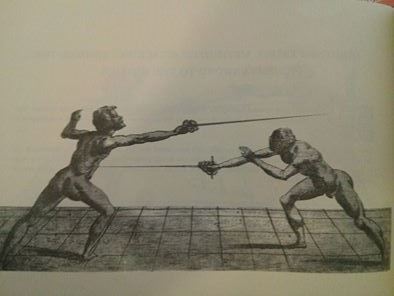
One of those necessary inferences is around the actual body mechanics of the void: Voids come from the hips and feet (and really, the feet just move the hips to different positions so that when you bend at the waist, either more forward or more back, it moves your upper body off-line). Three of the voids illustrated bend more forward, one bends backward. In each case, the hips and feet are moved to bring the center of mass out of the vertical plane of the opponent’s attack, and the torso leans to move the target area even further off-line while rotating the shoulders to move the sword in to close the line and point at your opponent.
Another inference is that voids are defenses used when at measure or inside measure, but considering most of Giganti’s fight begins just out of measure and concludes at measure, that’s not an unreasonable stretch.
Each begins by finding at measure, and waiting for the opponent to perform a cavazione. Against low-line attacks from the opponent, the step, of the front foot, goes to the same side as the original find (Find to inside, opponent cavaziones to the outside, you step to the inside; find to the outside, opponent cavaziones, step to the outside with the front foot – this is Capo Ferro’s Scanso del Pie Dritto). In these cases your hand is raised (with true edge toward their blade) and your point lowered to close the opponent’s line while targeting their exposed flank.
Should the opponent’s cavazione target your face, the response is to drop your head and torso out of the way (a sort of half passata soto) and extend in a low terza. Though it’s not described in the text, the art indicates a step is included: either the back foot to the inside and backward when starting with the find on the inside, or the front foot out to the side when starting with the find on the outside (as above, the step is to the side of the original find). In both cases, the follow-on is to put your left hand on the hilt of his sword (probably assisted by a passing step) and stab him a few more times, because this is Giganti after all.
The play wherein you find to the outside and your opponent performs a cavazione to your face in quarta is titled “The True Method of Defending Against an Inquartata with a Void of the Body”. While the art does not show the full girata that Lo Schermo does, the opponent is in a position that could be a slight lunge to the inside (fully in keeping with Giganti’s system) or a slight girata. Which means that voids are the counter to voids.
We’ve recently introduced our students to the concepts of measure, tempo, and line. Naturally they’ve already had some exposure through osmosis. Thursday’s drill was based on the idea that we can only safely attack an opponent who has given us a tempo.
So: to start, agente finds, patiente performs a cavazione and lunges against a passive opponent. Pretty standard stuff to get the mechanics right. Then, the next step. As Dave said, “wouldn’t that be stupid?” Yep.
The cavazione retakes the line, but agente has not given patiente a tempo in which to act. Patiente is acting out of tempo, and agente can use this to his advantage. Agente could, of course, simply retreat or parry, and survive. But he has better options. Among them: retaking the line in the tempo of patiente’s attack by turning the hand and extending through patiente’s proffered debole.
This is hard to do. When a sword comes at us, our instinct is to move it somewhere else (parry), or move ourselves somewhere else (void or retreat). Moving towards it violates all sorts of lizard-brain warning sirens. But if you can take the tempo, it works.
Usually, anyway. If patiente overfinds with the cavazione, agente will be out-muscled and unable to counterfind (but patiente’s extension will be off target, and agente can drop into a low pass or a void). This took a little time to discover. It’s always fun when something should be working, but it’s not.
After drilling, I fought Torse a bit. Sticking to Fabris’ fourth has opened my mind, even if the actions are still difficult to do. Torse is a great fencer, he trumps all my edges, but during our first few passes I could see the openings – I just couldn’t take them fast enough. He’s too quick for me to think about it, so I figured out the counters to a couple of his favorite patterns and readied myself to perform.
Attempting one of these resulted in a low pass in second, during which I caught a quillion between my metacarpals. That ended my fighting for the day.
Letia came out and did some lunge drills, pursuing a backpedaling Cailin until she was juuust in range, then launching the lunge. There was visible improvement in form, which resulted in MORE kibitzing from the sidelines. It was all well-meaning, of course. I think good fencing may be like good writing in that regard: the better your performance, the more critiques you’re likely to get. This is because only large-scale corrections can be made to an atrocious lunge (“no, hand first!“), but as you get closer to perfection, the critiques get increasingly detailed and thus, more numerous. Don’t get frustrated, and work one thing at a time!
Sunday
Baronial practice! We had six fencers, plus Dame Roz out of armor. After some footwork and lunge drills, we moved on to drilling Ruairc’s Book of Four Things: press, fall back, step, and charge. More to come in another post on these!
There was some trouble drilling. After basic instruction on the target maneuver, one unit (we shall call them A) was receiving the target command and performing the maneuver; the other (B) was supposed to provide resistance. Problem was that B invariably knew what A was going to do, and subconsciously (or consciously, in Gawin’s case) “cheated” to counter it. Once we became aware of this and called them out, we were able to fix the problem relatively quickly. Mmf. Have to make sure everyone knows how to do the drill properly, whether it’s melee or singles.
I also tried out my mezzo-tempo footwork drill. There were some problems with auditory processing latency and it didn’t quite work as hoped. We may need lights or something. I’ll keep thinking.
A Semantic Digression Into Lunging
I was trying to improve my lunge today, and Gawin was providing feedback. We were going slow, trying to figure out why my geometry was off vis-a-vis Fabris’ plates. We broke it down. Performing the lunge without the step worked well, but whenever I tried to add the step back in, I ended up screwy.
This led to an interesting line of inquiry …
When we teach fencers to lunge, we usually give some variant of the following:
1. Extend (the arm)
2. Lean (the body)
3. Step (and push off the back foot)
Naturally, this gets internalized after a few hours of drilling. But the Masters seem to conceptualize of the lunge a little differently. Giganti just mentions extending the body forward (presumably by driving off the back leg) after the arm, and mentions the front foot only when he describes the recovery. Capoferro notes that the “extraordinary guard” can be reached with or without an accressimento (an “increasing” of the pace). Fabris also notes that the firm-footed attack can be done with or without “carrying forward the right foot” (portando il destro piede inanzi; Leoni’s translation gives this as “lunging forward with the right foot” but I think this could be misleading for my purposes here). None of these are conceptually the same as “step” – which seems to indicate, at least to me, an extension of the foot.
Once I removed the idea of “stepping” and instead just drove off the back foot, with no muscular action in the entire right leg, everything immediately improved, and I had a much better sense of the muscle isolation that gives the lunge (and the “advance”, and the retreat) its rapidity. I also did not overstep as much.
So that’s an idea: there is no step; there is only extension, followed by extension, followed by extension. A straight chain of muscular action, quite in line with general martial principles (although inverting the usual power-generation sequence), with everything moving the sword and body forward. The right foot is simply “carried forward” and doesn’t do much moving on its own – certainly not as much as would be implied by the word “step”.
Of course, this hasn’t seemed to confuse anyone else. Maybe I’ll try it on my students and see if they get any mileage. Thoughts?
So, you’re about to head to your first melee event. Or third, or tenth, or whatever. Chances are that if you’re reading about how to be better at melee, then you’re probably not someone who would be considered a veteran of many wars. That’s fine: we all start there. You can’t have 20 years of experience without having 1 year of experience first.
Since you’re new, the best thing you can do is be useful. You’re probably not going to carry your team across the finish line to victory, but you can certainly help out those who can. Let’s get started.
First and foremost, melees are fights, so the best thing you can do is to get better at fighting. That’s your number one priority, so get to practice and make good use of the time and resources available to you. Your second priority needs to be your endurance, because you won’t be very helpful if you’re taking a “water” break after 10 minutes of an hour long battle. You can also practice maneuverability with 2 v. 1 fights at practice, and 2 v. 2 are all you need to practice a static line engagement or a limited front. Do those things enough, and pay attention to what works and what doesn’t, and why. Stop doing what doesn’t work, and do what does as much as possible (this sounds obvious, but apparently it escapes many!).
But those things take time to develop, and if you’ve got a battle coming up this weekend, we’ve got only a short amount of time to make anything useful happen. In that case, you have limited options for what you can do at any given moment in a battle: you can be an obstacle or a distraction. In essence, your physical presence is the single best thing that you can bring to the table. To use your presence best, find out the scenarios and think about what your team needs to do, and what the opponents need to do.
In the case of a limited front, a charge, a line fight, or anything else where movement is limited, your best course of action is to create as much of a nuisance for the other team as possible. Smack their blades around, stand in the way of their progress, and simply work to impede whatever it is they want to do. This might involve being hit a lot, but that’s fine: often, all it takes is a second or two to stall out an enemy action. You’re going to get hit plenty and you can’t stop that from happening while still being useful, so be in the battle and be as frustrating a speed bump as possible. The best person on your side is going to die plenty, too, because that’s the cost of making things happen. Controlling the victory conditions matters most, always, so be prepared to take some hits to accomplish that.
If you have an open field or some other area where you can move around and attack from angles, if you’re one of the people who aren’t in the line that will inevitably form, then the best thing you can do is be distraction. This is the core of what even the best melee fighters do who are roaming freely: stand somewhere that the enemy team has to deal with you or be punished for ignoring you. Good positioning comes down to making your opponents take their concentration off whatever they are currently dealing with to deal with you instead. The big difference here is that it’s harder to deal with better people, but even if you can only manage to pull one person, that’s just as good as a kill on the line. If they come after you, go for the double-kill: you already weren’t on the line, so your team loses no resources, but the enemy team does if they had to send someone after you.
Should you find yourself ignored, DFB everyone you can or threaten it. Your mere presence in their backfield will sow enough chaos to create a huge opening for your team, and if you can DFB even 1 or 2 people the resulting panic is invaluable. No matter what your skill level, a good sense of positioning can make you utterly lethal: I can think of dozens of cases where modestly skilled fencers with excellent positioning have made a massive impact on a battle by DFBing 4, 5, 6, or more opponents per resurrection. Those ratios are huge, and as good as what the best fighters hope for. Positioning is the great equalizer..
In all instances, if you can kill a more experienced opponent, do it unless it means giving up an objective. If you are new, and can send someone like me away from the fight from a double-kill, that is a hugely advantageous trade for your team. The reality of things is that if we fight, I will likely win. If you have a mind to defend yourself, I will likely emerge unscathed. You may delay me, which is good, but I am delayed tenfold if you sacrifice yourself to hit me. When to do this is a matter of judgment, but the newer you are, the better the bet becomes to take out the White Scarf *whenever possible* regardless of other considerations.
Fighting is complicated. Melee is simple. There aren’t many, if any, really good fighters who are not useful in a melee, but there are plenty of people who are only fair fighters who are wonderful meleeists because they know what they can and can’t do, and they only do what makes them useful.
Prevent the enemy team from doing what they want to do. Force the enemy team to split their resources. Kill more than you die, or kill better than you. Win the objectives.
Ed. This week Iskender (with an assist from Abbe Faria) discusses how to improve the speed of your actions and reactions.
What Abbe Faria discusses here refers not just to speed, which can be described for swordplay as velocity of movement, but explosive strength. This refers to the acceleration of body mass. Not just how fast you can move, but how fast you can get moving. Explosive strength is partially a function of musculature; therefore it can be increased, just as your physical strength (previously described as your capacity to move mass).
Explosive strength is a valuable asset in the toolbox of any aspiring combatant in both the armored and unarmored disciplines. It’s a recent subject of study in exercise sciences, but has numerous application in any sport where rapid acceleration coupled with power are employed at the same time – NFL football players, European rugby players, boxers & MMA fighters…all of these athletes have probably put in some training time to develop explosive strength.
Perhaps the most famous example of an athlete employing explosive strength is Bruce Lee’s famous one-inch punch, in which Lee knocks a poor soul into a chair and six feet across a floor. He does this utilizing the principles of fa jin, which bear a lot of resemblance to explosive strength.
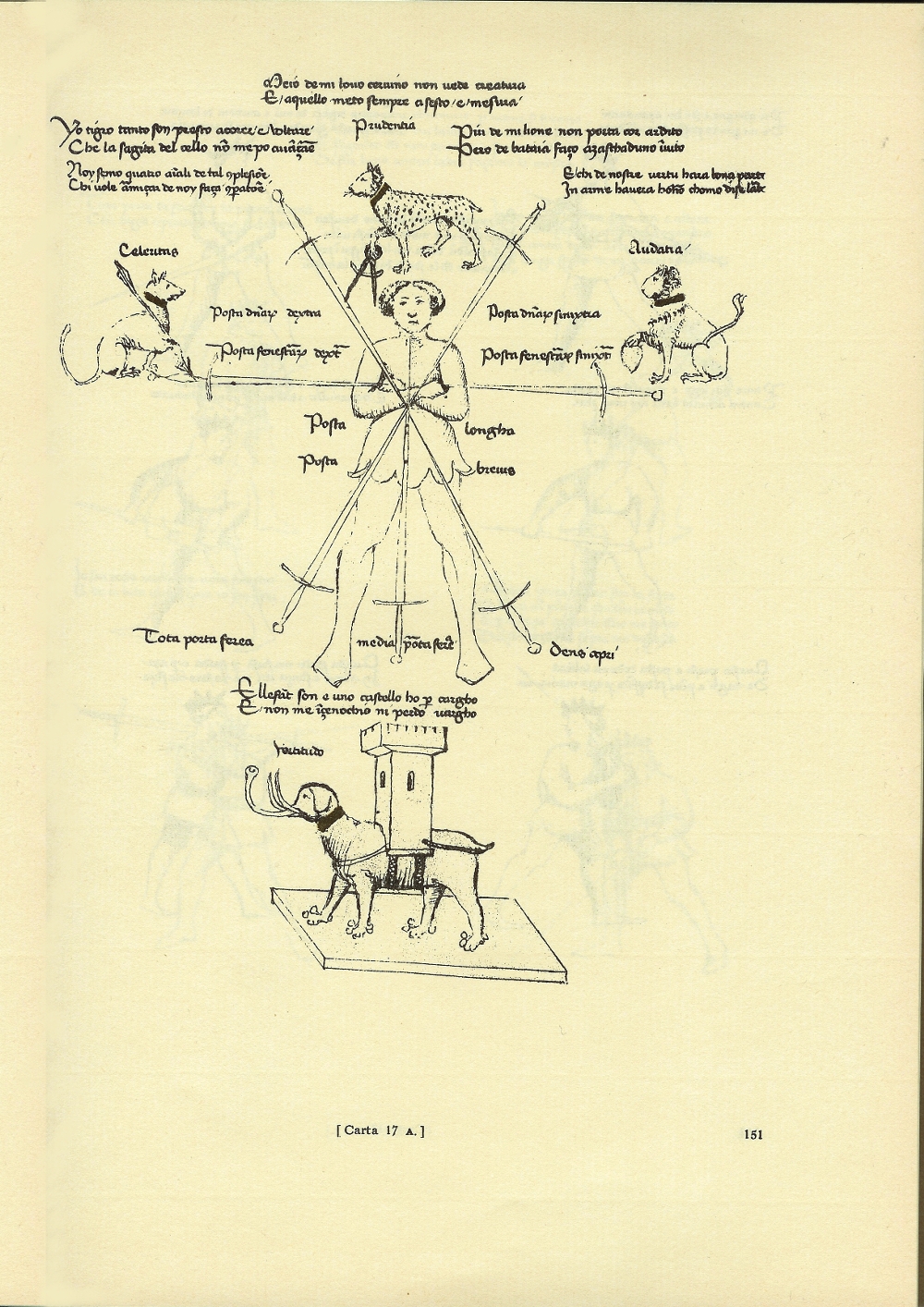
From a standpoint of technique, Lee accomplishes this through a combination of his physique and by bracing himself against the ground. A similar concept can be seen in European allegorical illustrations such as Fiore’s sette spada which emphasize standing strongly. The basis of all hand-to-hand combat is your connection to the ground – this connection has a factor in allowing Lee to perform such a dramatic feat.
More relevant to this article, is that both Lee and Abbe Faria are concerned with the physiology of developing explosive power. The particular executor for explosive power in the body is fast-twitch muscle fiber. Fast twitch muscle fibers stand differentiated from slow twitch muscle fiber, which is responsible for load-carrying in activities such as lifting weights. Slow twitch muscle fiber allow you to carry loads, and fast twitch muscle fiber allows you to get a load moving fast.
Fast twitch muscle fiber can partially be identified by their capacity to activate 2-3 times faster than slow twitch muscles. The human body’s muscular structure contains varying amounts of distribution for slow twitch & fast twitch muscle fibers. The muscles which control the motion of your eyeballs, for instance, are almost entirely composed of fast-twitch muscle fibers, while the muscles in your thighs are roughly split between fast twitch & slow twitch muscle fibers. It is possible for you to affect the proportions between your fast twitch and slow twitch muscle fibers in a measurable way.
Fast twitch muscle fibers are developed and trained the same way slow twitch muscle fibers are – through growth stimulated by repeated exposure to stress. When you lift weights in a gym, you are placing the most amount of beneficial stress on your slow-twitch musculature – this is because most people lift weights in order to be able to move more mass. By training your fast-twitch musculature in a similar way, you will be able to accelerate in less time than someone who hasn’t trained their muscles this way.
Just as training your musculature to move more mass involves other systems in your body and has other effects on your body (such as a more efficient metabolism, increased capacity to burn off fats, and a lessened chance of injury), training your fast-twitch muscles will also involve other systems in your body. If you choose to specifically train your fast-twitch muscles, chances are also very high that you will be cross-training your anaerobic cardiac capacity. It almost disingenuous to discuss training for explosive power without anaerobic training, however, my intention here is to lay out programs that may increase your capacity to accelerate. Further articles may discuss how to hit multiple fitness targets with single workouts and thus, save your time.
Unarmored fighters in the Society, quite frankly, have no need to communicate a lot of power into their opponent during a bout. It would get you thrown off the list in a heartbeat to drill your opponent with the complete amount of power available to most people. Unarmored combattants should learn to develop that power in their lower bodies which may allow them to move quickly. Simultaneously, they must develop the capacity to let that kinetic energy dissipate when it reaches the upper body, retaining only enough for the task at hand. This sounds complex, but it is a technique which all unarmored fighters in the Society develop to one extent or another. Developing explosive power in your lower body will allow you to conduct your footwork with greater celerity – this allows you to reach your opponent in less time, allowing them less chance to defend themselves. Timing.
However, one of the great unspoken challenges that faces unarmored combattants is precisely how to develop the capacity to allow the explosive power generated by their lower bodies to dissipate in their core & upper bodies before it reaches their sword-tip & their opponents. That undeveloped capacity may factor into one reason why new fighters hit so much harder, so much more consistently when they fight at full speed – they haven’t developed a practice that allows to keep their shoulders & upper arms un-clenched. This, coupled with an undeveloped sense of proprioception, can account for why training a new fighter is going to give you bruises.
Armored fighters, and Atlantian ones in particular, must retain that power throughout their motions, employing it to cease all questions about whether a particular shot was ‘good’ or not. Building your strength up will make this job easier, but plenty of fighters have learned quite capably to channel power from the ground into their opponent while developing the musculature to support that power delivery in an almost accidental fashion. Some fighters, in particular Sir Afshin Darius. have even been known to channel enough power through their core to not even need to have their feet on the ground when they land their blows – however, this requires an extremely high level of dedication to your training.
Different armored combatants have different methodologies for developing the efficiency needed to communicate power into their opponents – among most schools, an emphasis placed on blow mechanics through pell work and drilling will develop explosive power almost as a side effect. However, an instructor who can also place an emphasis on explosive power alongside shot mechanics will develop students who have shorter paths to excellence on the field. Most instructors already have these tools in their toolbox – they merely need to instill in their students the habit of dedicating an amount of pell-work to full-speed, full-strength blows (however, this should not take place against a rigid pell, as the energy channeled through the waster and into a rigid pell will be reflected back into the fighter, ruining rattan and elbows along the way – constructing a soft pell is key, here). This will go along way in allowing a student to develop a telling blow. Spending some time specifically developing your capacity to to exert explosive strength will also shorten that path to excellence.
The exercises listed below can also be structured in the same manner as a weights regime from my previous article. Instead of using ‘weight lifted’ from the previous chart, substitute in ‘distance jumped’ or ‘height’ or whatever other objective metric you will find useful. Be sure that objective metric is measurable. Not only does this keep the trainee honest, it allows for an adjustment in the structure of your workouts.
Lower Body Explosive Strength
For those who perceive themselves to be un-athletic, you might be surprised at how much power you already have in your lower body. People’s legs are pretty strong, and it doesn’t take much training to begin to recruit fast-twitch muscles for the purposes of combat. There are certain exercises which may prove beneficial in developing those muscles. My go-to website, Breaking Muscle, has a list of five very good exercises which specifically target this capacity. There’s another list of exercises which build explosive muscle here. No matter what level of athleticism you perceive yourself to have, there is an exercise choice here which will prove beneficial. It doesn’t matter how fat or slow you think you might be.
Upper Body & Core explosive Strength
Developing explosive strength in your core can allow an armored fighter to more efficiently channel power from their lower bodies through to their opponents. One exercise listed in the previously cited Breaking Strength articles is the bag slam. The name is pretty self-explanatory – get big bag of sand or whatever, and repeatedly slam it on the ground. When performed correctly, this increases the explosive power of the muscles in your core. As well, an actively-resisted situp can be employed, although the active resistance in a situp is personified by a workout partner who shoves your upper body back away from your legs at the top of the situp. So, you need a buddy for that one.
In order to develop explosive power in the upper body, pushups combined with a clap of the hands at the apex of the push can be employed. For someone just starting out in the development of explosive power, you can start out by doing pushups in such a manner that your hands just leave the ground.
Filling a basketball with sand, and throwing it around in a circle of friends, can also serve as a fun and easy (and less intimidating) way to develop explosive upper-body strength. You can also buy weighted balls for this purpose. If nothing else, a loaner bell-helm is about the right size & weight to toss around, however do be careful that you don’t hit someone in the face with a helm. That is widely considered a malfunctioning order of operations in armored combat.
If you prefer to lift weights in a gym, Olympic deadlifts are good ways to develop explosive upper body strength (along with a whole host of other fitness skills), however close attention must be paid to your weightlifting form, as your chance of injuring yourself becomes higher. The best scenarios for this involve joining a gym which specializes in Olympic weightlifting, or having a lifting partner or trainer who is experienced in that style.
Final Words
Developing explosive power is one of the more underrated skillsets that fighters develop. Needless to say, there are a number of demands on a fighter’s time; being involved in an activity that is part sport, part culture, and part art is (to put it mildly) demanding. However, the development of explosive strength can easily be meshed in with other fitness goals, including cardiac development and generalized strength development. Choosing exercises which will integrate explosive power into your regime will go a long way to becoming more effective at arms.
After a month of demos, meetings, and events eating up my Sundays, Elvegast practice resumed yesterday. As usual, most of my time was dedicated to teaching. This is fine; I’m learning enough on my own time.
What’s Good Enough?
First, a question for all the other longtime teachers out there: at what point do you consider your student to have sufficient mastery of a skill or concept to profitably move on? Obviously the fundamentals of fencing (guard, footwork, lunges, finds, cavazioni …) are something that we all can constantly work on honing, and it seems unreasonable to expect constant (or even consistent) perfection from a relative newcomer. But leaving specific instruction and analysis of those fundamentals too early can cause bad habits to persist and calcify, and lead to further errors down the road. Finds, cavazioni, etc all require a fairly solid guard before they can be performed correctly.
Because the SCA tends to spend too little time on the basics (I still have some awful, awful habits I internalized years ago), I think I might be overcorrecting with my own students. Is there a good measuring stick?
Giganti’s 9
This is the framework we’re building from for our students: once we’ve gotten them in a good basic guard (usually with stick drills, which will come in a later post) and moving reasonably well, we tackle Giganti’s first nine plates (lunge, gain inside/outside, cavazione inside/outside, contracavazione inside/outside, and feint inside/outside).
After five months of close instruction, our students are beginning to reach the feint, after which we may move on to more complex things. But I don’t think we’ll ever stop doing these drills – they are the fundamentals, after all. I anticipate devoting at least 15 minutes of every practice to one or two of these, perhaps allowing students to build up to choice drills once they perform consistently.
Yesterday we focused on a simple variant: agente finds, patiente cavares and lunges. As agente I added resistance quickly to be sure that the student was properly counter-finding with the cavazione.
Footwork Drills
Our usual approach to these sorts of drills, in the SCA, is to have everyone get in a line and follow the instructions of a single caller. One wonders if this hails from strip fencing. I’m not sure I like this. Playing around with Fabris’ 4th has made it obvious to me that we can’t think of footwork as monolithic (any more than any other action is monolithic). We must be ready to turn an advance into a lunge, or a pass, as the situation dictates – otherwise there’s not much point to the back-weighted stance.
I think I’m going to try something different: keeping the basic structure intact, but giving commands in mezzo tempo (so shouting “lunge!” halfway through their advances). The response will be either to complete the footwork, then perform the next step, or go straight into the next step if balance permits.
Experimental Tip
I put a new tip on a loaner blade yesterday – a small strip of mild steel folded over the point, wrapped in leather and taped on. Legal by all the rules. It has about half the surface area of the usual bird blunts or Darkwood tips.
Pros:
– Does not easily get tangled in guards or clothing
– Cannot be used to arrest attacks by stop-thrusting at guards (a chumpy, ahistorical tactic)
– Can be drawn from a narrow, period-looking sheath instead of the ugly PVC pipes some people use
Cons:
– Hits slightly harder
Less so than you’d expect, actually; strikes to the head and neck are actually lighter (the point does not stick as much on rigid armor). To the body, the extra stiffness was quite noticeable when taking static hits, but the shots I took in active sparring were barely harder, if at all. I’m not sure if adrenaline is to blame.
Giganti devotes two sets of plates to what he describes as “furious passes” but which seem more likely to be the combination of a passing step that flows into a lunge (the passing lunge or pass-lunge) that shows up on the SCA list so very often. The big advantage to the passing lunge, and why I used it for longer than I’d like to admit, was that it gobbles up huge amounts of territory and if your opponent thinks they are at “normal” measure they are really two steps or so inside your pass-lunge measure. The big disadvantage to it is that distance = time. It covers huge distances, but takes a huge amount of time doing so. Also, the way most people do it, it hits like a fucking Mack truck, but that’s body mechanics.
Giganti says that, yeah, people might try this stuff. He describes the counter to it as “a deceit” which leads into the most awesome sentence of the entire second book:
When two masters fence, they do not exchange thrusts or cuts, but rather wiles and new deceits.
Isn’t that a beautiful sentiment? I think so. And it’s exemplified by so many high-end fights, and absent from so many others. After all, the big switch from thinking “How am I going to overwhelm my opponent?” to “How will I make my opponent obey my will?” is a pretty clear marker of high-end fighters.
The deceit prescribed by Giganti is a simple invitation. Give your opponent an opening to attack. It can be a big opening. You’ll be okay.
Since his attack sacrifices time for distance, your counter turns that huge tempo he gives you into control of measure and line. When he attacks, you step back with your lead foot, moving your torso outside of the range of his big mucking lunge, securing your person and regaining control of measure. As you can guess, if you’re not at the edge of measure for that big mucking lunge, you may not sufficiently clear range to avoid the lunge. Giganti warns in a later plate (The Method of Defending Against a Pass of the Left Foot, at Distance Using a Counter-Disengage) that if you are in or inside measure there’s a chance his thrust will land before you can counter it.
While taking the step back, Giganti instructs to bring your dagger down/across to parry his blade away from your body, regaining control of line. And since at this point pretty much just extend your sword forward and let him plant his face on your sword. Winning.
This is one of Don David’s counters to righties who lunge at him (he’s a lefty). It’s an effective tool, but has some weaknesses: because the lunge is a smaller tempo than the pass-lunge described, righties can move into a continuation through passing steps to eliminate the measure gained by the defensive step back, and because the extension and lunge disorders the body less than the pass-lunge, cavazione and voids are more available to the righties.
Still, Sir Morgan Ironheart is the biggest user of passing lunges* I encounter these days, and he and Don David fight each other often enough that I’m going to start taking notes, and possibly video, and maybe handing out photocopies of the pages from the second Giganti to bystanders, because learning is fun.
*Sir Morgan also throws the safest and fastest passing lunges I’ve seen, by efficiently converting all of the rotational energy into a linear expansion of the body. Think pulling ribbon off of a spindle instead of throwing a punch. But they still take so much time you can usually block with your dagger, sidestep, stop thrust, and make a chicken salad sandwich before it arrives.
This is a distinction that I find myself coming back to a lot lately, and I think that there’s a meaningful distinction between the two concepts. This is ultimately a matter of skill progression, but I think that there is some nuance worth delving into here.
A well-coached person is one who can perform specific actions at specific times, and do them well. Someone who has been well-coached might have been so well-coached that they can do every single thing out of Fabris’s book one successfully, but more likely they are someone who can perform very well against certain styles or situations and not so well outside of those parameters.
Imagine a fencer who is studying Giganti and drills a handful of specific moves: the voids, a feint-lunge/cavazione in seconda or quarta, a few contratempo attacks, and maybe a cut or three. Let’s say that they practice those things, and nothing else, 12 hours a week for a year with a good coach who can correct their mistakes so that they are practicing those actions without any errors. Let’s also say that this fencer has no mental hang-ups and that their fitness is also good enough to perform well.
How successful will this person be when they enter into tournaments? I would hazard to say the answer is “very successful.” In fact, I think they will handily outperform 80% of the field, and that’s a conservative estimate. The simple truth of it is that if you have the ability to act in a way that brings victory 90% of the time in situations that you encounter 90% of your fights, your career average is going to start looking very good, very quickly. In fact, if the only attack you have is a cavazione di tempo when your opponent moves to find your sword, but you can land that shot 99% of the time, you’ll win 99% of the fights you have where your opponent moves to find your sword. Right?
Sort of. The problem with this is that you will win 99% of the times your opponent offers a tempo in the right measure with the right action for you to respond: good odds, but limited by some variables that are outside your control. If that is your only attack, any other action by your opponent will defeat you. Of course, none of us ever have just one attack, but this serves to highlight the problem of someone who has been coached, but has not learned: you can only handle the situations for which you have trained, and limitations on your training are limitations on your skill.
I see this all the time. There are a substantial number of fencers who can be quite successful up to a point because they can perform well within the narrow confines of other people with similar skill sets or familiar styles. How many of us have, at one point or another, come across something unforeseen that resulted in serious difficulties? How many of us suddenly struggled because the opponent was left-handed, or used a smallsword, or a longsword, or had a big shield, or fought case, or preferred to fight on the outside rather than the inside? I’ve been guilty of all of those problems, even when I was on a hot streak and winning a few tournaments a month. I knew what to do in specific situations, and I was lost outside of that realm.
Though my desire to solve that problem is in part what led me to the study of historical rapier, this problem also manifests itself in HMA enthusiasts in the form of those who can do all the plates, but still lose to those who don’t fight according to the “rules” of that system. Having depth to your coaching is still prescriptive, which always suffers from the same problem: anything novel will stymie you.
By comparison, someone who has truly learned and internalized the principles of fencing ought to be able to adapt to whatever circumstance they find. This is the difference between seeing a left-handed opponent with a big shield and hitting the shield over and over because you can’t help but target the right shoulder, and seeing that same opponent and keeping their sword on the outside of your dagger so you can negate their shield while you attack in prima with an angled lunge. That may seem like a tactically simple thing to do, but I have seen dozens of people fall victim to the former and far fewer perform the latter. Moreover, simply fighting on the outside line is enough to make opponents feel compelled to take several lateral steps, often in measure, just to get the fight back to the “right” place where they feel comfortable. Try that out, and I wouldn’t be surprised if at least half your opponents do it.
What does all this mean for us? It means that evaluating skill, both in others and in ourselves, must be done carefully lest we overestimate the abilities we see. It would be a shame if we hampered or halted our growth because of a misunderstanding of what the end goal looks like. It also means that victory is not the only measure of success or skill, and is only a measure of those things relative to your opponent in that particular instant.
Most importantly, it means that drill and automaticity are stages in a journey that are necessary, but should not be mistaken as the destination, or even as the means to the destination. To be well-coached is the cost of admission for expertise, but it is not expertise in and of itself.
I often remark that Giganti leaves nuance aside (having addressed theory sufficiently in the first six pages of his first book) and just tells you what to do. His section on attacking with passing steps starts with the same approach:
“If your enemy attacks… you can pass with your foot if you know how to take the tempo. Having passed you should free your sword and deliver two or three thrusts.”
He doesn’t mention the counter to the opponent’s attack, because that varies based on the attack, but otherwise it’s “Counter while stepping in and stabbing.” In general that counter is “parry with the dagger”. If he disengages your dagger with his sword, you follow with the dagger, and in general have already position youred sword to close the new line your opponent’s cavazione would gain. Your passing step is usually offline through your opponent’s blade, not away from it, which will make his cavazione more difficult.
Only when your opponent offers a center-line opening do you close the line with your sword while stepping in (because this places your sword next to his, so he can’t parry with his dagger without catching his own blade).
Of course, offering an opening is not an attack. His prescription applies not just to answering opponent’s attacks, but to exploiting any action of your opponent, including inaction. Which brings us back to the first book’s instruction to always deliver contratempo attacks. The general principle of the dagger-parry-while-passing is the same, whatever the tempo you’re exploiting.
Measure, naturally, is important and almost completely undiscussed (but implied by the art). The passing step always begins when you’re already at measure, whether through your action or your opponent’s, so that your passing step brings you inside measure. If you perform the passing step from just out of measure, where you would gain the blade, it provides a big tempo, brings your target area into measure, and exposes your flank to that cavazione. Only by performing it when you’re already at measure do you enlarge the necessary disengage to provide time for your counter. Consider this, you pass-lungers (Giganti talks more about you later).
There are a couple of glossary hints from this section.
One is his concept of “over” specifically when describing “attacking over the dagger”. The art shows the opponent’s dagger blade above your sword, but your hand higher than the opponent’s dagger hand. It may be that “over” better translates as “higher than”, and the important element is to have your forte/guard higher than their dagger guard. Support for this interpretation comes from strip fencing. Walter Triplette has a maxim: “The high man wins”. In practice the blade with the higher leverage point can block attacks below it, and attack over the arm (which is the hole in everybody’s guard). The art shows the attacker’s blade in a seconda, rolling to a prima, and even if the opponent’s dagger is attempting to parry from the attacker’s outside, he’s still boned.
The other is in the use of the word “advance”. Approaching Giganti, and all Italian rapier, from three hundred years of sport fencing, I think we automatically assume this to be the two part “step with the front foot, step with the back foot” advancing step. I think as he uses it (in the instance in question “you should advance carefully to find his sword”) it just means to move forward. There are other, and better ways, to do so than the advancing step. The advancing step moves the front leg and torso into measure, while depriving the fighter of a lunge. Basically, they end up hanging out at measure while they recover the back foot, unable to strike, frozen in space, even though they are AT MEASURE. A better option might be a gathering step, which closes measure (because the back foot moves) without moving the torso or front leg any closer to the opponent. Even a slight pass, while awkward from a balance perspective, would achieve the same goal because it would narrow the fighter’s measure without affecting the opponent’s measure. So, add “Advance step” to the pile with “parry” and that other word I don’t like. Anybody remember what it was?