A lot of our pre-melee discussion, in Atlantia and elsewhere, seems to center on assigning people to various roles. Where do we put the junior fighters? Where do we put the senior fighters? Who’s in command? Everyone together? Specialized units?
I think Windmasters’ Hill has it right: everyone should be capable everywhere. We shouldn’t ask ourselves “where do we put the newbies?” because we shouldn’t have newbies – at least not the kind that have never experienced melee before. If we have a rank newcomer who has never held a sword before, we don’t throw him into a tourney; we have him practice for at least a few weeks. Melee should be the same. It’s not just something for events.
General Guidelines
This whole series has been about how melee derives from the same principles that govern singles fighting, plus a few asterisks. Training is no different.
Start with single sword – it’s less complicated. Also, it forces you to be better, to learn to fully utilize a single tool. Start slow – whether you’re practicing a free 2v1 or a new maneuver, do it slow to begin. Let people see how it works. Then gradually go up to speed. Critique – especially outside observers. Ask questions. Get your fighters thinking in the right direction. But keep it short – you can’t improve if you’re not in mask. Build up from smaller parts – Again, 1v1 is hard enough for junior fencers. Don’t start them at 5v5. (Besides, you may not have enough people for that.) 2v1, particularly with skilled fencers who will take things slow and let them learn, is excellent. Schedule it – whatever your practice, if you have three regulars, put melee on the schedule. Maybe it’s thirty minutes a week. Maybe it’s two hours once a month. Whatever you decide, make sure it gets done.
2v1
Melee is all about 2v1s and 1v1s. I’m guessing that you’ll be getting plenty of practice in the latter. The former is, I feel, important enough to warrant getting half of your melee practice time, or more. A few caveats:
Limit the space in which you can run. There’s a tendency for the solo fighter to just run around or run away. That doesn’t help learning much. Block off a sizable but not excessive amount of space for the fight – 40 or 50 feet square is plenty.
Everyone should play every role – especially inexperienced fighters. It might seem cruel to set a newbie against two others, but that’s exactly what’ll happen on a line. Skilled fencers should be gentle, of course, and ensure that learning takes place, and the fight should be slowed to begin.
In larger melees, make sure that newbies get experience on a line, on a skirmish squad, and in command. Rotate fighters frequently – unless you are working something specific, teams should be consistent for only 2-3 runs. Learn to fight with everyone!
Stop the fight once it reaches 1v1 (e.g. the solo fighter kills an opponent and breaks measure). A settled 1v1 is not melee (not at least three people) and will only waste time. It may also be appropriate to halt larger melees if one team has an insurmountable advantage. Use your time effectively.
If you have the space, run multiple 2v1s simultaneously. Try to have as many people fighting as possible. But don’t forget the water breaks either.
A good goal to have is that, while armed with single sword, any two fighters at your practice can beat any other solo fighter, consistently and at speed. At that point, introducing secondaries is appropriate.
Some Variations
Static – No maneuvering allowed. Set up the fight with everyone at rough line-fight distance. Fighters may not move sideways or retreat (defined as moving the back foot behind its starting position). This is a rough simulation of a line fight and makes concepts of Readiness and Opening very clear very quickly. It’s recommended that the solo fighter be experienced and probably have a secondary.
Silent Pair – Note that this implies the pair should be talking under normal circumstances. Communication! Get them to use it, then take it away from them. A good variation on this is to have only one person allowed to talk (preferably the less experienced).
Timed Kill – The pair attempts to hunt down the solo fighter within a few seconds – if they fail, the solo fighter wins. This teaches aggression and defensiveness. Do not call hold when one of the pair dies. Start at 15 and try to reduce it under 10.
Reinforcement Drill – like Timed Kill, but the solo fighter is reinforced after the timer expires (at which point the timer resets for another reinforcement). If the solo fighter is killed, the killer steps in as the solo fighter for the next round. Once you get a good rhythm going, reduce the timer to 10 (or 7!) seconds and have people rotate through on their own initiative. This is a great drill for getting everyone fighting and everyone tired.
Small Melee
You can repeat all of the above with 2v2, 3v2, etc, if you have the people. Some other things:
Plan/No Plan/Brass Holes – a variation for any of the below. In the first parameter, teams may plan before the fight (limit it to under a minute). In the second, teams must come up with plans on the fly. In the third, teams must execute the plans secretly given by a third party (the marshal). Bonus points if those plans are stupid.
Splits – fighters start split into two equal groups (e.g. a 2v2 split is two 1v1s, a 3v3 split is a 2v2 and a 1v1, etc). Neither group may interfere with the other until their opponents are dead.
Asymmetric Splits – as above, but one or both groups has a strong advantage for one team. It could be numbers (3v3 = 2v1 + 1v2), skill, allowing one team to maneuver while the other must stick together, or even giving one team the advantage of planning. This is to teach aggression and defensiveness and situational awareness.
Line Fight – 3v3 or higher, static. Experiment with different spacing between fighters. Find what’s too wide and what’s too close.
Kill the Goobs – set up a line of experienced vs inexperienced fighters, with everyone fighting defensively. At some point (prearranged or improvised), an experienced fighter will do something dumb (say, lunge without closing out all of his opponents, or retreat, or advance, or fall out of guard, or lose cohesion while maneuvering); the green fighters must be ready to capitalize (killing him or killing his teammates). An advanced sort of 2v1 drill.
See Them Driven Before You – As “Kill the Goobs” or “Line Fight”, above, but when one of the fighters dies (or is arbitrarily called dead by a marshal), the other team has 10 seconds to leverage and propagate their 2v1 and destroy the enemy line. Get it down to 5 if you can. This drill is great for teaching the hair-trigger switch from the typical defensive line-fight mindset to coordinated-aggression-kill-them-all.
Throw Rocks At Them – Situational Awareness, Hard Mode. Have a marshal (or dead fighters) on the sidelines lob “rocks” (balls of duct tape, slitted tennis balls, etc) at fighters still alive. Rocks count as valid blows if they strike a fighter and will disable his limbs or kill him.
As you can see, these drills easily combine and recombine. Invent your own! Better yet, involve everyone. Have your regular fighters rotate through running the melee games, coming up with their own. Remember that these are for learning and fun, and act accordingly.
Wistric has a few ideas. Some look pretty good, but I’m not wild about others (particularly the ones that involve two fencers). At this point, you should know enough to figure out which will be helpful for your practice.
I’ve put nearly 8,000 words into this series now. Please chime in with thoughts!
This is the last of the core skillsets for melee fighters within my framework. There’s plenty more to melee, of course, but as with tournament fencing, a lot of it is simply refining these basics.
This section is also on the shakiest ground, as I’ve mostly moved beyond the hard truths contained in measure, tempo, and line (simplified as Range/Readiness/Opening) and now focus on unit- and battlefield-level Awareness. But whatever flaws you may find, I believe it’s worth thinking about. Improve it if you can.
As always, this framework is for focusing Attention, and improving it by giving fencers some solid heuristics to guide their decision-making and reveal what’s most important.
Aggression and Defensiveness
The usual disposition for fencers is a defensive one. It comes naturally from 1v1 fights – make sure you’re safe, then work on killing the other guy. It applies doubly so to melee, where we must have closed out multiple opponents’ Range, Readiness, Opening, or Awareness before we can be safe. But being too defensive risks not taking opportunities when they arise. Fencers must be comfortable both with defensive play, where we mostly wait for opponents to make mistakes and look to our own safety, and aggressive play, where we capitalize on mistakes and force them to make more. The latter is more risky, but vital for effective combat.
Consider a sterile 2v1 situation. As we discussed previously, the status quo here benefits the pair, so the solo fighter has to make up for it with maneuver or better application of the basic principles (i.e. being more skilled). He cannot afford to be conservative or static; the longer the fight remains a 2v1, the worse off he is. At a minimum, he will almost certainly have to expend more energy just to stay alive, and will fatigue before the pair. The pair, on the other hand, have every reason to check their aggression. If they keep their cohesion, they will remain safe, but if one of the pair overextends, he puts himself or his partner at risk.
Now consider the same 2v1, but as a subset of a much larger battlefield. The solo fighter here is in exactly the opposite position; the longer he can draw out the fight, the greater his chances of being reinforced. Furthermore, if the teams are of even numbers, the longer he occupies two fighters by himself, the better the situation for his teammates elsewhere. The pair, meanwhile, must kill the solo fighter as quickly as possible.
This is easily observed in a split 3v2. Consider a situation where A and X split off, leaving B & C to fight Y.
A is in a 1v1 with X, but his friends are in a favorable 2v1. His friends have an advantage where he does not, so he’ll (generally) want to be defensive. B & C, of course, should aggressively finish off their target and then move to assist A.
X is in a 1v1, without advantage, but his buddy Y is at a significant disadvantage; all else equal, it is far more likely that X will be able to safely kill A than Y will be able to safely kill either B or C. Therefore, X must be aggressive and try to kill A fast so as to even the score before Y falls. Y, of course, is defensive.
A 3v3 asymmetrical split is the same: A & B are aggressive against X, who is defensive; Y & Z are aggressively hunting down C, who is trying to draw out the fight as long as possible.
Because most fencers naturally take a defensive stance, they must be taught when to be aggressive and when to be defensive. The more quickly they are able to recognize and react to these situations, the better they will be able to seize opportunities and mitigate threats, acting effectively as part of a unit without direct orders.
Using Aggression
Interaction between two units should fall into one of three categories. Without direct orders or a compelling reason to do otherwise, by default, fencers should:
Kill – In general, when we have some advantage over our opponent, it is best to crush them immediately, before they can run away or maneuver to make the fight fair. Run – In general, when we are at a disadvantage, we should move – either maneuver, to create an advantage and even the score, or else to retreat and reorganize. Continuing to fight at a disadvantage is usually a good way to end up dead. Stand – In general, when neither team has an advantage, a conservative light engagement is the default. Without some advantage, an aggressive attack is as likely to be detrimental as successful. We need to slowly seek the advantage and look for a good maneuver.
There is a final possibility – that one unit has one kind of advantage (say, numbers), and the other has some other kind of advantage (say, greater skill). This is a complex situation and only experience can tell you how best to deal with it.
Types of Advantage
I mentioned three already in my last post:
Numerical – the most obvious, and frequently the most telling. Skill – less direct than simple numbers, skill is also important. Positional – a broad category covering cohesion and maneuver – whose fighters are in the best position to be effective. Terrain is also important here.
And since we’re building back up to the battlefield level, I’d like to introduce one more:
Strategic – simply put, if one team has the flag, and nothing changes, they will win. Because the other team must take it, they are at a disadvantage.
All fighters should be able to recognize numerical advantage. Skill advantages require more nuanced evaluation of “the other guy”, but regalia (white scarves), quality of garb, and confidence of posture are good hints. Positional advantages are easily recognized too, particularly if fighters scan the battlefield ahead of time for difficult ground or know what maneuvers their opponents might attempt.
Strategic advantages are mostly the responsibility of the commander to track and react to, but intermediate fencers should try to maintain a general idea of where they stand and what the tactical implications might be. Strategic disadvantages frequently have special consequences – the default is no longer “run away”. If you need to capture the flag in the next fifteen seconds, it doesn’t matter that the opponent outnumbers you two to one – you have to charge in there aggressively and try your best, or else resign yourself to defeat.
Again, the goal is that fencers recognize these things immediately and react immediately, without being told – even though (or especially because) they change rapidly from moment to moment on the battlefield. This is not a thing for the commanders alone.
Communication
We’ve seen that cohesion is important. We’ve also seen that Awareness is limited (abstractly by Attention, but absolutely by the limits of our senses). Communication addresses both of these.
Aggression on the part of an individual line fighter will likely get him killed. Likewise, if a single line fighter steps out of line to flee a bad situation, his comrades are at great immediate risk. Fighters who recognize moments of advantage or disadvantage must also communicate these to their teammates – as efficiently and directly as possible – to leverage the opportunity while keeping cohesion.
Everyone must be comfortable with giving (and following) these commands. If only the commander talks, then the unit’s reactions depend solely on his Attention and Awareness. And even were the commander to spot an ideal opportunity, orders cannot always be communicated in due time.
A hierarchy of command is not a bad idea, of course, particularly when orders must be countermanded. But advantages appear and disappear rapidly, particularly in line combat. Everyone must be ready to alert the unit.
Especially People Not Fighting
If you’re engaged with an opponent, you can’t spare much thought for the battlefield as a whole. If you’re returning from rez, you most certainly can. Take a moment, look around, and communicate anything important to your teammates (up to and including maneuvers!). Incoming flankers, etc, are obvious candidates, but one that goes too frequently ignored is telling your friends to fall back from a losing fight. There’s rarely any point in dying to a man.
This is why, when we can afford the manpower, we have commanders stay off the line.
A Dynamic Battlefield
Lines are fragile. Much like the proverbial chain, once one link breaks (whether a fighter dies, steps back, or simply loses his main hand and takes awhile to switch), the entire line is exposed. Fighters must be ready to capitalize.
I’m in a line fight. Three people threaten me: A, off to my left; B, across from me; and C, off to my right. Next to me, on either side, are X and Y. (Of course there are other members of the alphabet down the line, but they are out of Range, and I pay them no Attention for now.)
I move my dagger forward into the space between A’s sword and my body. Now he has no Opening. At that very instant, C makes a wide parry, an overreaction to an attempted hand-pick from Y. He lacks Readiness.
I lunge, keeping B’s sword locked out as I do so, and strike him in the chest. A attacks me with a quick stab, but my dagger is already moving to parry.
I could recover from here, but there is an opportunity now – we outnumber the opposition. We have a 2v1, and it’s time to be aggressive. Before B can even call “dead!”, before his friends can react to the hole in their line, I am widening it. I step towards C, taking A out of Range as I call for my team to press. I bind C’s blade, and he dies quickly to Y, victim of a 2v1 he barely had time to recognize. We turn to A, but he, and the rest of his line, has already crumpled before the coordinated aggression of my teammates. X has died in the press, unfortunately, but the other unit has lost its cohesion and does not have the presence of mind to retreat. I run to the fight with Y; the foe will soon be dispatched.
In a singles fight, a five-minute “dance” can come down to a single decisive instant, seized and acted upon with resolution. Line fights, among skilled fencers, are no different.
This takes practice. That, we will address in the next and final installment.
To start: I don’t think I know anybody who can talk about their “A” game without sounding pompous. Hopefully this won’t sound overly pompous and will actually be useful. What I sincerely hope is that people talk about how to defeat my kind of “A” game so that readers will learn more than just “stretch then kill ‘em”.
My goal state for a fight is physical and mental readiness for action, with absolutely no commitment to any particular action. This is the “mushin” of Asian martial arts, the fifth ring of Musashi’s Book of Five Rings. Prep therefore involves getting blood into all of the necessary muscles and joints, getting them ready for action, while clearing my mind of all thought.
I find sun salutations of progressively increasing speed and vigor work well for this. This is pretty close to what I do:
The actions provide the stretching and blood flow. After the first pair, at the various postures there are places you can press a little extra to work on stiffer joints and muscles (in the lunge back, pushing the hips down and forward helps get them ready for opening up when in guard; in down dog the more you press your heels toward the ground the more you stretch out your hamstrings). I also improvise on these: Adding a pushup when in plank, lifting a leg up behind me in down dog to stretch the hip and leg additionally.
Concentrating on breathing clears the mind. To start off, just thinking “in” and “out” got the mind clear. Now a days I just listen to the breath.
I then usually close out with a minute or so of pranayama breathing. This is forceful exhalation and gentle inhalation to further oxygenate the blood and stimulate the adrenal glands (some Yogis get… weird with this, but keeping it simple has never seemed to hinder). My yoga instructor called it “building heat” and that’s an accurate description of the physical sensation.
It takes a few minutes, but there’s more than enough time between the end of round robins and the start of the quarter finals, or while waiting for your champs fight to be called.
Then, it’s mask on and be ready. I don’t talk much in mask because that requires thought. Which isn’t to say there is no thought going on, but it’s not particularly committed. Analysis of probabilities based on opponent’s action: “He’s moving this way, holding his sword that way, he’ll probably do this…” But there is no “I’m going to do…” The ability to identify those probabilities is what experience earns, more than anything, and I’ve never found a shortcut.
What that looks like:
For the first part, notice I’m not in guard. I don’t commit to a guard until we’re just outside of measure. Instead, I’m watching him and analyzing. Note the head tilt to the side, that’s totally me thinking “Really? You’re putting your sword way back there? Okay. And, yes, I do see you thinking you’re sneaking into measure.”
At :10 he gets close enough that I prep a counter. He’s too far away to reach me in anything like a reasonable time, so I’m not forming a guard, again, not committing, but I want my legs under me to counter if he does try to rush me.
0:15 he’s close enough that I’ve taken a counter-guard (since he committed to his guard wayyyy back 15 seconds ago). My sword is on top of his, he can’t attack. I don’t want him settled, so the next ten seconds is me disrupting him with actions in tempo but too far away to risk my security, and seeing if he’ll revert to his original guard. Which he does. So we return to me gaining his blade, and waiting for the opening. I’ve said it before: I just want you to give me a tempo to attack in.
At 0:30 he gives it, shifting his blade enough to expose his lead arm and permit me to close out both his weapons on the inside line.
Steven Pearlman, in The Book of Martial Power, talks about how his cat commits 100% to all its actions. I’ve got five cats and I slap fight with the feistiest of them to see what 100% commitment looks like and to work on handspeed. At 0:30, I go from very little commitment (I am in a counter-guard) to 100% commitment to the follow through on that shot to his arm.
My fight with Llwyd at Ruby is another example of analysis without commitment, then triggering a pre-programmed decision tree with 100% commitment. Thus the over-extended lunge. Fucker had to die.
And that’s my goal mental state. 0% commitment or 100% commitment.
What does commitment look like? Well…
Taking a guard that allows him to form a counter, shifting weight to commit to one attack or another, and, worst of all, mentally committing to the idea of having a good, pretty Italian Rapier fight with a limited concept of what that permitted.
Ed: With Ruby Joust this weekend, we thought we’d give a little insight into tourney mindset, starting with Dante di Pietro’s discussion of his mental state before, during, and after a fight. Good luck at Ruby, everybody!
First, let me define what I mean when I am speaking about my “A” game. I think of this as, “I am winning this fight” mode, which is not how I approach 99% of my fighting. Most of the time, in tournaments or sparring, I am trying to adhere to a set of principles that govern Italian rapier, I am trying to move smoothly and cleanly, and I am trying to land my shots with the minimum necessary force for my opponent to accept his or her defeat.
The “A” game only comes out once in a while, because the “A” game is for when I consider knifing you five times in the ear to be just as acceptable as a clean contratempo lunge in quarta. This is a thing that happens. There’s video.
Exempli gratia:
That was a good fight. There was more to it than that at the start, which led to that being the third and decisive pass. Slow-motion around 0:14 and 0:46 show most of the action.
And again. (Before, actually):
In any case, I call these to your attention because you can hopefully tell that I’m relatively calm during all of that, despite there being some pressure and despite the action being fairly explosive. As I understand it, my opponent was chosen to be able to out-violence me in a brawl.
Plan B?
However, about four or five minutes after that was over, I had such a severe adrenaline dump that I literally soaked through all my clothes with sweat (yes, even *those* pants) and had to shed most of my armor to cool off. There hadn’t been enough violence to get it all out of my system effectively. That’s a big part of why I don’t fight like that all the time: Don Antonio was a tough, tough fight, and though I was victorious, I cannot sustain that level of intensity through a day.
What I actually do, under normal circumstances, is ignore my opponent almost entirely. They exist, sort of, but only as an object that I move around; a thing that creates the negative space that I will then occupy and dominate. I perform my technique. I feel no pressure or anxiety, and if I perform it as I have been training myself to perform it, I usually win. “B+” game, if you will.
For something with more pressure or higher stakes, I become increasingly calm. At rest, my heart rate drops to about 45 beats per minute, and I feel as though I could fall asleep. I might take a quick sprint to get my blood flowing again, but right before the fight begins I slow everything down. I take long, deep breaths, and as I walk onto the field I run my tongue over my teeth, feeling their edge. When the marshal signals for me to take my guard, I feel 80% of my weight settle on my rear leg, and I see everything.
I haven’t ever had those “everything slows down” moments; I feel as though I perceive more, instead. My visual processing index has been measured at the 99.9th percentile, which, to put it in perspective, means that I can read and understand about 28 words per second if I am pushing myself. If I am ramped up, I can see your hips shift half an inch before you lunge. I can see your fingers tighten in anticipation. I can see you breathe.
I used to have to pace around and work myself up like a caged animal, but I’ve left that behind. What works for you today may not tomorrow, and what works for me now may no longer some day. The key, I think, is to pay attention to when you have your very best days, and to spend time actively thinking about what was going on at that time. How it felt. What you thought about. The smell of the air. Everything. Once you find your path, you can walk it at will.
We’re starting to push up against the limits of these simplified principles, but we can go a little further.
In a melee, units form into lines precisely because it is a very safe formation (at least, at first glance). It’s hard for anyone, on either side, to attack effectively, so everyone is pretty safe.
Cohesion
This is largely a result of the line’s cohesiveness – it’s ability to position fighters effectively and to maintain that position. If a dispersed line meets a well-ordered line, the dispersed line is subject to lots of unilateral 2v1s, because of Range.
This might encourage us to pack in as many fighters as possible. But recall that a line fight is, really, just a lot of 2v1s. In a 2v1, remember, the pair does not want to be too close together – that makes it easy for their opponent to take away Opening. Additionally, as we saw in the 2v2 example, if fighters cannot move freely or are moving up against one another, they risk surrendering Awareness or Readiness (by bumping into one another, fouling each others’ blades, etc). They have to be more finely Aware of one another’s movements to maintain Readiness.
We might reason that packing fighters in tightly works well for shield walls or pike blocks. Perhaps shield walls work because they deny their opponents any Openings? Perhaps pike blocks just out-Range their opponents?
Nah. These historical formations require drilling to maintain cohesion – one guy out of step, or one guy who panics, can throw off the whole unit. And all drill goes back to Attention and Awareness.
In theory, we could pack more tightly than our usual units, but we’d need to practice a lot more and make most of our movements – even our attacks and defenses – essentially rote and standardized. This perhaps explains the prevalence of shields, which can defend the body passively without requiring any Attention, in medieval and ancient combat.
The point: cohesion is a factor of Awareness – knowing where your friends and enemies are, and what they’re doing, well enough to optimally position yourself.
Advantage and Disadvantage
So if a line is standing against another line, each with good cohesion, how does one side gain the advantage and win?
Let us consider a few scenarios.
First, a 1v1: a skilled fighter (Provost) against a relatively unskilled fighter (Scholar). Who is likely to win? The Provost, obviously; he’s better able to use Range/Readiness/Opening to win. Greater skill is an advantage.
Second, two Scholars against one Scholar. Who is likely to win? The pair, of course; the single Scholar is no more able to use the principles to assist him, so he is not likely ever to be safe. Greater numbers are an advantage.
(The astute reader may remember that skill and numbers were factors of Mass.)
Third, two Scholars who cannot move their feet against two Scholars who can. Who is likely to win? The mobile team, naturally; they are better able to create unilateral 2v1s by controlling Range and Opening in a coordinated way. Maneuver can create an advantage.
Of course, each of these situations can be ameliorated if we heap more advantage on the beleaguered party. A Provost fighting two Scholars instead of one is much less assured of victory; an immobile team of three has better odds against a mobile team of two; etc. Skill, numbers, and maneuver can also mitigate the other team’s advantages.
Let’s go back to the previous post. Consider that 3v3. It can break up in many different ways – but there’s no reason it has to stay, say, a 1v1 & 2v2 until someone’s dead. Indeed, if a fighter in the 1v1 can make his opponent flinch or retreat (losing Readiness or Range), he may be able to sprint back to the 2v2 and turn it into a momentary 3v2 – which will, of course, break down into a favorable 2v1 somewhere.
Smart fencers will use skill, numbers, and maneuver to their advantage, if they have the requisite Awareness and Attention. We’ll see how in the next few posts.
Static vs Dynamic
When numbers and skill are equal, or difficult or impossible to change, the team that’s best able to change the battlefield dynamically, and react to those changes, has a significant advantage. Interpreting the battlefield and reacting accordingly are facets of Attention and Awareness.
This is what maneuver is – an attempt to change the odds in our favor, to make a unilateral 2v1, momentarily, out of a 2v2 or 3v3 (or to make a 1v1 out of our opponents’ 2v1).
If one team is at a disadvantage (in numbers or skill), then, all else equal, the only way to make up the difference is maneuver. Static fights play to the hands of the team with an advantage.
So if the fight is even, we maneuver to create an advantage.
If we’re losing, we maneuver to get back on even ground.
If we’re winning and the other team maneuvers, we need to maneuver to keep our advantage.
The only time we’re static is if we’re winning and our foes are too dumb to know it – or if maneuver is impossible, such as in a limited-front engagement.
Maneuver and Cohesion
The problem, of course, is that maneuver and cohesion seem diametrically opposed. How can we keep good order when everyone’s moving about? If we try to gain an advantage via maneuver, but lose cohesion, haven’t we just shot ourselves in the foot?
Yes, provided our opponents take advantage of our poor cohesion (many untrained fighters won’t, because maneuver strains Attention and Awareness; it takes them too long to recognize and react to the vulnerability).
But we need not surrender cohesion to maneuver. A unit can successfully maneuver while maintaining its cohesion.
Because the problems of cohesion are mostly about communicating where we are and what we’re doing (problems of Awareness), a simple strategy is to reduce the size of the unit. If fewer minds and bodies need to be moving in sync, it’s easier to do. This is where the other common formation, skirmishers, comes from.
Lines are large but generally static, usually using simple numbers to win; Skirmishers are dynamic but relatively few, so they must use skill and maneuver to win.
But larger units – even lines – can still maneuver while maintaining cohesion (otherwise medieval warfare would look very different). It just takes practice to make it all automatic, to keep everyone on the same page, to free up Attention and Awareness for actually fighting at the same time. Static lines don’t place particularly large demands on Attention and thus do not require drilling to effectively maintain.
Of course, our practice time is limited. So what should we drill? We’ll tackle this soon.
Addendum: Unit-level Principles
We’re just about done with Range, Readiness, and Opening at this point – most everything else will focus on higher-level phenomena. Awareness, also, is going to be considered as the broader acquisition and movement of information rather than simply knowing where people are. But before we leave these dear concepts behind, I want to pose a question for the reader: can they be applied to units, rather than just individuals? Can we speak intelligibly of a unit’s Readiness or Openings?
These simplified Italian principles give junior-level fighters a way to process the chaos of melee, to focus their limited Attention in the right places, and to interpret the fight from the sidelines. However, to build up from individual swords and individual actions to a full melee, we’re going to have to add more people.
Principles in 2v1
Everyone who has practiced 2v1s (that’s everybody, right? If not, why haven’t you?) will recognize the basics here. Let’s view a few maxims through the lens of the above principles. A and B shall be our allied fighters, opposed by X.
The 1 wants to turn it into a 1v1 – If A and B both have Range, Readiness, and Opening, X will need to look solely to his own defense (so he can respond to an attack). It is impossible for X to attack safely – as he attacks one, he’ll be stabbed by the other. X needs to deprive one or both of them of Range, Readiness, or Opening (while keeping these things for himself on the opponent).
Approach from 45 degrees – also sometimes called “60 degrees”. If A and B are too close in space, it is easy for X to take away Opening (because they are on the same line, or near it). When X maneuvers to put his opponents in a line, this is what he is doing – reducing their angle to him.
If A and B are too far apart (or much wider than 60 degrees), it is easy for X to take away Range, simply by stepping laterally.
Move Together – This applies, obviously, to Range, but is more central to Readiness. If A and B are not coordinated – they are moving in different directions, one is stopped and ready while the other is still running, etc – X can exploit the lapse in Readiness. If X feints at A, and A flinches, X can attack B safely (and if the feint is small enough, he’ll still be ready to counter B’s simultaneous attack).
There is also an application to Awareness here. A and B have an advantage in numbers. They lose that advantage if they do not maintain Awareness of each others’ positions, or if one is too aggressive, etc. This is the first time we see the value of communication (talking) for maintaining Awareness.
Sweep/Stab – “Shut down your opponent’s Readiness and Opening/Exploit your opponent’s lack of Readiness and Opening”.
Attrition Is Okay – again, if A dies but takes away X’s threat to B in the same moment (most probably because X is not Ready), then B has an easy kill, and the pair wins.
Kill Him Fast – this segues into the next step up. You’ll see in my next post.
It’s important to remember that these principles are absolute. No matter how skilled X is, he does not get to cheat the laws of Range, Readiness, and Opening (particularly once they are fully realized as measure, tempo, and line).
Now there’s lots to talk about for the 1 as well:
Maneuver – take away Range by moving laterally (moving backwards just makes your opponents safe). Take away Opening by forcing them to “cross” (the line of attack of one is blocked by the line of attack of the other), most easily done by lining them up. Take away Readiness by staying balanced and ready to change direction quickly if your opponents commit too hard.
Use the Off Hand – whatever’s in it can frustrate Opening for A while you kill B. In the worst of circumstances, you have another tool to parry with.
Move While Parrying And Attacking – whether it’s a simple parry or a parry-riposte or an attack, you lack Readiness on A while dealing with B – so you have to take away something from him, or you’ll die. Ideally he’s already been closed out via Range/Readiness/Opening; if not, you have to close him out at the same time. Range is the obvious candidate (make a passing attack to take you out of range of A, or step away from A as you parry B). Opening can also be done, particularly with an offhand.
In its advanced form, this means that a right-handed X will be more defensive when moving to the right (his dagger hand is forward, the foible of his sword can be used to parry but not to attack) and more offensive when moving to the left (a passing attack with the sword withdrawn can close one opponent’s line while attacking the other, possibly as a compound attack including the offhand).
Take Advantage of Lapses in Cohesion – Although this reduces down to Range/Readiness/Opening, it’s really about exploiting poor Awareness.
All of this stuff will arise naturally in 2v1 free-sparring, particularly if X is the most skilled by a significant margin. It just takes a little bit of guidance to interpret it.
2v2 is 2v1
Now we get to the hard part. This requires a very different way of thinking about things, but it is consistent with the principles. Bear with me.
Consider A and B vs X and Y, all at standard line-fight range:
X is still in a 2v1 against A and B – there are two people wanting to kill him, and he has to take Range/Readiness/Opening/Awareness away from them before he can be safe.
But A is ALSO in a 2v1 against X and Y for the same reasons. Which means that X and Y are in a 2v1 against A.
Yep. Everyone is simultaneously on both ends of the 2v1. And all the rules still apply.
If Y binds B’s blades, hey, X is safe from B (and A is probably safe from Y). If Y and B split off from the main fight, then X is safe from B because of Range. (B’s attention and Awareness might also get focused on Y.)
And, of course, if Y flinches (loses Readiness), or retreats (loses Range), or has his blades bound (loses Opening) – X is in a momentary 2v1 (provided B still has Range, Readiness, and Opening on X), and all the stuff above applies – if only for a moment.
As an aside, 2v2 provides an excellent chance – the first really good one – to illustrate how to use Awareness. If A and B each step out to the flank, and X and Y stay together, then A can see (be Aware of) X and Y. B can also see X and Y. But X can only see A, and Y can only see B. This gap in Awareness, if not very carefully controlled, will spell doom for X and Y. If X, nervous about backing into his partner, takes a moment to glance at Y, he has taken away his Awareness of A – and should be stabbed for it.
Everything Else Is Also 2v1
Or 1v1, I suppose.
2v2 – if they split, it’s effectively two 1v1 fights (A vs X, B vs Y; A lacks Range and possibly Awareness to Y, as does X to B, etc). If they stay together, it’s a Crazy Mutual 2v1 for everyone until someone dies. Then it’s a standard 2v1.
3v2 – A, B, and C are fighting X and Y. This might break down into three 2v1s: A & B vs X; B & C vs Y; and X & Y vs B. If they split, it will be one 2v1 and one 1v1. When someone dies, it will break down to a 2v2 or a 3v1.
3v3 – are we starting to see a pattern here? It can break down into three 1v1s, a 1v1 and a 2v2, or 2v1 and a 1v2 (A & B vs X, C vs Y & Z) – which is the same as two 2v1s. It could also stay as a simple line fight, in which case everyone’s on both sides of a 3v1 or a 2v1, depending on position.
When someone dies, it becomes a 3v2.
What about 3v1?
This is the other mind screw of this framework: 3v1 is the same as 2v1.
No principles change – life just gets harder for X. If he takes Range/Readiness/Opening from one of his opponents, then he’s in a 2v1. And A, B, and C are always in a 2v1 situation – even after one of them dies.
4v1, 5v1, etc all follow the same rules. 2v1 is really just shorthand for “multiple opponents”.
Celric asked this question at Sergeants & Scholars and didn’t seem to like my answer. Eh.
And Line Fights?
Line fights are just Crazy Mutual 2v1 (or 3v1, if you insist) situations for everyone. It’s worth noting that line fights greatly limit your ability to control Range as a means of defending yourself – if you step backwards, some people on your line get stuck on the wrong side of a Unilateral 2v1 and probably die. (If you could get everyone in your line to step backwards at once, you’d be fine. But good luck training up that level of Awareness.)
When you’re in a 2v1 and unable to take away Range, it is very difficult to find a moment to safely attack. In a typical line fight, several (probably three) other people must each be missing one of Awareness/Range/Readiness/Opening, all at the same time, before you can safely go for a kill. That’s tough to process, although it can be done. Some useful heuristics (some of which will sound familiar):
Lacks Awareness – an opponent who is far away, or whose head is turning, or who is getting “tunnel vision”, usually focusing only on the person across from him/her; an opponent whose Attention is overwhelmed. Lacks Range – a short opponent, or one who has stepped backwards, or is far down the line, or is attacking across his/her body (a righty attacking to his left, etc). Lacks Readiness – typically, an opponent who is in the process of parrying or attacking elsewhere, or attacking you but without an Opening or Range. Lacks Opening – an opponent whose blade is bound or covered by your own, especially a secondary, or an opponent behind an obstacle (tree, flag, marshal …)
(We typically tell new fighters not to lunge in a line. Fact is, if every opponent lacks one of these things, you can lunge and be perfectly safe. It’s just hard for new fighters to make that judgement, for reasons I discussed in the previous post.)
Even so, this is a rare situation. So most of the fight should be waiting for a great opportunity, either from your buddies or gift-wrapped to you from the opponent (say, he lunges at the guy next to you while your sword is free). Stay ready, stay vigilant, stay safe, and perhaps bind blades to help your friends with Readiness and Opening, or make very conservative attacks at the opponents’ hands or feet; when an opportunity arises, capitalize.
Incidentally, our foes at Pennsic probably don’t think like this … I wonder how well we’d do, as an army, if we focused on simple “don’t attack unless you’re 100% safe” teachings and wore down our foe that way.
I’m teaching a class at Sergeants & Scholars next week. Might as well lay it out here, for my benefit and yours. This will also allow me to expound on a few tangential topics and theoretical underpinnings, while I’ll have to keep things relatively short and simple at S&S.
We have a certain way of teaching melee in Atlantia. And although it’s better than everyone else’s, it’s still not very good. We start fighters in a line. We discuss unit-level phenomena like maneuvers and orders and tactics and strategy and objectives. And that’s exactly backwards, particularly for new fighters.
I’ve been slowly coming to this realization, and formulating a better approach, over the course of nearly 14 months. My first attempts were good ideas, but still couched within Atlantian SOP. Some time ago, I had the epiphany which provided the basis for my current formulation; at the time it was a bit disorganized, as new ideas tend to be, but I have since refined and expanded.
It’s far from done, but I think there is some profit in these ideas. Take from it what you will.
The Currency of Melee
And now for a lengthy theoretical preamble:
We talk a lot about objectives. And yes, they’re important. Superlatively so. But they vary from melee to melee, and they’re almost always achieved in the same way: by fighting effectively. Therefore, I’m going to ignore objectives, or at least assume that they can be separated from generalizable principles of fighting, and devote my investigations to the latter.
Warfare (real warfare) has upwards of a dozen legitimate principles, depending on which doctrine you subscribe to. Our sportified sword-games have far fewer. I ask the reader to consider that all melee has, really, three currencies:
Mass, or how tough your army is. Mass is the product of skill and numbers (and armament, but that’s rarely a factor in our games) and represents, in absolute terms, how difficult you are to attrit down (the more skilled your guys are, the harder they are to kill; the more of them there are, the harder they are to annihilate).
In rez melees (which is most of them), Mass is converted to Energy, a product of skill and cardio. With rezzes, your numbers are infinite; the limiting factor is your fighers’ fatigue. The more skilled your guys are, the less often they die; the less often they die, the less quickly they tire. (Contrary to popular belief, actual fighting does not take much energy, as the movements are relatively small; moving around a lot by going to rez and back, however, is quite tiring.) And the better their cardio, the better their ability to sustain effective fighting over time and deaths. Ultimately, cardio should be your backup plan. Plan A is “don’t die”. This is important.
The last, I will call Attention, which derives from the limitation of time. Attention is ultimately about how well (how quickly and efficiently) fighters can react to changing conditions. At the battlefield level, this is realized in the flexibility and efficacy of your command structure, the tactical aptitude of leaders, and your army’s drilling and discipline. Your C2 determines how efficiently you can deploy your Energy/Mass.
But I’m more concerned with the individual level. Forgive the awful physics puns; here, we begin.
Attention is Everything
Neurologically speaking, you can only attend to one thing at a time. People who are “good multitaskers” may be able to switch their attention rapidly between different tasks and have good working memories, but they are not truly parallel-processing, as a computer might.
Successful fencers can track and react to a dozen variables at once, but it’s not because they magically have more mental resources. By practicing (and especially by drilling), we can create automatic subroutines in our brains, and ingrain effective (or ineffective) responses to certain stimuli. With enough experience, we can “pay attention” to these things – which is to say, we can interpret and react to them – without conscious thought, freeing our brains to examine other things.
Of course, newbie fencers start at zero. They have no automatic processing. Because of this, they have difficulty enough attending to the details of a single one-on-one fight.
Why, then, do we expect them to respond to commands given in the heat of battle? Why do we expound on the tactical implications of such-and-such a game-state? Any fighter without a modicum of experience – I’d place it around the Sea Dragon level – is, in most cases and at most times, literally incapable of processing or using that information. It’s not that they’re stupid or useless. Their brains are just overwhelmed.
And their brains are especially overwhelmed after we’ve stuck them in a line fight, where they must attend to at least five other people to be successful. The line is a terrible place for the newbie.
Unfortunate Realities
Of course, we don’t necessarily have a better place for newbies. They’re not likely to be much better at skirmishing – they can’t automatically process the tactical implications of an exposed flank any more than they can process the physical implications of a closed line. I hold that this is mostly a question of training, and teaching melee tactics is a lot easier than getting them to internalize, through hours of mask time, the variables germane to the physics of swords. But I’ll come back to this point later.
No matter how we slice it, newbies will probably encounter a line fight sooner or later, and they must be prepared to deal with it. They will, necessarily, be “in over their heads” as far as their mental resources (Attention) are concerned. But we can try to direct their resources where they will be most effective. We can try to simplify melee down to something they can handle.
Rule 1: stay alive. Remember Mass? Remember Energy? If you’re dead, you’re either useless or you’re becoming useless by burning your stamina on the rez run. So don’t die.
How do we not die? For the raw newbie, I’m going to say “keep your sword up and parry.” And that’s it. No attacking (unless the opponent is begging for a face stab). Definitely no lunging. Nothing fancy. Just stay alive, even if it means running away. (Try to take your friends with you.)
Rule 2? Ignored. It’s unnecessary cognitive load. If they’re staying alive and keeping their swords up, they’re keeping their friends alive by threatening the opponent. Rule 3? We’ll just barely touch on it. Rule 4 and up? Advanced stuff. Outside their abilities. Maneuvers? Commands? Formations? No. Keep it simple, at least to start, because they can’t deal with anything else. Once you get them some experience (preferably with regular practice – but that’s a separate topic), they can move on.
Universal Principles
Thanks to some basic automation, the slightly more advanced fencer can direct his Attention more finely. Again, we start with staying alive. (Will Ruairc have to sing some Saturday Night Fever at S&S? Maybe.)
In highfalutin Italianated fencing, the state of the fight is dictated by three principles: measure, tempo, and line. Each is pretty deep. But these can be profitably simplified for the novice, especially in a melee context. We are trying not to die. Let’s say that our opponents need three things to kill us, then:
Range – they have to be close enough to hit us (we’ll define it as a lunge) Readiness – they have to be ready and able to attack us, as opposed to, say, in the middle of a retreat or a parry or an attack directed at someone else Opening – they have to have a space through which they can attack
For melee, I’d add Awareness, which is to say that they have to know we’re there.
(From the Italian perspective, this is a derivative of Judgement, but can also be understood as a subset of Attention. As such, this one is also more complicated than presented here: more completely, the opponent must be aware and confident that they have Range, Readiness, and Opening, and they must be aware/confident that we are not aware of, or do not have, those things. This is where intimidation and other mind games, such as Connor’s no-look shot, come in; but for now, we’re keeping it simple.)
We start at the simplest place to demonstrate: a 1v1 single-sword fight. Awareness and Range are fairly obvious concepts and will not need much explicit instruction, and they should be automatic for even very fresh fighters. We’ll need our students to focus on Readiness and Opening. These should be fairly easy to demonstrate.
Once these are understood, we move on to the tactical implications: If an opponent knows where I am, is within range, is ready to act, and has an open line of attack, then he is a threat to me, and I must be very careful. I am obligated to look to my defense; attacking is suicidal. (Even an attack which simultaneously shuts down one of these factors – say, a lunge that closes the line – can be countered – say, with a cavazione di tempo or a void.)
On the other hand, if my opponent lacks any one of these things, they are not a threat, and I’m safe. If he doesn’t know I exist, or if I’m too far away to be hit, or if he’s not ready to act, or if he has no openings, he cannot hurt me, at least for a moment.
The best situation is when I have all of these things relative to my opponent, and my opponent lacks one or several relative to me. In this case, I am a deadly threat to him while he is no threat to me. (This is, in a very rough way, the basis of Italian tactics.)
Building Up
At this point, novices will have a basic framework, which logically and demonstrably springs from singles fighting, for interpreting melee. Now, they can allocate their limited Attention where it is likely to do the most good. That in itself is an achievement and is more than half the battle. Everything else grows from these. Let’s demonstrate.
The beginner is going to have difficulty enough with 1v1. There’s no reason to jump up to 5v5 or 10v10 or even 3v3. Melee is any fight with more than two people. If you have three, hey! it’s a melee! Let’s start at 2v1.
We can immediately apply these principles to this slightly-more-complex situation. Let us consider the 1 in a 2v1.
The rules hold. If each of my opponents lack at least one of Awareness/Range/Readiness/Opening, I am safe and can, at least for a moment, act freely. If even one, however, retains all of these, I am threatened, and attacking is likely fatal.
Success, for me, is found in taking these away from every opponent, even if just for a moment. This gives me the opportunity to act freely – and if I’ve retained Awareness, Range, Readiness, and Opening, that opportunity will translate to a potential kill.
The lesson for the 1: don’t die. When you are safe, THEN you can try killing someone.
The lesson for the 2: gang up on people. 2v1 is how you can be safe and still kill someone. 2v1 is, then, the basis for all melee at the tactical level. It is the basis for all maneuver and all melee drill.
This is the sum of the first class – the first few steps of understanding. Once the basics are known and 2v1 begins to make sense, we can expand. Soon, you have fighters capable of skirmishing. Build it up to 2v2, 3v2, and 3v3. There are some additional details, but they derive from the principles above.
After that, it’s easy to integrate your new fighters into a line. From the individual perspective, a line fight is essentially a static 3v3.
This eventually builds back up to the battlefield level. Attention comes full circle, complete with commands and maneuvers and such. But that’s a discussion for another time.
I am, I think, when bored or feeling mischievous given to relying on axioms that may or may not be completely accurate, or contain all the necessary nuance to enable true understanding (for instance, “Point control is a myth”). Sometimes the point is to elicit questions that bring enlightenment. Usually the point is to provide an easy answer that most will accept so I can go back to the conversation I was having with myself. The most recent Grand Pronouncement to enter into my repertoire is “If you can do four things correctly, you will be a White Scarf.” The list of four things is very simple. It’s the “correctly” that holds all the secret nuance.
The things:
Find the sword
Lunge
Cavazione
Feint
I can’t really claim originality for this idea. After all, these are the only four things Giganti bothers to teach. Everything’s just variations (a ricavazione is a cavazione after a cavazione, a contracavazione is a cavazione in the temp of your opponent’s cavazione).
They also follow a nice flow of “simple defense” to “simple attack” to “complex attack/defense” to… well, we’ll get to that fourth one in a minute.
Finding the sword: Giganti’s instruction of “just about resting your sword above your opponent’s” does a couple of things. It establishes the strong angle, with no commitment of your body to any action, and no communication to your opponent through the sense de fer. The nuance is in having the blades crossed in the second palm (so that your opponent’s disengage must be large enough for you to exploit), having the true edge against your opponent’s anything-but-true (usually false or flat, if you’re above them), having a straight line from your elbow to your point so that your whole forearm is engaged against any attempt to push through, and your body behind your guard so that the line is actually closed. You do all of this just outside of measure, so that when you perform the step TO measure, you are safe (or at least prepared for your opponent’s cavazione, which you will counter by finding on the other side, because we’re at measure, not inside) and can proceed with your attack. Not ready to attack? Don’t step to measure. In fact, step back until you are ready. Having found their sword and stepped to measure, you then…
Lunge: Extending your guard towards the point of the blades’ crossing while bringing your point into presence. Once your arm is fully extended you bend your upper body forward at the hips a bit to line your head up behind your sword’s guard. You then lift your front foot and fall forward onto it, pressing your back foot into the ground and straightening your back leg while falling to provide extension of the lunge. And you strike. If you come up short, no worries, just pass your back foot forward and pursue till your guard hits bone. On the off chance your sword is found DO NOT STEP TO MEASURE. But if they step to measure (placing your sword in a state of being found at measure)…
Cavazione: Relax your grip, let the sword tip drop and the pommel rise, provide any lateral motion necessary from the pad of the thumb or the index finger, then tighten your grip to bring your point back online on the other side of their blade. Rotate your wrist as you do so that you have their sword found on the other side. Because of this, if your opponent cavaziones, they will be finding your blade and you are therefore at measure and we just do another cavazione. In a broader sense, a cavazione is any change of line in response to being found (so a yield or a step to a new line are also cavazione but always make sure you close the line of your opponent’s blade). If you are found at measure and you do a cavazione while lunging, you should strike them, then, you know, don’t stop till guard hits bone.
Which brings us to feints…
A feint is actually not its own thing. You first learn a feint as a lunge and cavazione. When learning to feint, you stop the lunge before your front foot lifts to determine whether you need to cavazione or lunge. When you know how to feint, you judge whether or not a cavazione is needed (based on whether or not your opponent is parrying) during the tempo of your extension so the decision has already been reached by the time your extension is complete and you either cavazione or lunge. Ultimately, you can feint by creating an opening, feint by finding their blade, feint by extension, feint by cavazione, feint by stepping to measure, feint by immobility when found, feint by… damn near any tempo offered to your opponent that gives the illusion you can be attacked during that tempo. So really there are just three things (my pithy and simplistic saying was not pithy and simplistic enough!), and the ability to make judgment calls in tempo.
Modern fencing theory includes this thing called Sarbo’s Wheel:
Sarbo’s Wheel
You see it gets pretty complex, starting from Simple Attack and ending up… insane. But according to students and teachers of modern fencing, a fight rarely goes past that fourth thing, the attack in counter-time.
Their first thing is a simple attack, our lunge (while closing the line).
Their second thing is a defense and attack, since their weapons are dui tempi weapons. The rapier being single tempo this is a lunge (while closing the line) in the tempo of their attack.
Their third thing is a feint-attack. Which as we discussed above for us is a lunge (with or without cavazione).
Their fourth thing is a stop-thrust, a lunge (closing the line) delivered while your opponent initiates a feint (which is just the first half of a lunge).
If those first four slices of Sarbo’s wheel applied to rapier (and, well, they do), they would be:
Close the line and lunge. Or…
Close the line and lunge. Or…
Close the other line and lunge. Or…
Close the line and lunge.
And I’m back to pithy simplicity fencing is really that simple. The nuance I’m leaving out is the ability to execute these in counter-time. That’s not a question of form, though, that’s a question of drilling these actions into your body:
1a. As they step to measure, attack.
1b. As they stand there doing nothing with their blade found, attack.
2. As they attack, attack.
3a. As they cavazione out of your find, attack.
3b. As they go to find your sword, attack.
4. As they extend, attack.
And the final option: If you don’t like what’s happening, bail and start over.
Want to be good? There’s your list of drills. See you in a year.
Ed: In the third part of the series, Iskender discusses weight training.
In my first article, I briefly mentioned strength. Strength can be divided into two categories – how much mass you can move, and how fast you can move it. This article will discuss how you can move more mass. It will be geared towards both armored and unarmored combatants in the Society, who should have differing physical goals in preparing their bodies for fighting – however, there exists a significant overlap in methodologies.
Physical strength is commonly defined as being able to move a given amount of mass. Developing a greater capacity to move mass comes from repeated exposure of your musculature to stress as expressed by resistance. To get more muscle move heavy stuff.
Having more muscle in fighting is important for two reasons. The first reason is that as you gain musculature you become both faster and stronger. You will be able to reach your opponent in less amount of time and be able to hit them harder, if necessary, with less effort on your part. Given two fighters of equally good technique the faster and stronger opponent is more likely to win out.
The second reason is self-protection. Developing a better musculature for fighting will work to support your joints from the stresses that are placed upon them by combat; whether those stresses come internally as you exert yourself in new, unfamiliar ways, or those stresses come externally from the weight of armor or the blows of your opponents.
A significant amount of strength can be gained by exposing your body to resistance 30 minutes per day, every other day. That’s two hours a week. I am personally loathe to make blanket categorical statements. They are so easily exceptionalized and rendered false. However, I can state with no reservation that if you can put in 30 minutes of effort-ful strength training every other day, your fighting will become easier.
Sweat more in training, bleed less in war.
There are a number of ways to expose your musculature to stress in order to influence it to grow.
You can go to a gym. Gyms are good for two reasons. It will be hard to screw up strength training if you are in a building full of equipment specifically designed for that purpose and (theoretically) staffed by people who have some clue how to use it. Secondly, from a psychological standpoint, if you have put your money where your mouth is you are more likely to devote time and real effort into improving your strength.
Initially going to a gym may seem an intimidating prospect. There are lots of very knowledgeable, in-shape people in very expensive clothing who are moving very impressive weight around in what seems to be a very ostentatious manner. When you are confronted by this scene remember two things. First, everybody starts somewhere. I’d be very surprised if there was a regular gym attendee who had first set foot in a gym, and not felt intimidated. Everybody’s nervous their first time. Second, there is a very high probability that every single person who is working on their strength training is there for the exact same reason. None of them want their bodies to stop them from doing the things they want to do. Despite the variety of applications for this method the goal is the same.
Not going to a gym is also an option. There are a number of training methodologies which will improve your strength that will either require homemade materials or the clever combination of physics and body weight to increase your strength. Strongman training, playground workouts, and nerd fitness (that’s really actually a thing) are all excellent avenues for pursuing improvements in strength. These methodologies are generally designed to be eminently accessible to those who won’t or can’t pay gym fees but they require more imagination and willpower to implement. If you are not monetarily invested in your strength training it may require more willpower to get your butt off the couch.
Whichever methodology you choose, it’s advisable to structure your workouts so that you can measure your progress and make adjustments to your program that are needed. Randomly picking heavy things up & putting them down again will improve your strength in a rather haphazard way.
Structure begins with the way you work your body. Strength isn’t built during the part where you’re picking things up & putting them down again – it’s built as your body repairs itself after your strength training sessions. Therefore, working every single muscle group every single day is highly inadvisable. Not only will you retard the growth of your musculature, you have a good chance of injuring yourself.
Rather, work two muscle groups per day, with a day off between strength sessions (ideally, that day in between strength sessions is for your cardio work, but that’s in another article). For each muscle group you work, do two (different) exercises. In order, work chest, shoulders, triceps, legs, back, biceps, abs. If you are doing your strength work in the gym, you may have good results alternating between free weights & strength machines for each muscle group. Whether or not you are working in a gym, one exercise should concentrate on moving resistance away from you, or pushing. The other exercise should concentrate on moving the resistance towards you, or pulling.
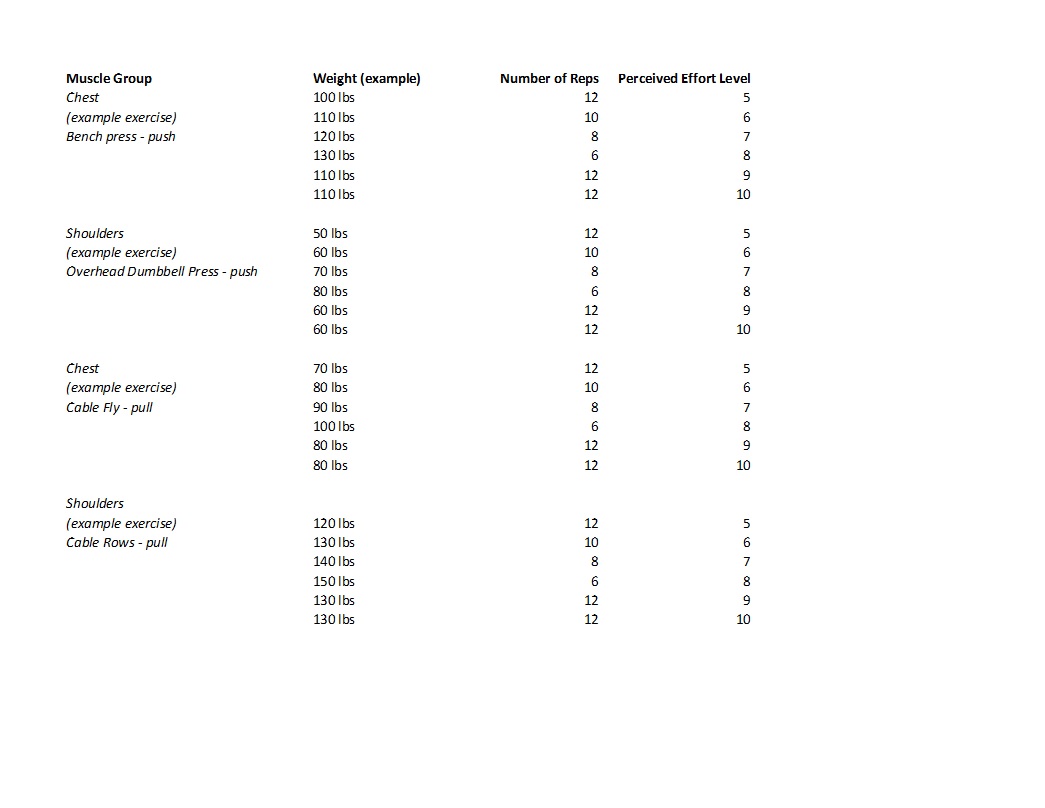
For example, on Monday, you would do four exercises – 2 chest (1 push, 1 pull), and 2 shoulder exercises (1 push, 1 pull). Then for Wednesday – four exercises, 2 triceps, 2 leg exercises. Friday it’s back & biceps. And then Sunday it’s abs & pick-a-muscle group; since I have listed an odd number of muscle groups, in an even number of days you’ll have one extra muscle group. That’s the time to pick whichever muscle group you feel is weakest & work on that. Viewed as a chart, your strength training sessions might look like this.
Bear in mind, that this is just an example structure. You could, if you liked, work one muscle group per day in rotation, narrowing the amount of time each day you work but doing strength work every single day. You could group three muscle groups into one day, loading up your day but keeping down the number of days you’re concentrating on your workout. As a matter of fact, approximately every two months you should differentiate your strength training sessions. Choose different exercises, try a new training methodology, whatever you like. Two months is the approximate amount of time that your body will acclimate to a routine – changing it up is very important in order to continue to physiologically stimulate growth. As well, routine becomes boring psychologically. This disincentivizes you to work on strength. Whatever you change, be sure to do some type of strength training. Don’t let the best be the enemy of the good – any non-injurious strength training is better than no strength training.
On that chart, you’ll see a very important number, which isn’t weight or reps. It’s your subjective effort level. This level is a way of expressing how much effort you’re putting in. Similar to blow calling, this is a subjective methodology marked by a couple of objective criteria. A ’10’ on this effort level scale is ‘failure to complete’. That is to say, if you have to pick up 100lb weight 12 times, and you cannot physically complete the set, that’s a 10. An effort level of 5 can be marked in some people by the feeling of muscular engagement; “I picked something up and it felt kinda heavy”. When you begin your weightlifting regime, you’ll take a couple weeks to establish your subjective effort level. This normal.
However, as you’re establishing your subjective effort level, there’s a very key difference to remember at the effort level of ’10’. Being physically incapable of lifting something again, and telling yourself you can’t lift something again are two different things. Many people shortchange themselves and think they are incapable of another lift, when in fact they are. Most people are much stronger than they give themselves credit for. This can be displayed when weightlifting with a workout buddy, a trainer, or in front of anyone who’s paying attention. You will lift more weight.
‘The mind is a liar, which will tell you that you’re doing well enough, just because you’re trying.’ – Sir Mordreth of the East Kingdom
Strength for your Discipline
Armor
The armored disciplines in our Society do well to practice strength throughout the body, with emphasis placed on core & upper body strength. Depending on your methodology of power generation, much of the force that you need in order for your opponent to call a blow ‘good’ is channeled through the core – not just your midsection, but your back as well. And considering the weight of the weapons that must be borne, upper body strength is important. A good machine that mimics the mechanics of upper body strength as employed by armored combatants is the cable fly. As well, it may be beneficial to research strengthening exercises performed by baseball players. One example is shown here:
Unarmored
Unarmored combatants in the Society don’t have to worry as much as the armored combatants, insofar as upper body power or core are concerned. Power generation is not the key – fine muscular control is, along with lower body strength. This means emphasis should be paid by the unarmored combatant to strengthen their entire lower body. Leg presses are an easy way to do this.
Additionally, unarmored combatants would benefit from strengthening the muscles in the hand – we are routinely required to manipulate 5-7 lb levers at high speed in a very precise way. Much of the imprecision that new fighters have with their tip comes from a lack of suitable musculature in the arm and hand.
One way to easily build hand strength is to take your local newspaper, and unfold it completely flat on a table. Rest your hand with your palm flat and your fingers splayed at the center of the newspaper. Using only one hand, crumple the newspaper into a small ball and throw it in the recycling. Repeat thirty times, three times a week. Squeezing a racquetball or tennis ball can also be beneficial. Finally, high-level mountain climbers spend time working on hand strength, and doing research into their techniques may provide suitable directions for improving your hand strength.
Knees
Special attention should be paid to strengthening knee joints for both disciplines. In armor they must bear the weight of additional mass distributed throughout the body. Wearing armor is tough on your knees. For steel combatants the biggest risk is launching yourself at your opponent in an undisciplined way. Pay attention to your form – not only will it preserve your victory, but by not allowing yourself to lean forward so that the knee goes forward of the toes it will ensure that you have a long fighting career.
As far as exercises go, deep knee lunges, performed carefully, will also strengthen many major muscle groups in the leg without compromising the knee. There are also several yoga sequences which may be beneficial in strengthening the knee. Be diligent in your research for knee-strengthening exercises.
Conclusion
There are as many ways to increase your capacity to move mass as there are people to move mass. Given the century of research (so far) which has been specifically targeted towards strength training there is a methodology to suit every body. Different bodies move in different ways and discovering the methodology which both stimulates muscle growth as well as keeping you mentally engaged are keys to increasing your strength. Try anything and everything, discard that which doesn’t work for you, and stay engaged with methodologies that do.
Similarly, you must learn to tell the difference between the satisfying soreness of having fully worked out and the sharp pain of injury. If you are experiencing discomfort because you are working hard, congratulations. You are alive. And in this case, pain is weakness leaving the body. Or taco bell leaving the body. Both are equivalent, to me. The delayed onset muscle soreness of having put in a good strength session can be significantly lessened by bodily immersing yourself in hot water – as hot as you can stand it. Hot showers, hot baths, saunas, steam rooms, hot tubs – all of these are not only beneficial but can relieve muscular soreness.
However, if you even remotely suspect you are injured, stop immediately and seek medical attention. Playing through pain is one thing – playing through an injury is foolish.
Strength is relative. Different people express strength in different ways, and although objective criteria are important in establishing benchmarks, taking joy in any achievement you obtain is key in staying engaged in strengthening your body. Never give up, and never stop. Never be satisfied in where you are, and always seek the higher plane.
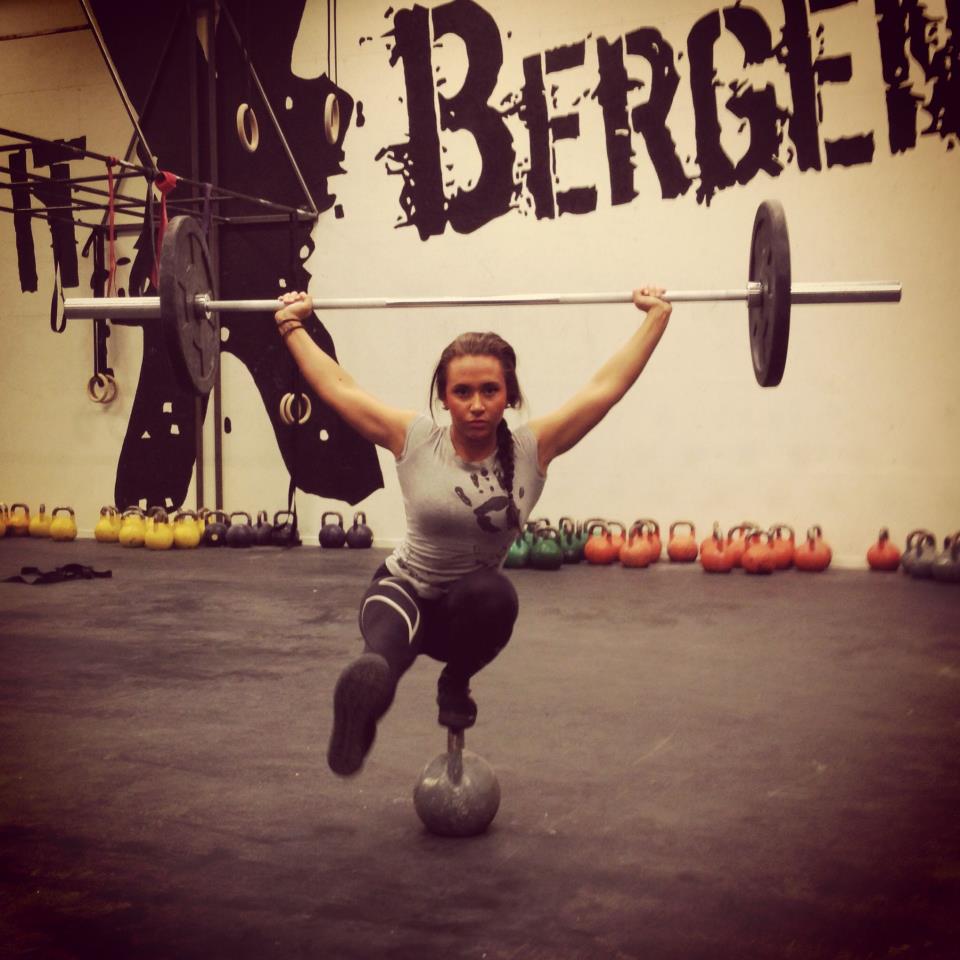
Figure 2; Susan Svanevik of Bergen Crossfit performing a barbell pistol squat atop a kettlebell
There was an Everyman tourney, open to all non-WS. I fought single sword in accordance with my training, per Fabris (which got some compliments. That’s always nice). A number of my opponents did not.
My strategy was, generally, “keep their sword covered, stay at measure, and wait until their secondary is out of position to attack.” This was remarkably effective, owing mostly to the fact that my opponents seemed reluctant to use their secondaries to find my sword or free their own. Remember, readers: Any secondary can be used offensively.
Of course, Maximillian (of Hawkwood) did not suffer from any such misconceptions. Our fight was long, but I was never comfortable committing to any attack; he eventually got my left arm. I was able to force a double (oh look, he’s attacking! Turn to prima and stab his face!) but lost the re-fight. He hit my right elbow with a stout thrust, and his apology interrupted my “immediately switch hands, go for the throat!” tactic. Bah. Next time, I will not be stopped by mere courtesy …
Torse, my kryptonite, was also in my pool (as always). He chose to match me, single-on-single. It was a nice gesture, but he should have taken the dagger – there wouldn’t have been any doubt. As it was, I think he still had the edge – he has better control of measure than I do – but for some reason, after playing around a bit, he chose to close. He ended up slapping my face a couple times before stabbing my pants, and I struck him as he went to recover.
There was another fight of note, my last in the round-robin pools. She was clearly a new fencer and clearly unhappy with the way things were progressing. I’d heard her complain earlier about stiff shots. She asked to calibrate. I landed a shot at my normal calibration, which is about as light as I can deliver with good form and a solid, heavy, C&T-capable blade. She asked for lighter. So … I gave lighter. We fought. I could have killed her immediately, but not at the calibration she wanted. With most of my repertoire gone, the fight went a lot longer than it should have and I nearly lost before I had the chance to gently tag her on the mask.
I’m … not exactly torn. I made a decision and I stuck by it: I was not going to give my kingdom a reputation for stiff shots, even if it meant losing the fight (and thus, very probably not making the top eight). That said, there’s definitely a question here: how does one handle a situation where a fighter is asking for a lighter blow than is feasible?
Torse and I went to the double-elim final-eight (of whom, like, five were Atlantian. Whoo!) where I fought a couple non-Atlantian guys with daggers. The first was clearly pulling the bind-and-close strategy. He was successful enough to enter, but I kept bringing my left hand over to stop his dagger. Unfortunately defensive left hands do not win fights, and I was never quite able to take the right tempo to make him pay. The second fight went largely the same way.
After talking to Dante about this I think it’s at least partly about controlling measure better – either retreating along an oblique or closing enough to catch his dagger and run past him, getting a draw if possible.
Oh. Armand bested Torse in the finals to win. Hurrah.
There was court later. Cailin and Torse were made Sea Dragons (’bout time). These two, plus Linhart and Vincenzo, earned Sharks Teeth for their melee performances. (Edit: Maximillian was also awarded a Shark’s Tooth. The Hawkwood unit continues to impress in melees.) Good day to be a Scholar. Giacomo was made Premier of the Order of the Brovosts. Don’t ask.
Friday
Rose Tourney. I fought for Seonaid. That was cool. This tourney was also double-elim. We had 152 fighters. It was grand.
First round fight had a dagger. It quickly became obvious that he was a little impatient, so I waited for his weight to come forward, retreated and gained the blade in the same motion, then finished him before he could recover.
Second round fight was a dona, also with a dagger. She, however, was the picture of “move small to move fast”. She was never aggressive, but always, always covered, moving her dagger in time with her sword. Slow. Methodical. Defensive. Aggravating as hell. I never had an opening I liked. She eventually won off two hand-picks.
Third and fourth fights were similar, against dagger-armed opponents. Both times it was simply a question of keeping measure, finding the sword, and waiting for the right moment. Not much else to say.
Fifth round was Don Avery of Ansteorra. He matched me with single. I’d fought him in Austin back in July, and he wasn’t much different: old, broken knees, very talkative. Likable guy. He was as deceptive as I remembered, frequently slipping out of finds and shooting for hands. My response to the hand shot is to angle my blade away, which is great for defending the hand but not so great for setting up an easy counter. A couple times I had him in obedience, but couldn’t close the measure before he realized it, and ran away. I got a little nervous about the hand-picks, thinking one might get through sooner or later; eventually we closed – at first, inconclusively, but the second time, my blade was too far offline and I dropped my weight (a bad habit I have when people bigger than me close), giving him a draw across the face and my second loss. Blech.
Lessons learned: deal with hand picks. Yes, they’re small, uncommitted attacks, but it’s still a tempo. Instead of pulling my hand away, I can drop the tip and twist into a stringer, then lunge (or close to stretta and force obedience). Just need to make that habitual.
Atlantia did not go on to win this one, but we had an excellent showing from our Scholars. Linhart made the sixth round; Cailin and Torse made it even further, to round eight or nine or something.
Following the Rose Tourney, there was the Novice Tournament. Ibrahim fought there, and did well enough, but it was clear that he needs more sparring time. Never thought I’d say that, being such an aficionado for drilling, but the lessons we’d taught him were getting crowded out by “OH SHIT THERE’S A SWORD COMING AT MY FACE!!” He’ll get there.
There was another round-robin, the Midrealm Tourney, after this. I entered, because I like fighting. My first fight was a knight, in parti-colored red and gold. Dude was strong, whipping around a 45″ like he did. At some point I fell back into an old, bad habit: I tried to find from measure while advancing. He promptly did exactly what he should have – cavazione and strike to the face.
He apologized immediately for hitting me hard. I could not figure out why. I could not remember being hit hard.
The next few fights were plagued by an increasing sense of … off-ness. I developed a headache that didn’t go away. The sun seemed brighter. My feet and my thoughts were not going where they should …
After the fourth round I withdrew from the tourney, trudged back to camp (walking past chirurgeon’s point, of course), and sat down in the common tent.
“Raph?”
“Yeah?”
“What are the symptoms of a concussion?”
Poor guy fixes cars, not brains. After a cursory and clueless moment of staring deeply into my eyes, he recommended I drink a lot of water and take a shower. I did. Then I napped, which was dumb and could have proven fatal. Gentle reader, should you ever suspect that you might be concussed, immediately seek the advice of a medical professional and follow their directions regarding sleep.
About 10pm the headache hadn’t abated, so it was off to the chirurgeon. His opinion was that I was not concussed. The real-life registered nurse back at camp, however, had a different idea. In the end I decided to assume the worst, and did not fight the next day.
Saturday
Although there was a town battle scheduled, most of Atlantia hit the road early. I don’t know how many of us participated.
There was a Cut & Thrust event scheduled, but it turned out to be a guided HMA feedback session. There were four instructors, each fighting a different style. Everyone present fought three bouts with each instructor and received feedback. The C&T was scaled back to “cuts only at the sword” for our heavy rapier fighters. It was a great approach (no focus on winning, no points) and I think the Windmasters folks impressed. Ibrahim was highly complimented – the instructors said he fought as well as some with twice his experience. I am proud. I’d really like to see something like this become regular.
We packed and drove back afterwards, staying the night at Wistric’s house before finishing on Sunday.
And then, owing to my head injury, I didn’t fight for two weeks.