(Posting this here today rather than Facebook. Tomorrow, Facebook. Because I’m pissed, and rather ashamed that some of these people fight for my King.)
I’ve seen a whole lot of butthurt coming out on my friends list, not just from the “People who are on my friends list because they’re in the SCA” but from people I consider genuinely good friends, since The Announcement. I’m a little dismayed because I thought that shit died 10 years ago. But I guess not.
A lot of the butthurt seems to come from negative anecdotes, so I’m going to argue largely via positive anecdote. If the only hard data available (the census) isn’t convincing, then anecdote is what we have left.
If there were not fencing in the SCA I would not be here.
In my first year of marriage, my wife and I needed a social activity. We were spending all our time alone together and just about to kill each other. I liked fencing, and knew of this SCA thing where I could fence. We showed up to a Kappellenberg meeting and liked the group, felt really welcome, and found out Kberg only had heavy practice. So I went to heavy practice and tried it.
I could not sit at work the next day. Two squires, at least one a squire of The Super-est Duke of Atlantia, both since become knights, basically spent practice ass-wrapping me. It was the most douche-y, dick-tacular thing I’ve ever seen. It was a bright shining “Go the fuck away, new person” message from two guys who never, as far as I saw, bothered to actually show up to any of the other Kappellenberg activities except fighter practice or do a damn thing in the SCA out of armor (still, even as Knights). Armored fighting was not, as far as I could tell, actually part of the SCA. That experience is why I’m still really reluctant to fight sword-and-board (love polearm, will fight spear, but not really cool on sword-and-board) despite some pretty awesome experiences with other sword and board fighters.
But those early experiences are what Atlantia’s and the SCA’s armored fighting community is to a great many people who show up.
This inevitably leads to newer members wondering why our kings come, exclusively, from that community, and when they express this opinion in public they receive a great deal of reasoned response explaining the foundations of our tradition, but always one or two absolute douches chime in insulting fencers as a class.
Since my time in the Order of the White Scarf, two kings of Atlantia, both super dukes, have both said “When you need shit done, you find a White Scarf.” In Atlantia especially we have, as a community, set the standard that an Atlantian White Scarf is an Atlantian who fences, not a fencer in Atlantia. You serve Atlantia. Is there the same expectation in our armored community?
In our barony, when shit needs doing you get a fencer. Ruairc, a Free Scholar, answered Her Excellency’s call to autocrat a small baronial event. Adelric, a previous autocrat of Ymir and current baronial seneschal, is a squire, true, but came to us as a fencer first.
And yet, because of the innate hostility towards fencers I, now in my position as a leader in the rapier community, find myself apologizing for the treatment and the attitude and the words of our armored brethren, and then in the next breath asking those same newcomers, who are feeling unappreciated and unloved, to chip in and be Atlantians first, do service, and give back to this Kingdom, despite the words of the armored community, and to pick up spears and fight for their Queen’s honor with the Queen’s Spears. Today we leaders in the fencing community again have to make apologies for the attitudes and words of our fellow Atlantians, who happen to fight in armor, and again we ask our newer fencers to help us make sure Serf’s Uprising runs smoothly, Ymir runs smoothly, the barony runs smoothly, and the youth of Windmasters’ are welcome into the SCA.
Lastly, we are an historical recreation society. We celebrate the historical accuracy of our garb, appearance, food, behavior, and love. Yet central to it all is the list field, where two very modern sports happen – Armored Combat and Fencing.
Fencing has spent its life making great strides towards historicity. We replaced our epees with rapiers; replaced Olympic technique with the teachings of historical masters like Di Grassi and Capo Ferro; we’ve added cut-and-thrust so that we can more fully practice the historic exercise of arms.
Ass-wraps aren’t historical for armored combat. Face thrusts are (see Jeu de la Hache or Talhoffer for more information). Which one gets banned at Crown? Rapier’s more and more about period style. Armored is more and more about who can survive the most concussions and rotator cuff tears.
In the face of rapier’s increasing historicity I’ve even seen the incredibly specious claim that rapier was the weapon of ruffians and knights didn’t use them.
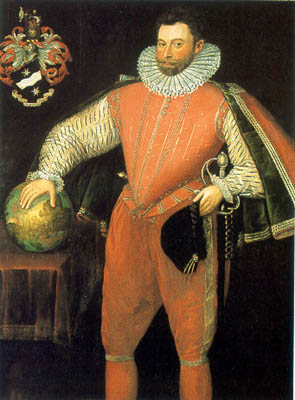


Sir Francis Drake, Sir Walter Raleigh, and Robert Dudley, Earl of Leicester, as knights and nobles of the 16th century, were expected to know how to use those “car antenna” hanging on their hips.
The chivalry, it has been said, feels itself to be “First among peers.” It should be. But just as one earns, by his own hand, the title of king, the chiv must continue to earn their primacy. Rapier has been getting shit done and making the SCA a better, stronger place, with fresh energetic blood serving in all areas of our society, and our work as a community is being recognized. Rapier has not been making entire swaths of newcomers feel unwelcome, unappreciated, like second class citizens, or like punching bags there for the entertainment of the squires. Try saying “Thank you” instead of “Fuck you.”
I’ve actually been meaning to write up my own Ruby Joust experiences since the day of, but haven’t quite been able to get a grip on it. So here’s a shot…
I lost. By my own standard I fell very far short of what I expect to achieve. I did not make it out of my pool. I had 2 losses. The people who advanced (Aedan and Celric) had either 1 loss or no losses. I lost to Celric (who surprised me by not being shlubby like he was a year ago) and to Jean-Maurice (who lefty-prima’d me over my guard, the bastard).
There are lots of reasons (head wasn’t in it, shoulder wasn’t healed up yet from the hits I took in April, etc) but they don’t stop me being grumpy. I expected to win the entire damn thing, would have tolerated going out in the semis against Aedan or Dom. The quarters would have been insufficient. So going out in the pools? Painful.
Losing sucks and it doesn’t get easier when you get better it actually gets worse because you don’t just think you can do better you’ve done it. It’s even more infuriating that in the bearpit tourney immediately after the Ruby Tourney I destroyed everybody (including Celric, who had finalled against Aedan, and Dom), so not only can I fight that well, but I could fight that well, that day. My body and my brain just decided it needed three hours of fighting to warm up.
The Private Brain Care Specialist talks about fear of loss and coping with loss: You manage what you can and recognize that some things are beyond your control. You can control whether or not you’ve drilled your lunge, you can’t control whether or not the first fight you pull is Aedan. So there’s the things worth beating yourself up over, and the things you beat yourself up over even though there’s no point to it. Like my fight with JM – he did a beautiful move that is entirely to his credit; I can learn from that fight, but he earned the W. Same with Celric.
Here’s the part where I try to tie it in to moving from Atlantia to Meridies at the end of December. But I got nothing clever for that. More loss, more suckage. Still, Meridies, I will be in you, and in the interests of this blog, I hope you like melee.
I’ve been doing a lot of thinking about this recently. These questions are getting at some pretty subtle distinctions, if they exist at all – I suspect Dante, given his trollish mien, might answer with a single word.
Why do you study HMA? What is your goal?
What’s the draw? Broadly, are you informing your own ability to spar (and win) with historical material? Or are you attempting to resurrect history, to fight, in mind and body, as nearly as would a person from this century and that nationality? Is it a performance art, a ballet of swords, substituting Plate 1 for First Position, etc? Or is it more of a puzzle to you – figuring out why people did such-and-such thing, or conceived of the fight in such-and-such a way, and why these are viable solutions within the constraints of physics and body mechanics? (There’s overlap, of course, but I’d like specifics.)
How do you study HMA? What is your methodology, and why is it effective vis-a-vis some other method?
Broadly: translations, interpretations, or original text? How do you work through a text? What does the process look like, in detail? Is it better to learn the history and traditions overarching a specific system or weapon, to fill the gaps created by assumed knowledge, or are those better filled by free-play and experimentation, devoid of preconceptions? How do you resolve confusing or contradictory text or plates? Is the text a “master” who is always right, or a “guide” to show you how to develop a fight of your own?
How much credence can we even give the texts we use, knowing that teaching via a book was something of a new idea for much of period; that they’re incomplete; that it might not progress in a neat stepwise “curriculum” style that we’ve come to expect from modern pedagogy, opening the door for mistakes; and that many masters were deliberately cryptic, their illustrations stylized? How do you avoid false positives stemming from a too-close reading of the text or pictures? How much weight can we give to modern interpretations, many of which are still first-generation and done by enthusiasts rather than professionals?
How does your chosen methodology support your reasons for studying in the first place?
When do you know you’ve reached your goal?
Given that combat is analog, and art is digital (maybe even binary), how good is good enough? How many iterations are required until you can profess true understanding?
Convergent evolution: n, the appearance of apparently similar structures in organisms of different lines of descent.
Essentially reaching the same solution derived from two different starting points. The advantages created by flight lead bats, birds, and butterflies to create wings.Visually the wings appear similar: large, thin shapes to help the creature fly, but structurally they have little in common and have developed from very different initial starting points. The development of flight in each of these creatures is vastly different, but the end result is successful flight
Ok that is great and all Letia, but this is a Fencing blog, not a biology blog….
So more on the Fencing:
As some of you know I have been studying Fabris for a bit. I also fought in the SCA for years before picking up any sort of historic fencing manual. (Historical fencing is challenging, frustrating, interesting, dynamic, crushing at times… but most of all it is game-changing.) The thing that has changed the most about my fighting is I “see” the fight differently than I did before. Some people seem to have an innate ability, some from strip fencing or other martial art forms, some from fencing long enough to discover it, and some from studying historical forms.
I went to Pennsic this year (Actually this happened at Pennsic 41, but I have been a slacker about posting and was reminded to post during a fight last week), and got to fight a number of excellent fighters, a few who study a historical style, and many who do not. Trapon is a fencer who does not fight based on a historical style. I did some pickups with Trapon the day after discussing Fabris dagger positions.
I threw a cautious shot towards Trapon’s shoulder he blocked with a beautiful high dagger fourth guard… and I thought “OMG Trapon just did a plate from Fabris, and Trapon is not a historical fight… there is convergent evolution in the movements of upper level fencers who study historical fencing, SCA style fencing, and strip fencing!” All this was thought as I was stabbed in the face.
Many of the concepts that people have taught me come from different disciplines and backgrounds of fencing. As I have studied Fabris I have found more similarities to theories that Percy (who has a strip fencing style) has explained to me, or Conner (who has a “gypsy” style) has demonstrated , or various other fencers who avidly claim “I don’t do historical fighting” have taught. The origin of the idea to use a specific hand positions or blade angle differs but the end result is the same position.
So while Trapon, to my knowledge, has never cracked open a historical fencing manual, there are only so many positions that give you an advantage in a fencing bout. He and many others have discovered the same motions and theories of historical fencing through other methods. I am curious how many fencers gain a mastery of, say, blade mechanics through a “these are the historical principles of fencing; I will do them” approach vis-a-vis discovering motions that work, and repeating them, vis-a-vis acquiring an innate understanding of what works through years of practice and experimenting. I think a combination of all three is most likely what leads to success, and everyone finds the combination that works best for their learning style. It seems that successful motions in fencing, like successful flight, can be reached through various different initial theories that in the end look very similar.
So, with the appearance of apparently similar movements in fencing from different origins of ideas, regarding practices and theories, can be seen as the convergent evolution of fencing.
On Tuesday I was fortunate enough to make the local practice for the barony of Bryn Gwlad, kingdom of Ansteorra. Interkingdom fencing never fails to be educational. Bryn Gwlad follows the tradition of having everyone meet up at the same spot – heavies, fencers, A&S folk, socialites. The evening was made more enjoyable by the music. Props for the integration.
The first thing I learned: if you’re going to fight out of kingdom, it’s not a bad idea to bring garb. Fencing was not my primary reason for travel and I saw little reason to bear the expense and trouble of another checked bag; but my Underarmor and T-shirt did not impress, especially since most everyone else was in at least a doublet. Despite Caitlin’s talking me up to the locals and (I would hope) bearing that out-of-kingdom exoticism, nobody seemed to take me seriously until I started killing.
As I was getting armored, the question came: “shouldn’t we tell the new guy about Ansteorran conventions?” “Nah, he’s Atlantian. He’s not from the East.” Ansteorrans seem to like their fencing much as Atlantians do. Their calibration might be a touch lighter – nearly every iffy shot I inquired about over the course of the evening got an “I thought it was good.” Eh, not a problem.
There were a good number of those, however. I’m not sure if it’s local to Austin, or the influence of epee or of general inexperience, but a lot of my opponents seemed to prefer the larger species of parry. Pretty much everyone (even the lefties) seemed to heavily favor the inside, so I spent most of the evening in fourth; after tweaking my form following Dante’s advice, I had a lot of strength in that angle. They may have been fighting against the angle with more force. I think it’s Giganti who recommends dui-tempi actions against the forceful approach; I took the advice and adapted well enough but was having trouble re-closing the line completely after a large cavazione, and only a few of my fights were completely clean.
It might be this particular practice, but the Ansteorrans seem to love them some bearpits. We had 14 fencers at one point, with just the one ‘pit and a couple guys off singles fighting. It seems an odd approach to me, one that gives the least skilled fighters the least fight-time.
But it made for some good showing off. Twice, I nearly held the pit for a full rotation. Cardio would have made the difference, I think; the weather was only slightly worse than KBerg practices (despite starting an hour later) but I was tired from the previous day’s swimming and hiking, and flagged fairly quickly. My first run ended with a double-kill to a quick lefty, when I decided that closing the line fully would be too much work. In my second run, I got through Don Tyvar Moondragon’s guard three separate times, and three times, my tip slapped his head instead of going into it. Eventually he made me pay.
There were only two other Dons there. I enjoyed my passes with the first, a thoroughly welcoming and jovial fellow by the name of Avery. I think I went about 60% on him; he had a nasty trick of allowing me to come into a counterguard and advance, and dropping his point at the last possible instant to escape the lock-out, then burying it in my chest and voiding his head. The second Don, Connor by name, was not in armor but spoke to me at length about his WMA school. It’s always wonderful to see more HMA. Moondragon shortly went off to marshal a heavy tournament (another somewhat bizarre feature of this practice), and Don Pieter didn’t show. Maybe next time.
There were also a couple cadets. One of them was fighting di Grassi, and well enough from what I could tell, but seemed to take my extended sword as an invitation to attack it, to predictable effect. The other, a lefty, posed little challenge with a single sword, but also professed little practice and a strong dislike for that form; when he picked up a dagger all we could do was double-kill each other. I’d feint to open up the dagger side and disengage to find the sword, but he seemed to anticipate it pretty well and move his sword to a new line in the same tempo, and follow my body as I tried to void.
Despite having over a dozen fencers, there was no mention of melee. I think melee at practices might be an exclusively Atlantian thing. I cannot fathom why.
On the whole, a good time with good people. Highly recommended, and I hope to get a chance to see everyone again at Gulf Wars.
Driving back from Champ’s practice, Gawin and I got to talking about advanced melee tactics. It inspired a little more thought along a line I had previously touched upon.
I mentioned in my Stierbach BB post that I thought analyzing a 2v1 as a microcosm of melee could be a valuable exercise for informing melee pedagogy. I have since amended my position:
2v1 is not a microcosm of melee; 2v1 is melee. There is only 2v1.
This is a bit of a logical leap. It’s worth spelling out some of the basics. A 3v2 is, really, the same as a 2v1, even if neither unit splits. At some moment, one of the 2 is going to have to occupy or deal with two of the 3 simultaneously. There’s no way around that. 4v3, 5v4, etc, it all reduces to a 2v1 somewhere, somewhen.
And in a 5v5? When a line fighter retreats, he’s created a momentary 2v1 against his own line. When a line fighter lunges or advances, he’s created a 2v1 against himself. When the line as a whole buckles and folds into itself, and the enemy surrounds? That’s several 2v1’s.
Now I find this very interesting, because this is exactly how offensive strategies in lacrosse were characterized by my father (who attained national recognition as head coach of Duke lacrosse back in the 80’s). Put simply, the offense creates a 6v5 by temporarily taking one defenseman out of the equation; they want to reduce it to a 2v1 as quickly as possible to get the best chance to score.
In lacrosse, there are two basic ways to do this: either by exploiting a skill mismatch (the attackman uses footwork, quickness, or deception to get around a defenseman he outclasses) or by coordinated movement among the offense (several attackers use footspeed to outpace their defenseman, confuse or flood their zones, etc. The classic “running a play”).
In small melees, we have the same options available. We can look to isolate an enemy fighter against one of our best, hoping to create an unfair matchup and win what is essentially a 1v1 fight, which converts to a numerical advantage over our opponents as a whole; or we can move in a coordinated fashion (i.e. maneuver) to create a local and temporary 2v1, which we then exploit. In the final analysis, all maneuvering is ultimately for the purpose of either creating 2v1 situations, or foiling our opponent’s attempts to do the same. (Uncoordinated movement, such as the collapse of a line, usually accompanies a desperate or panicked attempt to avoid a 2v1. Delicious irony, and the closest we ever get to enjoying a rout.)
No good 5-man team remains stationary and linear–they always have a plan to create 2v1 situations via maneuvering. Even the Black Tigers regularly maneuver in such a way as to avoid and interdict 2v1 situations, because they are confident in their ability to win a series of 1v1 matchups.
Melee does, of course, incorporate other aspects. C2 and field vision are important. Static lines do occur and are necessary for holding objectives, and when the line is arbitrarily long, it’s going to fight a little differently–but only up to the point where one side gains a local advantage in numbers, that vaunted “tempo of acknowledgement”.
As far as training solid melee skills at the individual level, it all comes down to knowing how to 1. recognize and exploit a numerical advantage, and 2. recognize and deal with being outnumbered. 2v1 or 1v2. Everything else–unit formations, commands, maneuvers, tactics, strategies–is built up from this.
So … we really ought to train that more.
I’ve been discussing actually working out my Derivation of Fencing from First Principles for a while now. Well, actually, just First Principle. And, there being no other, it isn’t actually The First Principle, just The Principle.
So, Derivation of Fencing from The Principle.
What is The Principle? I suppose I should actually clarify that:
Stick the pointy end in the other guy1
Is it in fact The Principle, or even A Principle? For our purposes, we will take it as though it were, and see if it holds up to testing. Therefore, The Principle is the thing which shall be done, nothing that does not obey The Principle will be done.
There are four elements to The Principle which shall be dealt with individually:
- Stick
- The pointy end
- In
- The other guy
1. Stick
- One sticks by poking, not by cutting. Ergo, thrust. Don’t cut (yes, The Principle has a decidedly Italian Rapier bias).
- Any other movement of the Pointy End is not sticking and should be eschewed.
- Any extraneous motion, including thrusting motion begun too far away, should be eschewed.
- Any wasted time should also be eschewed, therefore move your point along said line by the most expedient manner2
- Therefore, you should stick along a line describing the shortest distance between The Pointy End and The Other Guy.
- Don’t do anything else with the pointy end (like, parry)
2. The Pointy End
- You attack with the Pointy End. Not with the edge. Not with the off-hand. These are not Sticking the Pointy End in the Other Guy.
4. (yes, skipping 3, for now) The Other Guy
This has two sub concepts:
First, the concept of The Guy –
- Attack him, nothing else (like his sword).
- If he positions his sword such that you are no longer attacking The Other Guy but instead his sword, then change to an open line and continue. This is not an extraneous motion of the point, because it will be done while continuing to move your point towards The Other Guy.
Second, the concept of The Other –
- Pointy ends should go in him, not you.
- If he tries to stick his pointy end in you, prevent it.
- Don’t retreat, it moves the pointy end away from the other guy
- Can you defend with the off-hand? Only if the action of doing so does not interfere with the action of sticking your pointy end in the other guy (by, for instance, occurring before you stick the pointy end in the other guy, or by causing your body to rotate such a way that your point goes off line or is pulled back from your opponent).
- What about the non-pointy end? Why, yes, you can defend with that. How? In such a way that gravity, geometry, mechanics, and physiology are to your advantage, elsewise he might stick his pointy end in you.
3. In
- Make it go in. Position your arm, torso, and legs such that you maximally propel the point in to your opponent.
Yup, a whole lot of cheating via prior knowledge. More a personal guide for Socratically teaching fencing to STEM newbs.
Did I miss anything?
1And Dom is probably twitching now.
2Which, with experimentation, turns out to look like extending your arm quickly followed by an explosive large step through measure. Or, a lunge. As with the other discussions of this part, it should not waste motion or move the tip other than towards your opponent. Moving your foot before your arm moves your point up and down, and should be eschwed. If a lunge is not sufficient to complete the shortest possible path between The Pointy End and The Other Guy, you may want to continue its forward motion by, say, a passing step. Letia.
We had 16 fencers, of whom only two are regular readers of this blog. Some old, crotchety White Scarves insisted that we used to have much better turnout, and that Atlantian melee skills have eroded over the last few years. One is surprised he didn’t hear them yearning for the good old days of epee …
RBG’s Might Not Suck
Much has been made of the upcoming Pennsic Bridge Battle, wherein Rubber Band Guns will combine with limited-front and no-rez parameters. If nothing else, the fight will be very different from anything we’ve seen before. At least the shots are limited: two shots per fight, and fighters may be armed with a gun in only two of the three runs.
There has, naturally, been some grumbling. We’re fencers, we spend all year training with swords, and it’s understandable that we’re a little miffed when we get shot by some no-skill peasant 30 feet away. But them’s the breaks, so Celric had us run through a few limited-front engagements with RBG’s. It turned out to be more interesting than I had anticipated. Over the course of the day, gunners were presented with four different objectives:
1. Aim for their Provosts
2. Aim for their commanders
3. Aim for their flanks, then press
4. Aim for their center, then press
The first and second are self-explanatory. Firing at the flanks, and then immediately pressing your own flanks forward, allows you to form a shallow killing cup on your opponents. Firing at their center disorders their line, because the dead have difficulty removing themselves. This assumes that their dead are courteous enough not to remove themselves through your line, for which there is no guarantee at Pennsic.
Regardless, RBG fire should be coordinated. You want to shoot different people, and you want to be ready to charge as soon as you pull the trigger. Peppering them with sporadic fire is not going to result in significant casualties, particularly if they have shieldmen up front.
(Shields seem to provide an easy counter. In the past, a shot hitting a shield has disabled the arm, but this seems unenforceable for Pennsic and unlikely to be the convention in play. At Assessment we only had one shieldman, so it was difficult to get a sense of how shields and guns might interact. I wonder about dropping into a crouch and firing at the legs of the enemy … although I’m not sure a legged shieldman is considerably less useful than a standing one.)
Despite the complaints, I think there’s a place for RBG’s in melees. Not every melee, certainly; but a limited number of shots/guns/gunners does make for some non-trivial tactical options, decisions, and coordination. And it gives us a chance to play with some toys that rarely see the field–RBG’s and shields. I wouldn’t mind seeing more melees with guns.
The Rest of the Day
We ran several field battles, some with limited rez, some without rez. Initially we had a “battle buddy” system whereby the more experienced fencers would pair off with the less experienced fencers and give them direction, but I’m not sure how well that held up. Not much to say here; a lot of well-known lessons were reiterated for the newbies, but I heard nothing groundbreaking.
We broke into singles fighting and instruction after that. Celric challenged me for his Iron Spike; and despite his broken toe, I crossed with him in three passes. Came out with three losses. I allowed him to control the fight too much and he played to his strengths–speed and measure. A few times, I came a couple inches shy of him; I’m considering a 45″, but honestly I can probably get those inches out of lunge drills.
More interesting was the fight against Alessandro: he picked me apart relatively easily at Ruby Joust, but on Saturday I was definitively ahead. His fighting was sloppy, perhaps owing to fatigue, but at a minimum I showed that I was able to take advantage of his mistakes. Afterwards, Celric mentioned something about fighters who treat fencing as a science (such as Dante, Gawin, myself) vis-a-vis them who treat it as an art (he and Alessandro). I’m not sure what to make of that … the examples of “artistic” fencers strike me as people who find what works for them (or, possibly, adapt techniques from other disciplines) and tend towards improvisation rather than studying fencing as a combat system. I don’t know that I would call it “art”, but it’s effective. Of course, the Renaissance saw art and science as complementary (and, furthermore, defined art as any discipline that followed a set of rules for good performance); so I think the distinction is moot.
Oh, and Her Majesty gave awesome embroidered favors to all the fencers present. Seriously, you should have been there, these things are great. From a distance, they look like gold scarves. Perhaps the intimidation factor will make up for the 4-to-3 odds on the fields of Pennsic.
Cardio
The ARA held up pretty well throughout the day, losing only a couple people by the end. However, it was about 10 degrees cooler than last year, and I think we did less fighting as well.
Gawin and I continue our thrice-weekly Hell Drills, rain or shine. I cannot speak to his motivation, but for my part, I mostly want to spite Wistric, who has expressed doubt in my ability to maintain this regimen throughout July. Three sets the day after Assessment proved to be tough, but on the whole it’s getting easier. Physical fitness, I think, needs to get more play in our discussions of how to improve. It can be done solo, without a sword or armor, outside of weekly practices, and improves more than just one’s ability to fence. Rarely do things work so well.
The Jaunty Lads headed up to Warrenton for a bit of fencing this weekend—a combined eight hours of driving, all for someone else’s baronial birthday. Might be a Foxworthyesque joke somewhere in that …
The event was hosting a pentathlon (A&S, armored, rapier, archery, thrown weapons). Cool stuff, but I have only one skill. For us pure fencers, that translated to “fight a 45-minute multiple bearpit under a 90-degree unclouded sky. Then, do it again.”
The bearpit format worked well. Flaithri (RMiC) awarded one point for a loss and two for a win, and dispensed with the lazy three-and-out paradigm, instead opting for progressive bearpits. Two fencers enter, one advances to the next pit up, two more enter the first pit. Therefore, each progressive pit is, at least in theory, harder than the one that came before, and holding the “top” pit is the only way to maximize fight time.
Of course, the format also suffered a little from bottlenecks, and in the interest of getting more fights, the rules were occasionally relaxed (particularly in the second run, where Gawin and Dante each held their own pits for a half-hour).
Ultimately, the outcome was decided from the start: the laws of probability are far more kind to the most consistently strong fighter than to the Scholar-having-a-good-day. That’s not a bad thing at all, but most tourneys have at least a modicum of excitement regarding the overall winner; even the best Provosts can get unlucky.
So: Dante won handily. Marcellus might have made a strong second-place finish, but he arrived after the first round was already completed.
I fought decently and finished the first run in second or third place, following a by-then familiar pattern of “beat someone, beat someone else, lose to Dante.” For the next round I opted to fulfill a longstanding promise to myself and dropped my dagger on the sidelines, going single-sword for the rest of the day. 45 minutes later, I’d fallen to sixth or seventh. Eh, to be expected.
So, About That …
Some people say that the dagger’s a crutch. I don’t like that term; it has a distasteful ring of “REAL men don’t use daggers” or something, and it’s been ambiguously tossed about on Atlantian RapierNet in recent times. There’s nothing wrong with a defensive secondary from a tactical or a historical perspective, and it can be used to complement, rather than replace, skill with a single blade.
Nonetheless, limiting yourself to the Queen of All Weapons has some advantages in the long run. Unless you’re doing some bizarre dagger fighting, you will always be equipped with a sword and will always be able to use single-sword techniques and principles. Good footwork, tighter form, and a solid understanding of blade mechanics become that much more important when you have to defend and attack with the same tool, and when you don’t have a secondary to close off the line you left open. And training at a disadvantage (fighting someone with a secondary) can open up your mind to trying new techniques or tactics to level the playing field.
So for the next, oh, six months, I’ll be fighting single-sword exclusively, focusing on enhancing my understanding of finding the sword (particularly through instantaneous tactile feedback), contracavazioni, girate, and all the other things I just sort of ignore when I have a dagger to do all the defensive work. And since it’s in print now, I’ll have to stick to it. The only exception is for melees, when I’ll pick up the dagger once more; there are many more angles available to multiple opponents and taking a single sword is too limiting in a game that favors raw point density.
Two-Vs-One as a Melee Microcosm
For some reason utterly incomprehensible to me, there were only a handful of fighters willing to run around after our hour-and-a-half of sun-drenched bearpits. Cardio, people! As is my wont, I made sure to squeeze in a little Bruder-inspired melee instruction. Our scenario was 3v3 CTF with rezzes, which frequently broke down into 2v1, so after a couple runs I invited those few fencers still standing for a short lesson on handling 2v1s, from both perspectives. As I was teaching, an epiphany hit me.
We may be teaching melee the wrong way.
Our usual approach, to be honest, reminds me of certain bad didactic methods present in a lot of education today. We start at the line-vs-line level and teach rules. We have reasons for these rules, and our rationales make sense, and our students nod their heads, but because they haven’t learned these lessons from experience, they have difficulty understanding, applying them to new situations, or spotting the exceptions.
We tell them not to die, and it’s all they think about. We tell them not to let their friends die, but they don’t really know how. We tell them to kill the enemy, but they’re so paralyzed by the first two rules and the prohibition on lunging that they just sort of stand there, afraid to move and potentially expose themselves. And it doesn’t help when a Gold or White Scarf, with a little more thorough understanding of these “rules”, goes and breaks them all, because he knows when and how.
But what if we start at the most fundamental level of melee, the 2v1?
First, this creates a difference in how students approach and perceive the fight. That contemptible illusion, “a line fight is just a series of single fights”, is impossible. No longer can fencers conceptualize of the field as two large, mostly static groups, nor a series of pairs; the dynamism of melee is instantly recognized.
Second, the “rules of melee” that we lecture about in professorial tones emerge naturally with a couple run-throughs. “Don’t Die” is easy enough. Assuming the 1 is a more experienced fencer, “Don’t Let Your Friends Die” becomes pretty obvious for the 2; if you let your friend die (and don’t immediately get the kill), you’re soon to follow. Furthermore, the WAYS you keep your friends alive also emerge: stick together; attack him together; fall back when he threatens you, press when he threatens your buddy. “Kill the Enemy” comes up, obviously, especially if you’re using a reinforcement drill or put a time limit on the 2. Likewise for “Remember the Objective”, particularly when a fencer realizes that his survival is unimportant if it leaves the target exposed for long enough for another to get the kill.
Other things 2v1 organically teaches: good order/spacing, communication, sweep/stab, possibly awareness of terrain, how to use numbers effectively …
Oh, and 2v1’s are that much more appealing to smaller practices.
We’re rapier fighters. Skirmishing is the most natural thing we do. No good 5-man team just sits there and pokes at hands. Why start with boring, static lines? Build up from the bottom.