This past weekend, Wistric, Aedh, Tassin, and myself drove up to Dante’s for the second of his Champions practices in Fredericksburg. Saturday was a tad bit rainy, but it didn’t really rain on us much. Fortunately it was quite a bit warmer than the last of these. In addition to the 5 of us, Brian De Morey, Dominyk, Simone, and Benjamin showed up. Because of the numbers, Dante opted for having people work some individual things rather than the planned mock champion’s fights.
I got some good feedback that included a few corrections to my guard from Dante and a suggestion that I attempt to “mimic” how certain provosts fight in order to learn how to respond. Interestingly, last night I realized that this was the exact same recommendation that my former roommate gave me regarding League of Legends. So, Ruairc, as a free scholar I think you should play League of Legends.
How did the practice go for the rest of you? What did you take away from it?
K’berg put on a small local event this weekend basically meant to be just fun, because lots of events tend to be about something else. I was working Gate the majority of the day, so somebody else will have to talk about the fighting.
Somebody else, take it away…
First of (hopefully) a series, to revenge myself ironically on Letia’s ill-conceived term “plateify”. (Don’t ask.) I’ll be taking a plate each week or so and drilling it, then presenting my findings here.
In this episode, I attempt to ameliorate my abysmal oblique footwork. Fabris seems fairly consistent in advocating an offline step to the outside when attacking or lunging to the outside, and I need to work on my outside game anyway, so it seems a good place to start.
The play itself is quick, but there’s a fair amount of detail.
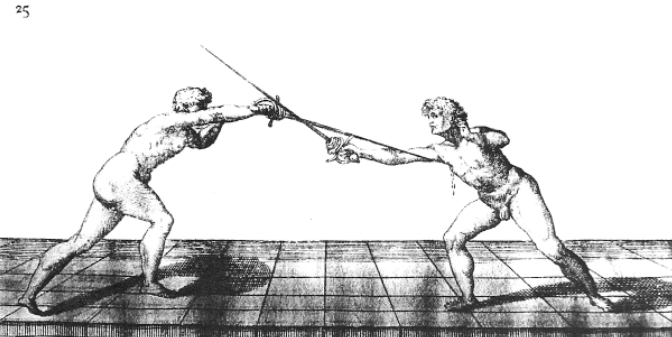
Agente and Patiente start in terza to the outside, at long measure and parity.
Agente
Push the right foot forward
Forcefully press against Patiente’s sword to push it out of line
Patiente
Resist pressure, turn to prima
Push right foot forward and offline to the left. Strike (plate)
Bring left foot behind the right, and recover to guard
Drilling Correctly:
– Properly performed, Agente will cause his own sword to be found; once Patiente turns to prima, Agente’s pressure against the blade will cause his debole to slide to Patiente’s forte. Patiente must drop his point to achieve this angle (see illustration).
– As is often the case, the drill must be done with some speed and intent to work properly. Train up the footwork first (as the offline step is a bit foreign to most fencers) so you can do it without thinking and focus on performing the bladework in the correct tempo.
– The drill can also be performed with the fencers starting in seconda, with no changes.
– The offline step strengthens Patiente’s angle and is especially important for landing a killing shot when both fencers begin in seconda.
– If Patiente is wounding the shoulder or under the arm, you’re doing it wrong (probably failing to drop the tip when Patiente turns to prima). The strike should come over the arm and land somewhere in Agente’s chest, no higher than his neck.
– Note Patiente’s posture in the illustration–specifically, he is very upright. Falling into a too-low lunge can foul the angle created by turning to prima.
– As in all things, hand before foot. Pushing the foot forward before turning the hand usually causes both blades to become locked in each others’ quillions. It’s ugly. Don’t do it.
– This plate beautifully illustrates the maxim “the blade is stronger on the side to which it points”.
Expanding the Drill:
– Once you are comfortable with the movement, have Agente apply less and less pressure, for less and less time to train an automatic, instantaneous reaction triggered by the slightest pressure on your blade.
– Turn the drill into a pressure/no-pressure drill to the outside–but instead of disengaging or yielding around Agente’s pressure, turn to an advantageous angle (prima). Do the same to the inside.
– Performed in the proper tempo, Patiente’s action is a counter-find. Have Agente find Patiente’s sword with his initial step in addition to applying pressure; Patiente must counter in contratempo, or his blade will be taken off line immediately.
Notes:
– Fabris mentions very little about the footwork here; his only note is that Patiente is taking the offline step. Due to the illustration of Agente’s front foot and leg, and due to the fact that no intelligent fencer will press on his opponent’s blade for any significant length of time within measure, I inferred that Agente’s pressure is understood to come in the course of an earnest attack to the outside. Likewise, the footwork behind Patiente’s recovery is not mentioned; but the raised left foot in the illustration and the principles of Italian fencing suggest the interpretation I have given here.
Questions:
– Patiente’s offline step necessarily brings his right leg and hip to a different angle (pointing off to the left rather than straight at his opponent); does the right foot stay in line with the leg and hip, or does it stay straight and not change its angle? The former feels a lot more stable and seems more in line with Italian principles of good body mechanics; but the latter seems to give a little more reach and seems to fall closer to the plate’s illustration.
– Is it possible for Patiente to pass with the back foot rather than stepping with the front foot? When is one better than the other, and why?
– Fabris uses “pushes forward” to describe Patiente’s footwork here. Elsewhere this verbiage seems to describe a lunge. In drilling this plate, however, a lunge did not seem to work very well, and I’m at a loss for a good reason why. It may have been due to the height difference between the fencers … due to the importance of the angle formed by turning to prima, I’m not sure the play works if Patiente’s forte is not higher than Agente’s.
– Looking at the details of Patiente’s footwork, does the toe of the right foot leave the ground first, as for an advance or a lunge? Does the heel leave first? Or does the whole foot move as one? The “pillar and buttress” model seems to cause the weight to naturally shift forward when the toe leaves first, which is great for a lunge or a pass … but here, Patiente is not looking to move to the side, not forward.
So, philosophical question, because I’m of the mind “run to and run back and then rest where you can see what’s going on”, even if I don’t always do it:
“Run to rez, run back (unless it’s an hour-long melee. Then only run if it’s important.)”
How do we help our newbs understand when it’s important and when they can take their time?
Dante was sniggering last weekend because, after teaching The Basics of Line Fighting and expounding on the virtues of the first three Rules and guidelines like “don’t lunge” and “don’t step back”, I proceeded to, in his words, “break them all” when we actually began fighting. Now, like a certain “i before e” maxim, these Rules of Melee and related aphorisms are oversimplifications intended to instill good fundamentals. They are baseline behaviors, things we expect line fighters to prioritize, and they will rarely steer you wrong, but they are not the full picture. Teaching fighters to recognize the exceptions, and how to respond to them, is the business of instruction, practice, and good didactic methods.
With that as our guide, we define the rule here as “if it’s a long melee, walk to rez and back.” The exceptions take some expertise to learn and utilize. Newbies, bless their hearts, aren’t very likely to have that experience.
Therefore, my answer to the question is: run if your commander says so.
… What, you want more?
Fine.
On any battlefield appropriate to 30 minute- or hour-long melee, the rez points are likely to be a little distant. Running to rez and back takes a lot of energy. I only want to run if it will help my team immediately gain or preserve a strategic advantage. So when I die, I am going to ask myself the following questions:
1) Is an objective (for my team or theirs) immediately threatened?
If the fight is pretty stable, with two lines about a meter apart growling at each other and taking occasional pot-shots at hands or feet, and no flag checks anytime soon, then nobody’s really going to miss me. If the line guarding our flag is about to get munched, or if the enemy’s got reinforcements incoming and we don’t, I might want to hurry.
2) If so: can I provide significant assistance to our team in taking/holding that objective?
If our numbers are much greater, my line probably won’t require my prowess in the immediate future, and I can take my time rezzing. On the flip side, if the enemy got into our backfield, and our line is utterly demolished, it’s better to regroup near rez and saunter up together, as a unit, than for me to sprint to rez and back alone. Generally, running is only a good idea when the forces look pretty even, and my presence could be decisive.
A telltale sign: I hear somebody yelling “fall back” or “die slow” near an objective. That’s either my team or the enemy team fighting a delaying action; if it’s the enemy, I want to get in there and kill them all before they can get reinforced. If it’s my team, I want to reinforce as quickly as possible!
3) If so: after running to rez and back, am I going to have enough energy to fight effectively?
Or: do I have the footspeed and cardio to make that rez run and return to the line in a controlled, orderly fashion, and maintain the ability to fight not just for the next pass, but for the rest of the melee? If time’s running out, there’s no reason to take it slow; but sprinting too much, too early can leave you a step behind for the rest of the fight.
It’s fairly rare that one should be running to or from rez in an hour-long melee or similar–which is why I think it’s better to listen for particular orders (and make sure commanders know when and how to give those orders). Of course, the easier solution is to train up cardio …
I didn’t go, somebody else who did should sound off on how it went, what they thought of the scenarios, etc (Tassin, I know you got thoughts)
How’d it go for you?
(One of these days somebody else will do an event post mortem…)
The day’s fighting broke up in to three pieces:
Part 1: Woods Melee
First was an hour or so long woods melee. There were three capture points along the center of the field. Each side had three flags. A capture point was only captured when a team’s flag was in it (the capture points were PVC tubes for the flag poles to go into). The enemy could pull the flag out of the capture point, at which point it would have to go back to rez before coming back out on to the field.
Halfway through we switched ends of the field. Possession was checked randomly (and unannounced) throughout the battle.
The “North” side was lots of little pine saplings and muddy ground between rez and the flags. The footing was really crap. But the rez point was closer to the flags
The “South” side was much more open and firm, with clear sight lines and lots of paths through the trees. The rez point was further away to compensate for the better ground.
Jean-Maurice, RMiC, split up the scholars, free scholars, and white scarves relatively evenly, and did a good job of balancing the sides.
His prep work in laying out the field, and judgment in balancing the sides, paid off: The teams tied at the end of the hour. Blue, which started off on the South side, had more heavy hitters, but they flagged after twenty minutes or so. Yellow, starting North, had a lower average skill level, but a ton of cardio (the three Green Scarf Lads were over there) and were able to push the fight to the end. This showed up in the scores: Blue won the first half by a point, Yellow won the second half by a point.
From my spot on the Blue team it looked like great fighting. The trees were a little denser around the western flag, the ground much more open around the eastern flag, so there were some steady line fights mid-to-west, and lots of skirmishing on the east, with massed charges carrying the point, then being attrited or redistributed, and overwhelmed by a counter charge. I spent most of my time either skirmishing on the eastern flag or hunting Mattheu, because Welcome to the Order, Sucker! (Oh, yeah, Mattheu’s a White Scarf now, got made right before the fighting started).
A few takeaways for me:
Make everybody sit down when giving the briefing. Some White Scarves are given to standing around talking instead of listening to the RMiC (CERTAINLY not me) and we, er, they had no idea what was going on and had to ask again. Making everybody sit means everybody can see and hear, and be seen and heard.
Then demonstrated DFB, even if everybody’s done it a thousand times. There’s a guy who’s been authorized ten years who did it wrong during the battle. He probably should’ve had his card yanked, but we can’t be sure he saw the DFB briefing and just ignored it, or didn’t see it.
Don’t charge Ruairc, even if he really has it coming. I kinda hit him hard in the face. Then I kinda tripped and landed hard on my shoulder, and my rotator cuff is very irritated. One of these I regret more than the other. I’ll be sure to tell you as soon as I figure out which.
Cardio. I haven’t been hitting the bike as much as I’d hoped to (only once a week or so), due to health issues around the house the past month. But, it’s 70 degrees in the morning here now. Really no excuses.
Queen’s and King’s Champions Tournament
After the woods melee a tourney was held to determine the Queen’s Champion, with the runner-up to serve as King’s Champion. I’d been debating entering it, but figured I couldn’t in good conscience serve as QC without going to Pennsic (I was more flexible on KC and Pennsic), and could not in good conscience fight any less than my best, which meant a decent risk of screwing with my conscience. I’m 99% skipping Pennsic this year so She Who Must Be Obeyed and I can go see the Mair fechtbuch in Munich in October or so. There’ll be other reigns, hopefully.
As a result, though, I got to marshal the tourney and narrate the finals fight for Their Highnesses (Dante vs. Giacomo). Giacomo took it after five passes.
Charity Tourney
The fighting wrapped with the charity tourney. However, I wasn’t around to participate in it because I was off defending the Iron Spike which I picked up at Defending the Gate. Faced Gawin, Geoffrey, Raph, and Colin, and still have it. I’m liking having the thing, because it means I get challenges from people who genuinely plan to kick my ass, and aren’t busy cursing the Luck of the List. The result is great fights, and I was tuckered out afterward.
Given the slew of nigh-contiguous rapier melee events promised by the coming weeks and my stated desire to increase both the quality and retention of Scholars in the ARA, I have taken to teaching a short, basic class to recently auth’ed fencers at each melee event I attend. As an unfortunate incident involving a sickle recently demonstrated, the principles of one form of combat may not be wholly appropriate to another; this applies equally to the singles fighting/melee dynamic, and this is where so many newbies struggle. To some extent this is to be expected, of course; not only are they too inexperienced to know better, but also there’s so much activity and movement in a melee that newbies may have difficulty processing it all.
“Melee 101 – Basics of Line Fighting” is pretty self-explanatory: I introduce the line as the default unit of rapier combat and use Wistric’s Rules of Melee 1-4 as the core lessons, with a few specific addenda such as “don’t lunge” and “leg ’em and leave ’em”. The class is short and limited because it’s designed to present a simple framework for the total newbie fighter to use immediately. The idea is to provide the Scholar with easily remembered objectives and some ability to process the confusing swirl of melee so she has fun and can enjoy some success (“I didn’t die and didn’t let my buddy die!”) instead of dying repeatedly until someone takes her aside to explain what this line thing is and why people are doing it.
My ultimate hope is to build a full semiformal curriculum and make pre-fighting 10am melee courses a standard and expected item on the schedule of any rapier melee event–ideally to the point where a handful of ‘Bruders can take a look at them-who-show-up and say “alright, I’ll take the new auths and teach 101, you teach those guys 110, and those two over there are probably ready for 201.” We encourage people to practice, expand, and experiment with these ideas at local practices, spreading competence throughout Atlantia. Then we destroy everyone else at Pennsic, and much fun is had by all.
This raises some important didactic questions, even beyond “what do we put in each course, and how do we order them?”
When teaching singles fighting, we start with the basics: This is how you stand. This is how you move. This is how you lunge. It’s all fiat, which is fine at that stage. The next level of instruction starts to touch on some of the simpler tactical considerations: Keep your point in presence to remain a threat. This is how you parry/riposte in a single tempo, to prevent your opponent from defending. This is when, how, and why you disengage. Remember hand-before-foot? This is why. Now we are talking about controlling the sword, leading to the first maxim of rapier fighting: control the sword, and you will be safe. From there, we start getting into understanding principles as a means to control the sword; it’s here that discussions of the basics of line, measure, and tempo emerge, and the fencer is introduced to the first truly foundational bits of knowledge from which all the rest springs.
This progression, from fiat rules, to the first steps of manipulation/control of a system within that framework, to more mature understanding and use of underlying forces, to eventual discovery, exploration, mastery, and application of the basic principles, mirrors instructional methodology in a variety of other disciplines.
So what are the equivalents for melee? We have plenty of fiats (this is a line. This is how you fight in a line. These are the commands), but what are the principles? How many of these are universal or can be borrowed from other combat forms, and which are specific to rapier? Our more advanced crews can run maneuvers or “plays”, in the basketball/hockey/lacrosse sense, and some counters to those, but can we enunciate what it is that makes them work, and build new material from that? Most any reader of this blog can bloviate on the tactical considerations of a singles fight; but our understanding (or at least our codifying) of melee tactics seems to be quite primitive and limited (compare it to the heavy field …). Can we expand this? How does it inform our pedagogy?
Or are these silly questions to ask at this point, given that “seize the initiative and press them” works against 85% of teams at the Pennsic 5-man tourney?
Two Saturdays back some 25-30 fencers gathered, of their own volition, in 40 degree weather with a 15 degree wind chill, to push each other to their top game. It was a great time.
The practice served a nominal and a secondary purpose: First, to train our fighters for champions fight settings with high pressure, high intensity, zero margin of error fights. Second, to offer more advanced training to our up-and-coming fighters.
It was an open practice: If you wanted to be there, you should be there, so the first test of the participants was “Do I think I belong there?” The turnout was approx. 10 White Scarves, 5-8 Free Scholars, and 12-15 Scholars. Which says a lot about those scholars. Cocky little bastards.
A number of other contributors to the Warfare was there, and I’d rather hear from them than do all the talking myself. So, Letia, Ruairc, Gawin, Tassin, spill.
And, yeah, you ferr’ners who read this: We’re coming for your souls.
Tibbie asked some questions which are probably worth consideration. I’ll get to them in my time, as well
How well did the format work? Did enough of the past and prospective champions attend? Was the practice productive? What were the thoughts of the rest of the Carolina crew (e.g., Letia, Gawin, Tassin, Ruairc)? Who had an especially good or bad day? Was the feedback helpful, even if brutally honest? Were there any aspects of the practice that could be adapted for training novice or intermediate fighters?
I won. That was pretty sweet. So was the mead.
The Ymir Tourney
It was low 30’s, snowing intermittently, raining intermittently, and miserable. I kept thinking “We should’ve been practicing outside during the winter!” I also kept thinking “I should’ve put on my silk sock liners” and “I should’ve been practicing with my silk glove liners on so I could fight with them on in the tournament” and “OH FUCK OH FUCK IT’S COLD!” I kept my mask and hood on, and my wool cloak, at all times when I wasn’t fighting so I could stay warm, and vibrated up and down.
It was a pure double-elim tourney, with, I think, 33 entrants. Not entirely sure on that one, but I do know there was one challenge-in. Because he, Colin from Black Diamond, challenged me. In his words, “Go big or go home!” In his lady’s words “I did not drive four hours to go home!” We danced a little, then I lunged in high quarta with a passing step, planting it in the middle of his bib. He, well after, brought a shot into my side. He said “Did you get me on the neck?” “Oh yeah.” “Yours.” Luckily, Giacomo was fighting armored, so he got to jump in to Giacomo’s spot in the tourney tree any way.
I don’t remember the entirety of my list (I’m seeing if Mistress Genvieve can send me a scan/picture of the tourney tree. If so I’ll share it around). I know I fought Tors at some point, and kicked him into the loser bracket (sucker was all excited to fight me, I think I one-shotted him for it). He’s no slouch, but still relies a little too much on being young, fast, spindly, and left-handed.
I pulled Master Alan at some point, and realized I hadn’t fought him in anything like a “real” setting since Holiday Faire 2008. Thanks to the joys of the Provost e-mail list archives I know I did not impress him then (scotch and an unplugged keyboard) but also have had very complimentary things said to me, by him, since then. Early on I tried my big-ass snap lunge on him, he backed out, and we both acknowledged “well it was worth a try.” I like that shot because a) it usually disrupts my opponent’s initial planning in the fight, b) it might score the touch and make my life easy, c) it scares people, and d) usually it risks me very little because I automatically spring back from it. A short while later I landed a low center-line lunge on him.
When it came time for the losers’ bracket to shake out, the last four fights, which would feed the opponents of the last two fighters in the winners’ bracket, were Aedan vs. somebody, I can’t recall who (anybody know?) and Arghylle vs. Master Alaric Domhnullach. Aedan took out his opponent. Arghylle and Alaric double-killed. Twice. Lord Alric the RMiC had, at the start of the tourney, said “Double kill twice and you’re both out.” So I had a bye fight instead of an opponent and watched Aedan fight the other member of the winners’ bracket, Adam Gladiatura* Feralis (Letia, make sure that boy has an SCA name before he shows up to his next event, or I will call him Kunte Conte aka Toby). Aedan won.
The end result was me watching two rounds of fighting getting cold as hell and then pulling Aedan who, I will say, is probably the best fighter out there in Atlantia right now. I may have peed a little. It didn’t help warm my legs up.
He’d lost one, I hadn’t lost at all, so there was theoretically a “He has to beat me twice” situation in effect. But he suggested a best 2 out of 3, and the angel on my right shoulder (I do have one, just sometimes he’s busy thinking about that hotty Mary Magdalene and not paying attention to me) said “Wistric, be honorable, face him equally, righteousness will be on your side!” The devil, who, let’s face it, is pretty much camped out on my left shoulder with a never-ending bag of Doritos and a comfy-ass couch, said “Eh, fuck it, if you can kill him once, you can kill him twice, let’s crush some mother fucking souls!” So I said “Sure, 2 out of 3!”
Pass one I went for the big snap-lunge because, as I said, it might just work.
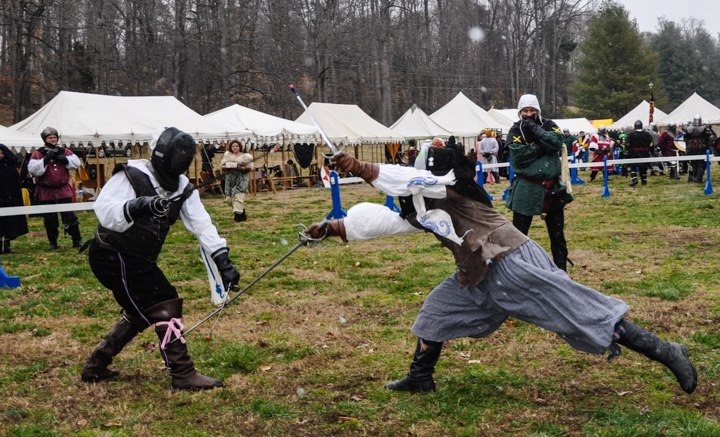
Photo by Mistress Belphoebe
It didn’t, he backed out of it and knocked it down, and I recovered and settled in to my guard. A short while later he lunged, I swept it down and it landed flat against the inside of my knee. Another attack, and it landed. Point to him.
I will admit it: Aedan is a better finesse fighter and tactical fighter than me. It’s why I say he’s probably the best fighter out there. If you fight his game, at range, attempting to out think him, he’ll kill you. For two years in our fights, every time I’ve started to put a plan together he attacks and I either die or back-pedal. I’ve only figured out one thing that works (see Ice Castle two years ago): Go straight at him and make him dead. So I did. In his words “Oh, he’s awake now.” I dropped my weight down, got good and behind my sword, and aggressed like a goddamn pit bull. My first attack came up a bit short with me exposed, and I thought “Ohhhh fuck I’m boned” but he was back-pedaling instead of countering into me like I expected, and I had enough time to recover. I said “Thank you Master Aedan for permitting me to live another few seconds!” He tried another lunge, again a sweep down and it landed flat on the inside of my knee.
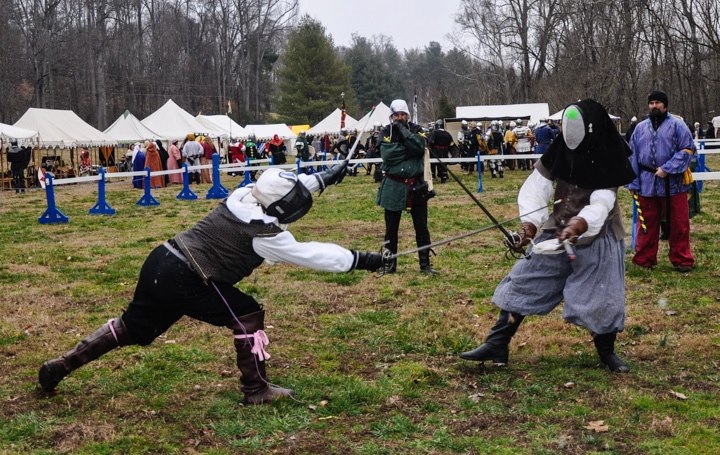
Photo by Mistress Belphoebe
We resumed our guards, and I saw his weight drop in prep for another attack, so I went for an attack in quarta. I landed on his upper right shoulder, pocketing under his collar bone then kicking up over it. I’d closed the line JUST enough with my sword that his blade kicked into the peplum of my jerkin then lodged in my big baggy pants, passe.
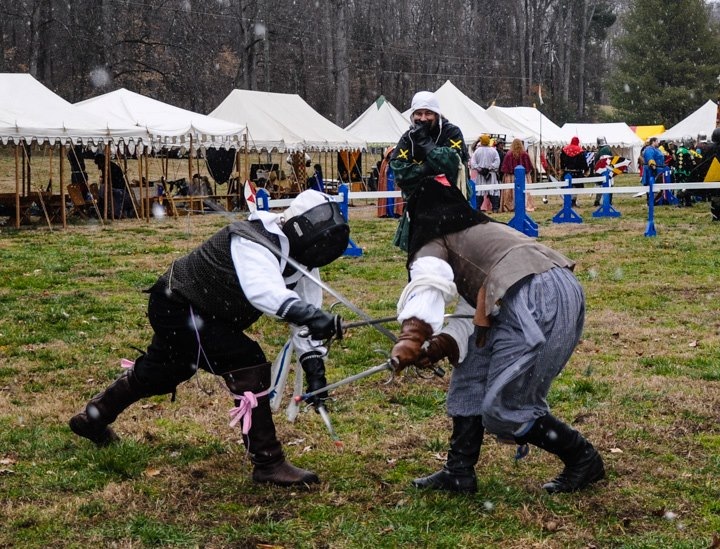
Photo by Mistress Belphoebe
At this point, the voice in my head that is not an angel or a demon but a rational thinking self-preserving monkey said “Shouldn’t have gone two out of three, asshole.” But it was too late for that sort of thinking so I had to do it again.
And again, he dropped his weight just a little bit and I launched, this time landing on his gorget and avoiding his blade completely.
Both of my shots were in full on collisions and landed stiffly. I felt like shit about that and the little angel was saying “Maybe we should offer to re-fight?” I dithered, he allowed as how I’d won, and so I… er… won.
* Trying to figure out the Latin for “Fencer” led me to stumble onto a joy-making happiness. While Gladiatura is “Sword fighter”, the more period sense of “Defender” (ergo the Italian “Schermiatore”) can also be translated as “Vindex”. Some of you may know about my planned alternate persona, Vindex Vipereus, Vindex the Viper (there’s a Vibius Valerius planned for the praenomen and nomen, so I can be V. V. Vindex Vipereus formally). Or, if you W-ify the Vs, “Windex Wipereus”. OH MY GOD IT MUST HAPPEN NOW! Where is a herald?
Winning Sucks Slightly Less Than Losing
After any major win where there was any sort of contact with my opponent’s blade on my body I find myself doubting whether or not I should have called something that I didn’t.
After the Pennsic champs I was wondering if what I’d called a hip was actually a torso, and therefore was it actually a double kill and we should have refought it?
Against Aedan there were those two lunges that I swept down and felt land side-on to my knee, and the attack that went passe on my left side as I struck him. All three of these, after the fighting, I analyzed over and over again in my mind: Did he angle his hand and actually land point-on my knee? Did that shot on my left side stick a little before it went passe? Even if I didn’t feel it, did HE think that it did?
After major wins I have that little voice in the back of my head asking these questions over and over and over again, asking if, maybe, just maybe, I cheated.
I looooooove Mistress Belphoebe, because looking at those photos I can see that, yeah, in that attack I’m sweeping down he was too deep into his lunge to be able to angle his shot and stick my knee; and in that collision attack it really does look like it just slid pad my hip and there’s my sword on it pushing it off-line.
After we got home from Pennsic I finally saw that pic from my champs fight with my knee showing, and stared at the line of his blade (down across the top of my thigh, pulling up my pants to bare the knee) and realized “Yeah, no, if he’d been above my hip it’d be on my stomach.”
As a result that little voice is muted, but without the pictures it would still exist; and until I see pictures like those I question my wins, starting even before the win is declared and continuing pretty much constantly for a day or two. I’ve only been fighting at what I would consider the top end since 2011, and in that time I’ve had less than a dozen big fights that I won, so I’m still sort of getting used to this whole thing. But it just takes a little bit of the joy out of victory. I hope it goes away.
White Scarf Challenge
Immediately after the finals I went off to chat with Roz and let She Who Must Be Obeyed know that I’d killed all the people for her. Also, this gave me time to get through the first wave of questioning and self doubt.
I got back to the field and talked with Aedan about our fights, about my strategy against him, and he said “Yeah, when you start to think you relax and open up a little, that’s when I go for the kill.” Good to know!
A few fighters requested fights with me, and I gave them a few passes (using Roz’s 35, because my elbow was sore from the tourney and the cold. That’s a new one), and talked about improvements for both of them. Pretty simple stuff, but the fundamentals are, well, fundamental (though one guy was fighting with a 33″ or something, with no hand protection, and wouldn’t close on me, so after a few passes I said, more or less, “You are fighting the absolute wrong fight with that sword. Let’s make a new fight for you”).
The post-victory crash had robbed a lot of my energy and adrenaline, and the cold was getting into my elbow and my back (youth is wasted on the newbs). I decided I was done for the day, then found out it was only 2 o’ clock. I headed up the hill and found Sweetums, and we went back to the cabin and took a nap. After that it was go to court, hand off the Kappellenberg Seneschal job to Lady Rowan, eat, drink, sleep, and pack.