At the start of it, I pursued physical therapy to correct a twenty-year-long issue with my left shoulder, and experienced firsthand just how difficult it is to access tiny muscles you never knew existed, and re-learn common movement patterns by telling other, bigger muscles to shut up. Shortly after, I took up yoga. I started teaching historic rapier in formal classes. As summer began, I dived into anatomical studies. I wrote up a fundamentals manual for my students. I began delving into pilates. Recently, I’ve started swing dancing.
All of this has forced me to think much more deeply about movement, and develop a far greater degree of internal awareness. This is good. Six months ago, I did not have the proprioceptive skills necessary to understand the structural changes required to improve my fencing.
A Digression On People Who Win A Lot, and Teaching
There exist “natural athletes”, people with more instinctual control of their bodies, a better innate sense of where they need to be and how to get there efficiently. This proprioceptive/kinetic sense is developed by sports and physical activity, of course, but some people develop faster, or can develop with less input from a less knowledgeable coach. Some kids will learn algebra no matter how bad their teacher is, and some will struggle even with the best.
As previously observed, our teachers and teaching, in the SCA, are generally not very good. As a result, the most successful fencers tend to be those with the most innate advantages – talent, height, etc.
If we want to improve this, we’d do well to begin with a deeper understanding of body mechanics and dynamic movement so we can better teach those who don’t have the “natural athlete” sense.
Finding Stability
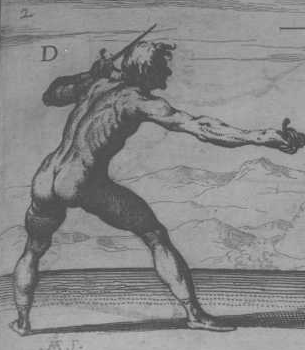
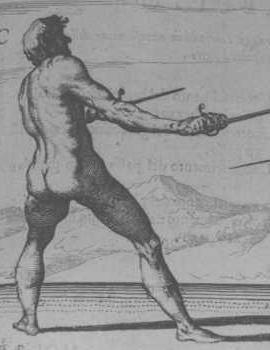
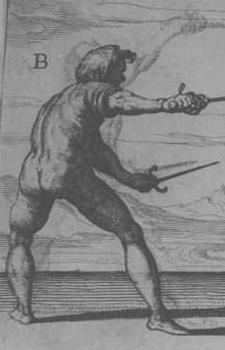
To make my point at the end of the previous post a little more concrete, observe Capoferro’s quarta, terza, and seconda:
Note the hips and the angle of the legs. They don’t move. When mutating guards, the upper torso is rotating in isolation. Losing stability during this rotation results in slower, sloppier, weaker actions.
“Easy enough”, you say. You are wrong. Try balancing on an unstable surface (a block of foam would be an easy version) while in guard, maintaining the proper weight distribution. This is challenging by itself, but can usually be accomplished by intermediate-to-advanced historical fencers. When you’ve found your balance, try rotating the upper trunk in isolation. The unstable surface will magnify the effect of any changes in your center of gravity. That’s your weight going somewhere else. Your body has to control and compensate for that. And compensations cost you time and power. Maintaining stability is absolutely essential to performing fluid, quick, and powerful actions. Smoothly transitioning from one strong, ready guard/counterguard to the next. Proceeding with resolution.
Basically, you should be able to do this. Just replace the straight balletic leg with the rear leg in guard. Also, the dancer shown in is rehab, so you should be able to do it better than him. While facing an unpredictable opponent. And performing spontaneous actions.
This is very hard to do.
Similar examples for the spine, scapula, hips, and shoulder exist – perhaps for all the joints, but the proximal ones are the most important. And similar examples exist for all movements in fencing. More dynamic movements require greater stability and control.
You cannot achieve this with “show up and spar”. You cannot achieve this with “drill guard, footwork, and technique, then drill applications at speed, gradually increasing complexity until simulating a real fight.”
Good Form is Not Basic
Consciously accessing the small muscles needed for stable, isolated movement, and turning off the big ones, is EXTREMELY difficult. Novices will not have the proprioceptive skills required for some of the details. These are not basics; these are things to build up as strength and body awareness develop, alongside technique and its applications.
Many people, it seems, think of alignment, balance, control – all that “good form” stuff – as essentially binary, and the purview of beginners (Are you doing the thing? Y/N. If so, great! Let’s move on). Once a novice demonstrates “good enough” in these basics, we start teaching more advanced, fun stuff. But we never, or rarely, come back to hone this foundational work, deepening our mastery of these skills. We get to “good enough” and never get better. We don’t acknowledge that the basics have gradients, and that improvement at the fundamental level trickles up to everything else.
(I think this is a large part of why many HMA practitioners on YouTube, or at Pennsic, can perform plates admirably well in a sterile, choreographed setting but fall into sloppy, athletic sword-tag games when sparring, never using the advanced historical material and rarely even doing the basics well. It’s not just a matter of automaticity or “kata black belts”. Many fencers undermine their own technique by neglecting to develop their body and their form; under stress, they fall apart, losing the stability and control and alignment necessary to perform historical technique. Winning with timing and distance and gaming-the-rules is easier. People do what works, and can’t be blamed for it. But it’s not historical, and it’s not pretty.)
We are never “done” learning form – we simply find smaller and smaller details to perfect. Gains in strength, range of motion, and body awareness must be pursued continually and integrated into our fencing. This is best achieved via very technical, targeted exercises, applying these gains in athleticism to technique, and then reevaluating the tactical and strategic considerations of our better technique.
Each level places more stress on our attention, meaning we need more and more automaticity to be successful. And we gain automaticity only by focusing on doing things right, over and over again, until we can’t do it wrong.
On Goals
On Facebook, Dante lamented that the reactionary response to praising and striving for the perfect record is, eventually, to hold all successes, no matter how small, equally praiseworthy – until the definition of success is watered down and meaningless. This echoes the idea that objective measurement is important, and that we need to identify “good” and “bad” in order to continue to improve. I agree.
When I brought up the counterpoint that “good fencing” goals can be just as objective, and might be more approachable and achievable than “did I win?” goals, the response went along the lines of “if you do things right, then you’ll win.”
The problem is that judging success by wins implies the converse of this heuristic: “if you won, then you did things right.” This isn’t true. We can all remember instances where we did something atrociously wrong, but took the point anyway – because our opponent was having a bad day, or just wasn’t good enough to exploit the mistake, or some element of pure chance went our way. Likewise, I’m sure we all remember times when we were fencing very, very well, at the maximum of our abilities at the time, but still lost because someone else was better.
I can go 10-0 at a small, local event. I can go 3-7 in the wrong pool at Ruby Joust. Externalities affect win percentage. You can try to take these into account, but it does render the measurement less objective.
Furthermore, “winning by doing things right” holds true only if you do most everything right, at the same time. This is difficult enough, and not appropriate if building some smaller novel movement pattern up to automaticity – that’s too much to pay attention to. Instead, the focus should be on “do this one thing right, no matter what. Try to do the other things too, but never at the expense of this very specific primary goal.” It doesn’t matter if I get hit. We’re wearing masks.
As an example: right now, I am working on strengthening different patterns of muscle innervation to maintain better spinal alignment and scapular stability through dynamic motion. Sometimes that means I have to focus so much on what my subscapularis is doing, or the exact position of my T5-T8 vertebrae, that I forget to parry. Whatever. The alternative – focusing on striking my opponent, and slipping into more familiar, worse form – reinforces suboptimal movement patterns, which is a step away from the goal.
Maybe Dante doesn’t need to drill down to this level of single-minded focus – maybe he’s got the innate talent I talked about above. But me? I don’t have that. Neither do most of my students. Neither, I’d wager, do most SCAdians, or most people in general. For me, the focused approach is much better.
Now the ultimate goal should always be to do everything perfectly, and there are times when it’s appropriate to temporarily put more nuanced goals on hold and try to win a lot. But I posit that turning all our focus to a singular, specific goal is the fastest way to achieve it. With this assumption, a goal so broad, and subject to so many externalities, as “win more”, will slow our improvement. I’d say shifting the focus from “do good fencing” to “win” should occur almost never in drill, rarely in sparring, and only sometimes even on the tournament field.
Certainly, we should respect and seek to emulate people who win a lot. Replicating success is a lot easier than reinventing it. But the emphasis should stay on “what is the difference between what I do and what they do? What’s something specific I can focus on?”
After all, if my goal was simply to win more, I’d buy a 38″ and a stick.
Summary
There are a lot of ideas here, and they’re intertwined – or muddled. I don’t feel I’ve expressed them as well as I’d like, partly because my understanding is only halfway developed. But I can say that this narrower focus has brought about a very different proprioceptive quality to my fencing movements – one that feels right, and seems to be reflected in the movements and training of high-level acrobats and dancers and figure skaters, other professions where body control is paramount. At present, I’m determined to pursue it. Maybe it won’t lead to success, but right now I’m quite convinced that the most advanced historical material will forever remain out of our reach without this substantial rigor.
I’ve not posted here in several weeks. This is not reflective of a lack of things to say, or even a lack of free time. Instead I am motivated by the thought that I should be spending more time doing things, rather than merely writing about it, particularly since every week brings some new insight or a hint of one. Why bother writing about something if the way I think about it will change in the next couple weeks – particularly given that so many of these notions are vague and complex? If my attempts at writing ramble, and are so often misunderstood, surely the ideas behind them are insufficiently developed for verbalizing.
The natures of the frequent commentators on this blog do not help matters, given as they seem predisposed to find fault with new ideas rather than to expand upon them. (This itself gives me pause, but that’s a subject for another post.) This further encourages one to keep one’s thoughts to oneself until they are quite solidly developed.
Nonetheless, rambling has recently been demanded. Ramble on.
Plate 32
My new favorite: a yield to the outside with a girata of the front foot, striking in quarta.
There are two ways this can happen, according to Fabris:
– Variation 1: Fencers start inside. The opponent cavares, and our fencer performs the strike shown in tempo.
– Variation 2: Our fencer starts in second to the outside, and performs this strike in response to the opponent’s find.
There are a few notable bits of instruction from Fabris here. Among them: the striking fencer should move his sword-hand “far to the inside” (towards the viewer in this illustration).
This seems a little counterintuitive at first, since it moves the guard away from the fencer and gives his opponent an open line through which to strike. But then we have another bit from Fabris: “By virtue of this angle, the more force the opponent uses trying to push our fencer’s sword away, the more forcefully the thrust will penetrate the target.” Okay, so our fencer is safe because the opponent is trying to parry, putting a lot of inertia into our fencer’s guard; by the time he recovers, our fencer will have time to defend himself. The girata adds a little more security, both moving his body away and increasing the angle (by allowing the shoulder and hand to move farther inside). Makes sense.
Except … the opponent is not trying to parry. The yield is done in the tempo of an opponent’s inside-to-outside cavazione, or in response to a find. These are small, well-controlled actions, not forceful parries. Indeed, if the opponent tries a bona-fide parry, raising his guard or the tip of his sword, he’ll probably be successful in defending himself! And if the opponent makes a small, well-controlled find, and our fencer responds with the (comparatively large-tempo) girata and yield, the opponent has ample opportunity to immediately thrust or cut at our fencer, who is not well positioned to defend himself. Double hits seem likely.
So how is our fencer kept safe through this action? Does it rely on the opponent’s sense of self-preservation – attempting to push his sword away in response to the attack, giving our fencer sufficient time to void and strike? That doesn’t seem very convincing …
Solutions
One thing that struck me is the idea of contrary motion – moving in the opposite direction of the opponent. Obviously this idea is used in contratempo strikes, effectively halving the time required to cover a fixed distance by moving into your opponent’s action. But turn the vectors 180 degrees, and you double the distance per unit time. That’s what’s happening here. Our opponent is moving his sword to the outside (with the find, either from guard or at the end of his cavazione) – towards our fencer’s left. Our fencer responds with a void – moving his body to the right. Thus, although the opponent may be making a well-controlled action, he’ll still have to overcome his own inertia and move twice as far in the opposite direction to strike our fencer. That motion takes time, and that time may be sufficient for our fencer to recover or defend himself.
While I think this has some validity, it doesn’t quite address the point that Fabris made – “the more force the opponent uses in trying to push our fencer’s sword away, the more forcefully the thrust will penetrate the target.” This suggests to me that, somehow, our fencer is suckering the opponent into using more force than is necessary for a simple find. Perhaps our fencer’s attack has caused him to panic a little … but a bit more intriguing was the idea of counterguard.
The stronger our fencer’s sword, the more leverage the opponent will need to overcome it. So our fencer can certainly begin with excellent musculoskeletal alignment in his counterguard, fortifying his sword and forcing his opponent to make a larger movement to find. In the plate above, the opponent is also hampered by a comparatively weak guard, the angled third, necessitating even more angulation to compensate.
In sum, the opponent’s movement, although a find, is perhaps not quite so small and pretty as might be advisable, and might carry quite a good bit of force indeed. In this case, the yield is successful, our fencer is safe, and we can quite literally feel Fabris’ “more forcefully the thrust will penetrate its target”. If the opponent DOES keep his finding action small, he’s not likely to have the strength necessary to displace our fencer’s sword, and a straight-line attack outside will likely be successful.
Applications in Sparring
Naturally, no interpretation is worth anything if it can’t be performed in sparring. This plate was particularly fun to try, since so many SCAdians like the angled third. It worked beautifully. There were no doubles. Subsequent passes had the opponent so concerned about the yield that extensions to the outside frequently drew overlarge parries, allowing for easy feints.
But more intriguing was when I attempted to apply these ideas to a slightly different context.
A few weeks later I tried to pull out this action against Carlos, doing his best Capoferro. Carlos, like many historical fencers, doesn’t hang out too much in angled third, preferring seconda-terza or terza-quarta with considerably less vertical angulation.
It went a bit like this:
Attempt 1: I cavare outside as I enter measure, attempting to set up Variation 2. Carlos turns the hand and counterfinds before I arrive, making blade contact. I feel that I have lost control of the line, and know that proceeding would be suicidal. I retreat and reset.
Attempt 2: I cavare outside as before, mutating into a stronger counterguard in second. Carlos turns the hand again, and briefly, I feel contendere di spada – parity with pressure. Pressure resulting from an action with too much force. Pressure I can use. From here, I can perform the yield in quarta.
(In writing this, it occurs to me that the yield in prima, per plate 25, might also be a valid response; the optimal choice likely depends on the measure, the opponent’s guard, and possibly the relative height of the fencers.)
I try, but he’s able to parry. My action took too long; the mutation into seconda slightly upset my balance, and the fraction of a second it took to compensate for that slowed my footwork too much.
Attempt 3: This time, I focus on rotating the upper trunk in isolation, keeping the hips steady. My balance does not shift noticeably. I feel pressure, and I can immediately move forward, turning the front foot into the girata and landing safely in fourth, exactly as the plate describes.
Ruminating on this later, I realized that I was able to perform a fluid mutation and a safe, valid extrapolation from plate 32, but only because I was focusing on it – only because I was setting it up ahead of time, relying on my opponent to respond the way I wanted him to … this thought led to something much more speculative, but also, I think, much more significant.
I recently finished reading Ken Mondschein’s Fencing: A Renaissance Treatise, which is a translation of Camillo Agrippa’s Treatise on the Science of Arms with Philosophical Dialogue, published in 1553.As someone who is most accustomed to the writing styles of the later Italian rapier treatises, I found Agrippa’s approach somewhat difficult to understand at first. Giganti, Capo Ferro, and Fabris begin with an introduction that describes the core principles of their combat system and then they provide examples (the plays) of how to apply those principles. In contrast, Agrippa primarily explains the principles of his system using examples. This approach is far less explicit and relies on the reader to make inferences based on the actions provided. In this, Agrippa seems to be rather similar to most of the other historic fencing treatises that I have read, suggesting that either the Italian rapier treatises are unique in their level of explicit discussion of fencing principles or that the fencing principles underlying Italian rapier are more complex/developed than manuals that were written earlier. In any case, the result is that understanding Agrippa requires that we delve into the guards, motions, and plays in order to understand the principles.
This may contribute to why Agrippa seems to be relatively rare amongst SCA fencers. Despite the fact that Agrippa is a thrust-oriented system of combat, and should fit relatively well into the heavy rapier rules, I have met far more fencers who studied cut-oriented systems and attempted to adapt them to the heavy rapier field. Indeed, I have met only one fencer who sought to learn to fence like Agrippa over the course of several years of active involvement in the SCA. In contrast, it seems like everybody and their cousin is “fencing Giganti” or “doing Capo Ferro” these days. While certainly some of the relative popularity of Italian rapier is due to people like Dante who have spent lots of time teaching and instructing in the Italian rapier systems, I suspect that the lack of explicit principles in the text makes Agrippa seem more daunting to new students who might prefer something that is more easily chewed.
Differences in the approach taken by the modern translations may actually compound this problem. If we compare the Tom Leoni translations of the Italian rapier systems with Mondschein’s translation of Agrippa, we will notice that where Leoni provides a relatively straightforward tutorial to the basic actions and core principles of the manual, Mondschein instead provides an academic discussion of the historic context of the manuscript. While I thoroughly enjoyed Mondschein’s introduction, it certainly does not make it easier for a beginner to pick up Agrippa and learn to fence. To that end I am hoping to provide such a tutorial here over the course of several posts.
Approaching Agrippa:
As noted above, understanding Agrippa requires that we work from examples and use those to infer not only the core principles of the system, but also rather basic concepts such as how to move. In order to do this, it is important that we understand two key concepts. First, we must understand that fencing is a combinatorics problem. Combinatorics is the study of finite sets, and we can use combinatorics in order to solve problems by identifying all of the possibilities and then either identifying good solutions from that set or by eliminating bad ones. It should be apparent from a cursory reading of Agrippa’s manual that he provides a finite (and relatively small) set of positions (labeled A, B, C, …) and a finite set of actions (the plays). Second, we must understand the concept of degrees-of-freedom. In this context, a degree-of-freedom is a place where a system can vary.
It should be obvious that fencing is intended to be carried out using the human body, but it may be less obvious that the human body has a finite number of degrees-of-freedom. That is, each joint in the body is a single degree of freedom and, at each joint, it is only possible to move in 1-2 ways (extension/flexion, rotation, adduction/abduction, elevation/depression, extension/retraction). Based on these two concepts, we can see that there are a finite (but large) number of ways to position the body and that there is a finite (but small) number of positions that are used by Agrippa. However, it isn’t particularly efficient for us to address the thousands of possible ways to position the body, and clearly some of those will be ridiculous ways to stand for fencing. Recall that a degree-of-freedom is a place where a system can vary, so rather than using all of the possible ways of moving the body as our system, we can further restrict the system by looking at the positions provided by Agrippa.
Fortunately Agrippa gives us relatively few positions to consider. He provides us with 4 basic guards, 3 alternative guards, 3 voids, 2 “lunges”, and 2 left-foot forward stances in his explanation of the single sword for a total of 14 different positions. Because a degree-of-freedom is a place where a system can vary, we first should identify similarities between the positions provided by Agrippa. Let us first limit ourselves to considering the four basic guards provided by Agrippa, A, B, C, and D. For now, we will hold off on discussing the use of the dagger in the left hand and will focus on how the body and sword arm are held.
Basic Guards:
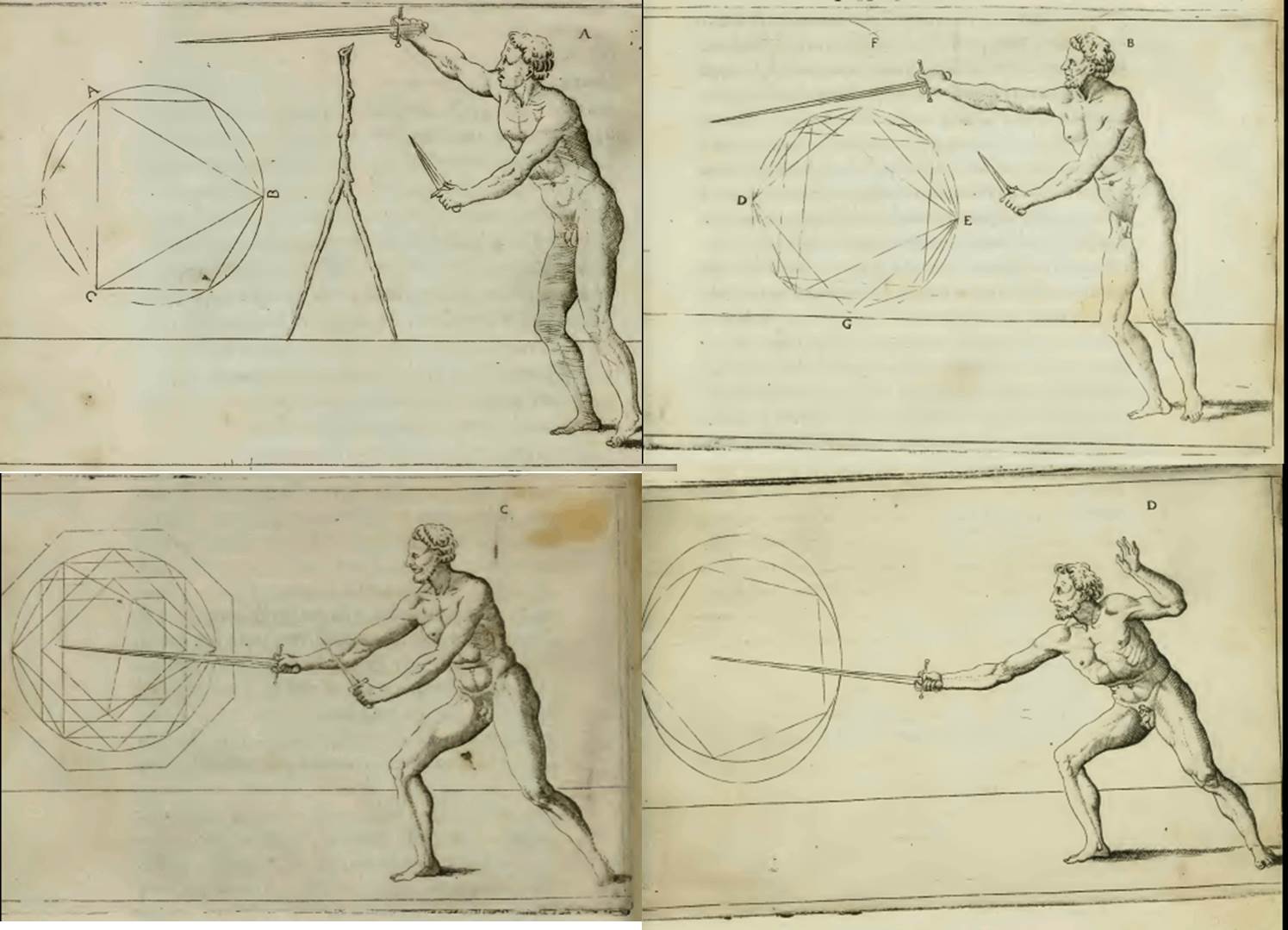
Agrippa’s Basic Guards, A – narrow prima; B – narrow seconda; C – wide terza; D – wide quarta
Similarities:
Right foot is forward
Weight is on the front (right) foot
Right leg is bent
Body held upright with lean forward
Body is profiled, with right shoulder forward
Back is straight
Sword held pointing towards opponent
Degrees-of-Freedom:
Guard:
Because these four plates are intended to show us the difference between the four guards, it follows that we should consider guard to be our first degree-of-freedom. These guards are named first, second, third, and fourth and differ specifically in the rotation of the forearm. It is worth noting that these “basic” guards vary in more ways than just guard.
A: prima (first) – True edge up, palm to the right (outside), hand slightly above the shoulder
B: seconda (second) – True edge to the right (outside), palm facing down
C: terza (terza) – True edge facing down, palm to the left (inside)
D: quarta (fourth) – True edge facing to the left (inside), palm facing up
Those of you who study Italian rapier will recognize this naming scheme and the basic guards, however, I will point out that they seem to differ in one important way, namely that the quarta is held to the inside of the right knee.
Stance:
The second degree-of-freedom we can see in these plates is a difference in stance. Simply put, the basic guard for first (A) and second (B) occurs using a narrow stance while the basic guard for third (C) and fourth (D) uses a wide stance.
Agrippa’s F: A narrow third guard
If you have been paying attention you will note that these two degrees of freedom provide us with 4 guards x 2 stances = 8 possible positions, so there are 4 possibilities that we have not yet addressed. Agrippa addresses two of these possibilities, first and second with a wide stance, in chapters 4 and 5 respectively, noting that by being in a narrow stance, you gain additional reach over your opponent without putting yourself at additional risk due to the strength of the guard. In other words, both narrow and wide stances are safe while in first or second, but a narrow stance gives you more reach and is therefore better. The narrow third is shown in position F by Agrippa, however there is no explicit explanation for the absence of a narrow fourth position. However, Agrippa does note that in the fourth guard, the fencer must be more cautious, suggesting that it is less safe. Combined with what was said about using narrow stance in first and second, we might conclude that Agrippa considers a narrow quarta to be unsafe as, it leaves the head relatively unprotected from high attacks. Therefore, using only 2 degrees-of-freedom, we can define 5/14 positions described by Agrippa.
Additional Positions:
Sword Position:
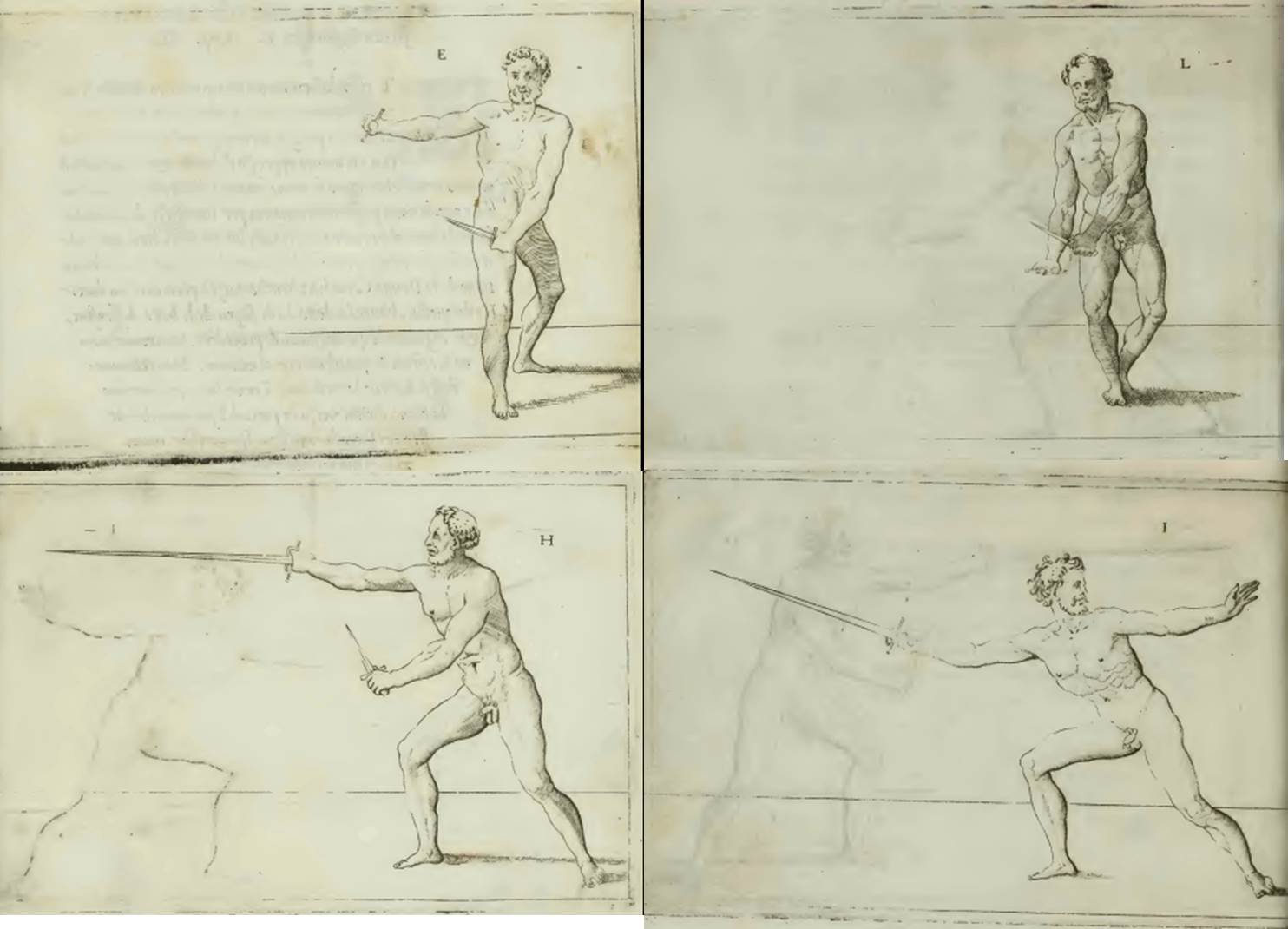
Now, if we wanted to describe the rest of the positions in Agrippa, we would need to add degrees-of-freedom, so let us next consider the four positions E, L, H, I. If we compare these stances against each other and with the basic guards, we can see that there are different ways of positioning the sword. H and I show the sword extended in wide second and wide quarta respectively by extending the arm at shoulder level. While Agrippa does not use the term “lunge” these positions are the closest to the lunge that we are familiar with and Agrippa seems to use them in that manner. In contrast, E and L show the sword retracted in narrow second and third respectively. Agrippa specifies that he purpose of these positions is to deny your opponent access to your sword. Finally, our basic guards A,B,C, and D, as well as F show the sword in a “neutral” position. This means that we have an additional sword position degree of freedom, and using these 3 degrees-of-freedom, we can describe 9/14 of Agrippa’s positions.
However, we have even more possibilities that Agrippa has chosen not to include. You may have noticed, for instance, that there is no explicitly extended nor retracted prima. However, if you form A, you’ll find that it isn’t really possible to extend the arm any further. At the same time, Agrippa’s description of A given in chapter 4 notes that the forward position of the sword is important because it allows you to defend yourself with the strong part of the sword (near the hand). This would not be the case if you were to stand in a retracted prima. We also may note that position N involves a retracted prima albeit while placing the left foot forward.
Based on what we have already concluded using the guard and stance degrees of freedom, the only missing positions are an extended wide third, an extended narrow third, a retracted wide third, a retracted wide quarta, and we might likewise be surprised by the existence of an extended wide second (H). In chapter 6, Agrippa suggests a strike in wide third carried out by pushing the front foot forward to a wider stance, however, we might conclude that this particular strike is suggesting a thrust from below in C. This “lunging” action might then describe a transition from F to C for instance. The lack of an extended narrow third and the presence of an extended wide second may actually occur for the same reason that it is safe to use a narrow stance in first (A) and second (B) . In chapters 4 and 5, Agrippa notes that it is safe to use a narrow stance in first and second because those guards cover the head. However, in H, the extended arm is actually lower than it is shown in B, which may mean that the head is left uncovered. If this is the case, then we would also expect that an extended narrow third also leaves the head uncovered.
Agrippa does not explain the absence of a retracted wide third, however, chapter 16 specifies the use of L as a method of convincing your opponent to close distance. If you were to do the same thing in a wide stance, you would find that these gains would be negated, as the distance you can extend yourself forward is dictated by the placement of the left foot (Consider a transition from L to H or I, for instance). Finally we must explain the absence of a retracted quarta. This is relatively easy to explain, as, if one were to go into quarta (D) and attempt to retract your arm in quarta (mirroring E), you will find that the sword arm crosses the body rather awkwardly.
The retracted positions E and L and the extended positions H and I
The last 5 positions that Agrippa gives us can be divided into a set of 3 voids and a pair of positions with the left foot forward. We can therefore fully describe these using only two more degrees-of-freedom, namely the Alignment of the stance (in-line, off-line to the outside, off-line to the inside) and the Front Foot (left vs. right).
Alignment:
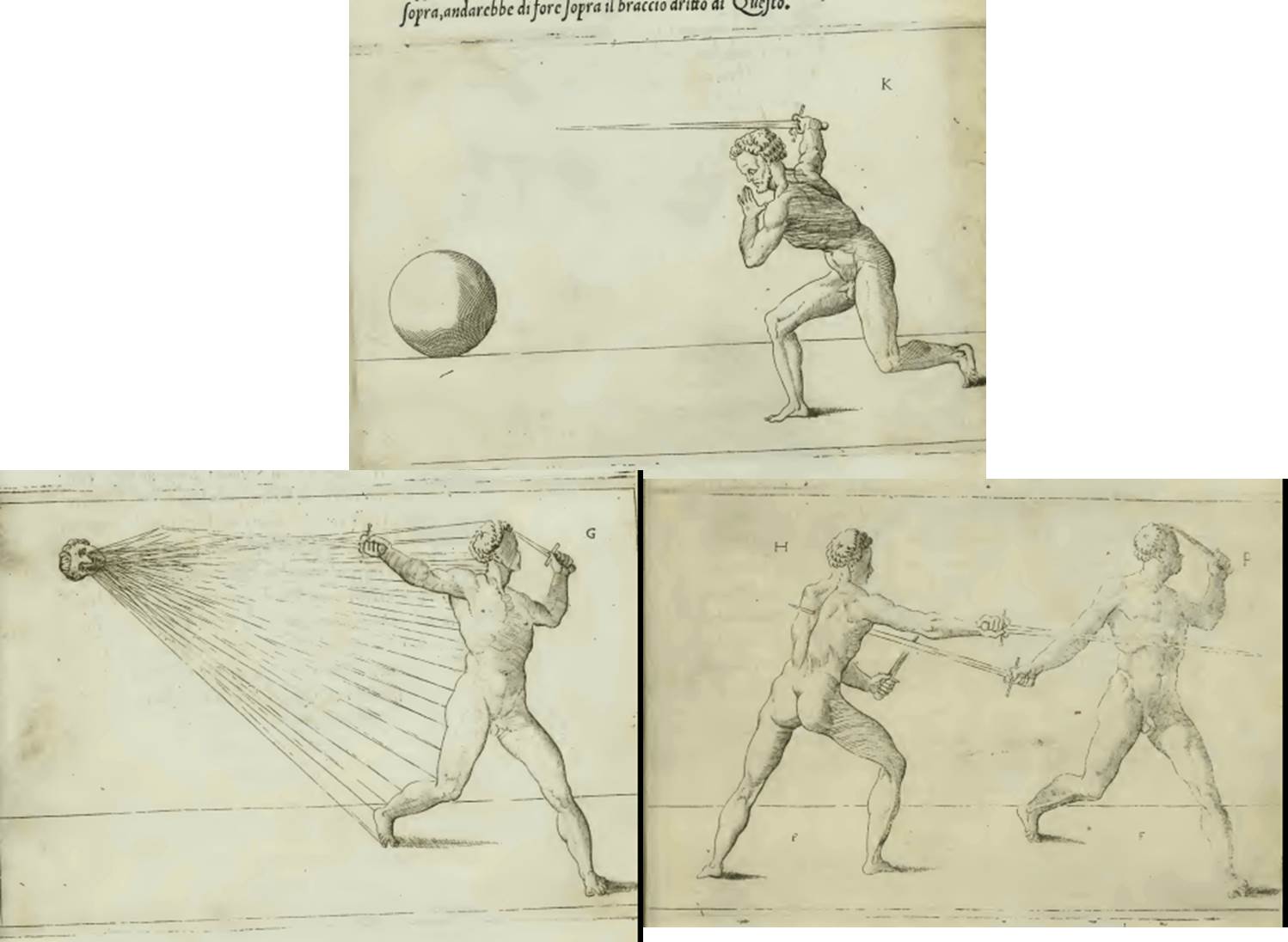
Agrippa presents us with 3 voids, G, K, and P. Both G and P are voids of the inside line performed by stepping towards the outside with the right foot. They differ from each other only in the position of the sword, with G delivering a high thrust (extended) and P delivering a low thrust (neutral) (Book 2 chapter 9). Agrippa specifies that it is best to perform G in second rather than in third, but also discusses performing G using fourth in chapter 11. It seems that P can be used similarly, and Agrippa does say that it is identical in Book 2 chapter 9. K is instead a void of the outside line. It seems to be performed by stepping off-line to the left with the right foot, by lowering the body, and by twisting the body clock-wise. The sword is held in a retracted second (like in E). Interestingly, Agrippa’s description of K in chapters 14 and 23 suggest that this is not performed in opposition, but rather that the opponent’s weapon will pass between your sword and your head. Indeed, all 3 voids seem to occur without blade opposition.
In these three cases, the important aspect seems to be the step off-line and Agrippa seems somewhat ambivalent in his advice about which guard to use. If we consider our other degrees of freedom, we’ll see that all 3 of these occur in a wide stance. In fact, Agrippa seems to prefer striking the opponent using a wide stance, as he does so in C, H, and I, and only strikes the opponent in a narrow stance in A where he states that forming a narrow stance provides additional reach (chapter 4). If we consider position of the sword, we can see that G and P include both the extended and retracted positions respectively, however there is only a retracted form of void of the outside (K). However, if we consider that the opponent’s weapon is supposed to pass between the weapon and our head, then we will note that an extended guard would not allow this as the sword would be in front of rather than to the right of the body.
The voids: K void of the outside, G and P, voids of the inside
Front Foot:
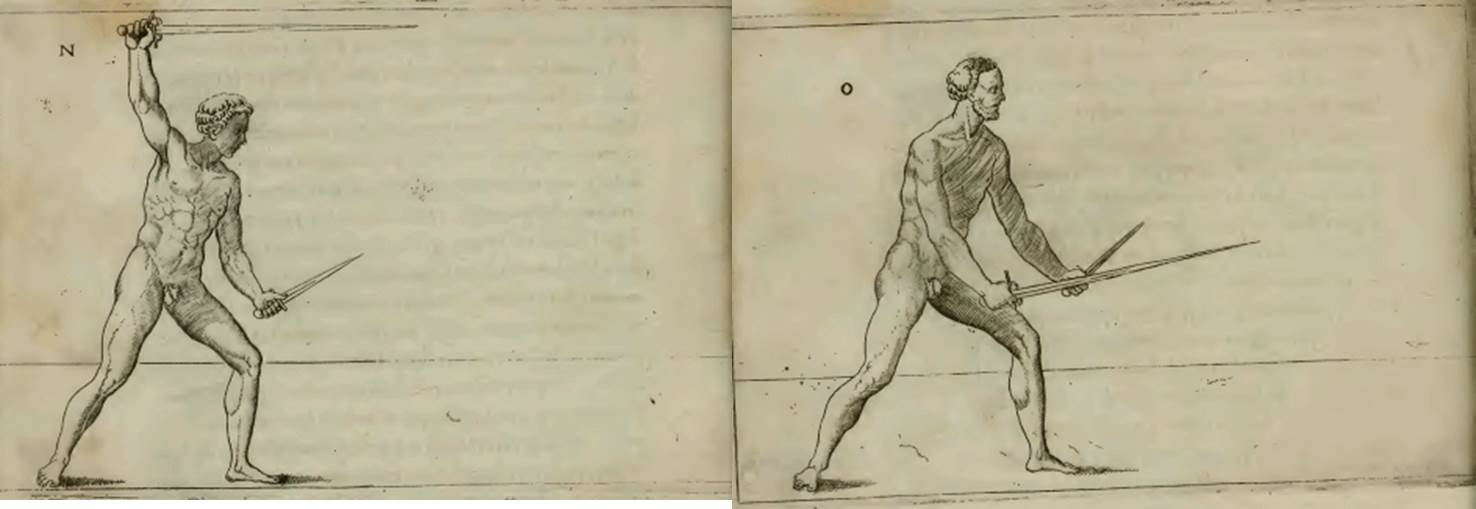
Finally, Agrippa provides us with two positions shown with the left foot forward, N and O. You will note that these guards both use a wide stance, but only use a retracted first and neutral third guard. Agrippa is far less clear about the usage of the left-foot forward guards and suggests that they are useful for some limited and explicit situations. As such, it is hard to see a reason why these are the only guards depicted by reading chapters 25-28 which describe these positions. In chapter 28 (which describes O), Agrippa suggests that by taking a wide stance we can avoid the need to parry feints to the front leg, which I assume suggests that he intends to void the front leg either by moving to a narrow stance or performing a full traverse back to a right-foot-forward stance. We also might take note that there is relatively little practical difference between right-foot-forward and left-foot-forward in a narrow stance, and so Agrippa may have not felt it necessary to discuss (or to even assume a narrow left-foot-forward guard). The absence of a second guard is a little more obvious, as with the left foot forward, second provides little protection for the left side of the body. This is likely also the reason for the retracted, rather than neutral, prima guard shown in N. It is also apparent that a left-foot-forward quarta becomes awkward, as we would be turning the sword in towards the body.
The left-foot forward guards N and O
References:
Ken Mondschein, ed. Fencing: A Renaissance Treatise by Camillo Agrippa. New York: Italica Press, 2009. 234pp.
Images copied from an electronic copy of an original manuscript held in the collection of the Getty Research Institute. Accessed from: https://archive.org/details/trattatodiscient00agri on September 5, 2015.
I was envious of her. She was another female fighter, also 40ish, and she had started rapier a couple of months after I did. But she progressed much faster. Less than two years after authorizing, she received a Sea Dragon at a field court as I watched, feeling happy for her and sorry for myself. For whatever reason, her award did not get recorded in the Order of Precedence. I don’t know whether she noticed. Here was an opportunity for me to combat my jealousy with a good deed. I privately contacted the Clerk of Precedence and corrected the omission. I felt much better. I might have no success on the field, but I could make sure that my fellow rapier fighters were recognized properly.
My efforts spread beyond correcting the Order of Precedence. When I had joined the SCA, Atlantian RapierNet would generally announce awards and accomplishments of fighters from throughout the kingdom, even things such as earning a marshal’s warrant or a baronial award. I happily posted congratulations to people I knew. Later those announcements dwindled. Even Free Scholar prizes were not always publicized well. Since I like having my accomplishments recognized in public, I supposed that other people did, too. So I have taken up the task of announcing other Atlantians’ awards on RapierNet and Facebook groups, if they haven’t already been posted. I try to highlight fighters for winning awards for service or arts and sciences as well as combat. One of my inspirations to publicize awards came from my former Baroness, Mistress Sorcha Crowe. As Baroness of Storvik, she took care to praise any Storvik member who did something worthy at any level.
I also found that another way in which I could enjoy other fighters’ recognition was to instigate it. I started to write people in for awards and to pester the White Scarves to sponsor them for Gold Scarves. For example, I admired Gilig von Baden from the Shire of Roxbury Mill. He established the rapier practice there and trained numerous fighters who became successful. He himself also demonstrated prowess, honor, courtesy, and considerable service. I was personally grateful for his teaching me at events and his encouragement. However, being in a Shire rather than a Barony, he tended to be overlooked. I thought he had the qualities that I admired in a Free Scholar (and that I thought some other Free Scholars and Provosts lacked). So, I started urging Celric and other White Scarves to promote him, and eventually he did play his Free Scholar’s Prize, shortly before new fatherhood took him away from the SCA.
I haven’t stopped being inwardly envious of other fighters’ success, but I’ve channeled envy into writing my own role as a promoter of rapier and rapier fighters.
So I’ve come across a couple different mechanics for the retreat, in a historic Italian context:
Through the Heel – peel up the toe (dorsiflexion) and straighten the front leg, pushing the front heel into the ground to drive the body back.
Through the Ball – flex the foot in the opposite direction (plantarflexion), using both the ankle flexion and knee extension to push yourself back.
A student of mine is interested in this question, and when I couldn’t give a satisfactory answer I promised to seek a wider array of input. Which do you think more correct for the system (or are both acceptable? Or is something else better?), and why? Please support your answer with text from the primary sources, better-known principles of Italian fencing, anatomy/kinesiology, or physics. Personal anecdote is weak but acceptable.
(In which Wistric opens up a whole bag of philosophy, opinion, and tradition, tapping into primal desires to “not be skewered like a pig”, begging for vehement discussion. Will you enable? Remember: “Probably grossly erroneous” is part of our editorial policy) As an RMiC I like to keep to a schedule as much as possible (the only tolerable violation of the schedule is when their Majesties are planning to make a friend a WS, and even then it’s only tolerable, not welcome). A well-scheduled event crams as much fighting as possible into it, and I’ve only gotten “better” about it as time goes on (six tourneys and two melees at an event? Ohhhh yeah, this is happening). The biggest delay I run into is getting authorizations done before the fighting starts, especially when an event is well-attended. And as the RMiC this is one of those few areas I don’t have all that much control over. I make all the effort I can think of to announce when authorizations start and end, including all communications outlets I have access to, and requesting marshals and group leaders pass that information on to their fencers AND contact me to let me know people will be authorizing. Then it’s up to the fighters to arrive on time. If they do (say, up to twenty minutes before cutoff), I accommodate them. If not, they get to wait unless two marshals and an usher are willing to skip the fighting and go off to the side. When the authorizee does show up, I hand them off to two experienced marshals while I attend to the other needs (arranging inspections and making sure people get signed in). From there, it’s out of my hands. I have seen authorizations take twenty minutes from start to finish. I’ve seen JUST THE QUESTIONS take an hour. As you might guess, I prefer the twenty minute version. I also prefer marshals who notice when the RMiC is staring at them in wide-eyed disbelief.
I believe a fighter’s safety can be accurately (p < 0.05) judged within twenty minutes. It starts with the questions. The fighter needs to know:
Armor standards. Knowing the specific terms is preferable and earns a gold star from me, but demonstrating an understanding of what the standards actually are is sufficient.
Target area. Knowing what happens when you get hit where. Kind of a good thing to know in my mind.
Valid blows. What constitutes a good shot? Also a good thing to know.
Know what hold means.
Engagement in melee. When can you and can’t you deliver a shot? (This one serves two purposes: Making sure they know not to throw shots from outside the 180, and warning them that they can be hit by a fighter who they don’t know is there)
DFB. Don’t point stalk, don’t jack them in the kidneys, the usual.
The front 120 rule when their opponent is legged (which apparently is only an Atlantian thing. I will make many kingdoms regret that oversight).
Blade grasping
That’s it off the top of my head. If they have problems with these, they get a copy of the rules and come back to try again later if there’s time. The first two should take less than five minutes, total, the rest should take less than five, total (Confirmed by a scientific survey [N=1] yesterday!).
Then comes the fight. We CAN do the “three part auth fight” but I don’t think it’s necessary to establish the fighter is safe and can call shots. Here are some skills I expect of the usher:
Bait or trigger a lunge from their opponent and receive the blow.
Trigger an attack and retreat out of measure. Repeat. On the third, don’t retreat and receive the resultant blow. This is where I receive stout blows, but I tend to be understanding of them and discuss how to address the situation – it’s not an automatic fail. But super hard shots? Yeah, those are going to be a problem.
Close safely to close measure, receive the draw cut or thrust delivered.
Close unsafely to close measure, preferably wrestling over the authorizee’s blade and in as many ways as possible discombobulating them. Once in a practice auth, my opponent seized my arm and tried to throw me. That’s about the only failure I’ve seen at this point.
Distract opponent and deliver a draw or thrust to the arm.
Distract opponent and deliver a draw or thrust to the leg.
Most of all, the usher is not there to prove a damn thing about his or herself. That’s a useless usher.
It can be done in six passes. They don’t go in this order all the time, though I usually start by letting the opponent attack so they get to thinking about attacking and are less likely to notice the limb blows I land. At a minute per pass, you’ve got four passes to spare to re-check one of these before you even reach ten minutes.
If you have an hour set aside for authorizations, a pair of marshals and an usher can knock out three authorizations (two is tolerable).
This is not an argument to rush through authorizations, but to focus on the important things: those questions that represent a solid understanding of the rules that keep us all safe, and those actions which are most likely to result in paperwork for the marshal. If an authorization is taking much more than thirty minutes, there’s clearly something wrong, either with the authorizee, or the process the marshals are following. If it’s the marshals, well, they’re wasting not just their time, but potentially the time of everybody at the event. They are negatively affecting all of the rapier fighters. And that? That shit is intolerable.
I’ve been asked to elaborate on an idea I had not too long ago, and I’ve found that it coincides well with a few other ideas I’ve been fleshing out recently, so all of those things are being combined here.
First, a simple assertion: height, more specifically reach, is very advantageous to fencing. Yes? I think we can all get on board with that notion. To any short people who are getting grumpy with me: I’m 5’8”, and yes, you can craft a strategy to beat a taller opponent, but the fact of the matter is that if someone cloned me and gave that clone a meaningful reach advantage, I will not beat the clone. It would be equally skilled, and have a decisive advantage.
A second: athleticism matters, and the more you have, the better. Still with me?
Good. Let’s investigate this further, and see what we can uncover through examination.
The Dreyfus Model of Skill Acquisition is something I’ve made reference to before, and I think that it remains a very useful tool for discussing a person’s relative skill level. The basic concept can be found here: https://en.wikipedia.org/wiki/Dreyfus_model_of_skill_acquisition
The short version is that everyone is either a novice, advanced beginner, competent, proficient, or expert. If you take the time to read the descriptions (and you should, since I don’t want anyone getting confused later), they do a good job of connecting to martial arts skills, or any other skills that anyone might have. They are not, strictly speaking, indicative of performance, however, which is what I’ll be addressing soon enough.
If we take the Dreyfus Model, I think it is fair and reasonable to divide each level into 4 stages, and fairly easy to do so accurately. I say this based on my 11 years as a teacher: it is very easy to grade an essay and say, “This is an A, this is a B, this is a C,” but far less so to say, “This is a 76, and this is a 77.” Within each grade, it is similarly easy to say, “This paper is a B, but in the better half of Bs, and close to a low B than an A,” which would give us a top 50% B, but not a top 25% B. An 86 or 87, but not an 88 or 89.
Still with me? The skill levels divide the same way: “Jane is competent, but closer to proficient than advanced beginner. She is also not that close to proficient, so she’s in that top half of competency, but not the top quarter.”
Since this gives us a total of 20 skill levels to measure, we can represent that visually as follows:
1
2
3
4
5
6
7
8
9
10
11
12
13
14
15
16
17
18
19
20
J
Overall, this puts Jane at an 11 for the time being.
Fans of Thibault are going to be really excited soon.
The next concept I need to introduce is that of the “Boyd Belts,” which is the first topic in Ryron and Renner Gracie’s video, “Jiu-Jitsu Over 40”, found here: https://www.youtube.com/watch?v=FGk_urw1_hA
I recommend watching the whole thing, as it’s all very important, but the relevant part for us is that in BJJ, age and weight matter a lot. The Boyd Belt is a recognition of that: if you are a 45 year old black belt and grappling with a 25 year old blue belt who also outweighs you by 70 pounds, that match is closer to even than just looking at skill would indicate. An Olympic champion wrestler at 126 pounds is going to struggle considerably against the last place 276 pounder, even if the skill levels are vastly different. Weight matters for that sport.
And reach matters for fencing! We already agreed to that, remember?
I happen to think it matters in 3 inch increments. I think this because my 42 inch blade won’t reach someone with a 45 inch blade, even if I do everything right, if they opt to neglect to parry and just yield in seconda around my quarta and counterattack: they haven’t defended themselves at all, but since the swords aren’t sharp, I get hit first and they might not get hit at all if they arrest my forward motion enough. Test it out if you don’t believe me.
In any case, I’m saying that 3 inches of reach is significant, and that’s why I’m using that number.
Let’s imagine, then, that Jane is fencing John, and they are both equally skilled. Jane is an 11, and John is an 11, so they go about 50-50 with each other. Jane goes and grabs a 45, so now she’s a 12 and John is still an 11, so she starts to win more. Maybe not too much more, but more. She’s now artificially more skilled than John.
John gets tired, and we have Bob step in, along with some other variables relevant to this bout: Bob is also using a 45, is 8 inches taller than Jane, and is 22 years old to Jane’s 40.
What does this mean for Jane? Well, she’s at a 12, remember? But Bob here has about 4 inches of extra reach in each arm, plus the extra 8 inches of height, for an overall reach advantage of 12 inches, which translates to 4 levels.
The 20 year gap in age… I’m not so sure, but I think I’d give 1 level per 5 years of youth: at 35, 30 and 40 seem very similar, but 20 seems sufficiently far away as to be worth a couple of levels. A good case exists for combining age with athleticism somehow, so I am open to ideas here.
Now we know that Bob is not coming into this on equal footing with Jane. She’s actually a more skilled fencer overall: Bob is a lower-end advanced beginner, at about a 6 on my scale up there. All else being equal, Jane will mop the floor with Bob.
All else being equal.
In reality, Jane, with her 45, is a 12. Bob, with his 45, height, and youth, starts out at 9 (height + blade + age, 4 + 1 + 4) and then gets to add his paltry 6 in skill to that to make him a 15! Jane is in trouble, and this is assuming she’s equally strong, athletic, etc.. There could be dozens of variables at play in reality, and the purpose of this is a rough approximation, not a hard, scientific calculation.
Jane is in trouble.
Fast forward a decade or so, and imagine that Bob has worked really hard to become an expert. Bob’s skill is now at a 20, but he’s still adding points for his height and reach. If Sally is also 30 years old and also at skill level 20, but is 5’1” to Bob’s 6’2”, Bob gets a free 7 points for his height (13 inches taller + 6.5 inches of arm length /3), and since Sally uses a 40 inch blade, Bob gets a total of 8 or 9 points on her, depending on how you want to round.
Sally versus Bob is a 20 versus a 29. It’s the same as if Sally met someone more physically equal, but with the skill level of Jane: an 11 versus a 20.
No matter how skilled you are, an opponent with equal skill will push their number higher and higher by being taller and more athletic. A 25 year old, 6’6” competitive gymnast with a skill level of 2 is going to blast past someone a foot shorter who is more typical in athletic conditioning, even if they’ve reached Competence.
What does this all mean for us? It means a few things, besides telling us things we already know about practice and genetic advantages.
Significantly, check out the average height of your White Scarves, OGRs, Bronze Rings, etc.: of the 59 in Atlantia, I think about 45 of them are taller than me, and most of them are above average male height. Most of the ones who are my height or shorter are women, who account for only 9 or 10 of the total number of White Scarves.
This is why this is a big deal: the standard SCA training method of “show up and spar” is detrimental to women as a byproduct of being detrimental to shorter people. This is true even if we remove all other considerations: socialization, athletic ability, athletic history, etc..
Our practices are terrible and actively contrary to every useful learning model. We know this. It’s not a debate that SCA practices are mostly really bad. These non-methods favor taller, stronger, and younger novices, since they start out incrementally ahead of all of the other level 1s. As a consequence, they have more early success, get more positive reinforcement, and get more encouragement and attention.
And the people who aren’t that get left behind and left out, or never start in the first place. Our lack of training hurts our growth because people who could become great never do.
It’s been observed before that rapier combat in the SCA, featuring minimal armor and positive-pressure calibration, may appear to be less physically demanding than “heavy” combat, and may suggest to the uninformed that less physical training is necessary for success. Popular culture may have ensconced similar memes in the public at large, vis-a-vis strip fencers and, say, football players.
This is absurd, of course; modern Olympians, certainly, are consummate athletes. On the historical side, it takes significant strength just to hold a rapier properly, stand in a reasonable guard, and perform footwork for a minute straight. It takes even more strength (and flexibility, and control) to perform Italian fencing with any consistency. This should be absolutely no surprise to anyone; the people who used this stuff in life-or-death situations were, by modern standards, paragons of fitness, and used their fitness to their advantage.
It follows that strength training is not only beneficial, but necessary, just to grasp the rudiments of historical fencing. And if we want to achieve excellence? Randy Packer’s observations, here, are difficult to rebut.
Not If, Not What, but How
Dante’s approach is “do lots of fencing, especially when you’re tired, and you’ll get stronger”. Which is true, but inefficient, and can lead to developing and programming compensatory patterns. The best way to get stronger is to do exercises that specifically increase strength; the same goes for stability, power, etc.
Those exercises are not difficult to identify, particularly with the knowledge and resources that I presently have available. What’s difficult is implementation.
I have unique freedom in that I’m running my own classes now, with a core of dedicated students. Eastern MA dojos often have a block of strength training before the main lesson. That’s certainly an appealing structure.
But some of my fencers have (quite rightly!) pointed out that they do strength training on their own time, and would like class time to include as much fencing instruction as possible, rather than losing time to squats and box jumps and the like that they can do on gym day. Fitness-stuff could also be a turn-off to newcomers if not very carefully managed, as I don’t yet have the skills to make it approachable. (I can barely convince newcomers that, yes, with time and effort, they CAN build the strength necessary just to stand in guard.)
There are counterpoints: performing exercises before class serves as an excellent way to prime the right muscles (absolutely key in historical fencing), and allows students to get feedback and corrections. Also, there’s the very elemental fact that, if you have to do strength training in class, it WILL get done, and fencers with less discipline or inclination to train outside of class won’t fall behind.
Thoughts?
Also, Cardio
Catherine made an observation yesterday. After going dancing for the first time in years, she’s confident that an evening of dance is more exhausting than an evening of rapier.
Makes sense. Rapier fighting is interval training – short periods of intense parrying and attacking followed by rest periods after measure is broken or when fighters reset. Dancing is continuous activity for several minutes.
(Of course, this explains Pennsic. SCAdians, Atlantian or not, aren’t used to going full-bore for minutes on end (never mind in Pennsylvania summer heat), and when they get tired, they lose control. And then people get hurt. And then holds get called, and battles consist more of waiting than fighting, and Ruairc gets cranky and swears off Pennsic forever.)
Nonetheless, we can change this, and we should.
The first fix is completely on me as the instructor. Less talking, more stabbing. Right now I’m not confident enough, or experienced enough, in my teaching to know exactly what to say. I’m also very enthusiastic. So I tend to say everything that comes to mind, and answer all questions more thoroughly than necessary. That needs to stop. Enthusiasm is a good thing, but it needs to bleed through without compromising learning.
The next fix involves restructuring my practice paradigms. The vast majority of drills can be done at a lively pace. Solo drills can be done with continuous movement (when tired, switch hands) for several minutes on end. Partner drills can work the same way (salute, come into guard. Don’t break guard until you’ve done 20 reps, and saluted again to end the drill). Even sparring can be kept fast by adding time limits.
It’ll be tricky to find the line between fast, accurate, technical fencing and rushed slop, particularly with beginners. But I feel the gains to be had in control and stamina are too great to ignore.
I’ve always found the teacher-student relationship(s) to be one of the more singular things about the SCA. Like any “official” relationship, it should probably be given time to develop organically, with a lot of thought and consideration, before any real commitment is made. While I am by no means an expert on the matter – and am writing from a student’s perspective (i.e. I am not a Peer, a White Scarf, etc.; I am not in a position to be an “official” teacher in the Society in any of its Peerages) – I recently found some questions I asked myself before I approached anyone regarding the possibility of a “cadetship”, and thought I’d share them in hopes of helping anybody in a similar situation. These were all things that I considered and reflected upon when I realized that I wanted to pursue the terminal Rapier award in the SCA – which was, at the time, the Order of the White Scarf in Trimaris, my kingdom of residence. Here are the questions that were hastily scribbled in my journal, with some additions and inclusions of the new Order of Defense terminology:
1. What is a White Scarf/Master of Defense/equivalent, as has been described by others to you?
1a. Do you know what your Kingdom Law says about them? If not, do you care to find out? Why/why not?
1b. What is a White Scarf/etc. in your own words? What qualities and requirements do you, personally, associate with someone carrying the title of (insert Order here)?
These questions got me thinking about what my end goal actually was, and what it meant to me. To me, there is a lot more to being a White Scarf than being able to wear a literal white scarf: a White Scarf is the embodiment of personal achievement in prowess upon the field, as well as leadership and knowledge within the rapier community, kingdom, and society.
2.What is a cadet/formal student/variant/equivalent, as described by others to you?
2a. Does your Kingdom Law say anything about them?
2b. What is a cadet to you/in your own words?
This set of questions was intended to give me an idea of how well my personal definition lined up with those of Kingdom Law and the populace and/or rapier community, at large.
Around the time I was searching for a teacher, I had heard many definitions of what a cadet actually is, and what wearing a red scarf symbolized. To this very day, whenever I ask other people what they think a cadet is, I hear different answers (sometimes from the same people, who are either evolving in their personal stance on the matter, or are adapting the definition to better suit what they feel is the best answer for them at the time. It’s actually a fascinating topic to me, as far as the culture and history is concerned)
For example, my takeaway based on the majority of opinions gathered was that you did not have to be a high-end fighter in order to receive a red scarf. The red scarf is more a symbol of a student-teacher relationship, founded upon a shared love of rapier, and a desire to become the best fighter one possibly could while choosing to train mostly (but not necessarily exclusively) with the teacher. Having a Don/Dona/White Scarf/equivalent meant that you also had representation within the Order at meetings; someone to speak on your behalf whenever the Order begins to take notice of you. It also had other components attached to it, which were not as unified in responses, such as households/camping, general camaraderie, etc.; basically, it was like becoming SCA family. Other answers I received had an emphasis on fighting prowess, with some going so far as to say they thought a physical “test” should be established into kingdom law which the student had to pass before even being considered for a red scarf. This approach seems far less personal.
I’ve heard so many different interpretations, I could easily write up another article about them all. In the interest of being fair, I will not go into too many personal opinions on the matter, as it’s something I tend to get a little heated up about. I will say that my opinion of the red scarf and those who wear it is more in line with the first description (I am, however, absolutely willing to discuss any questions with people in the comments section, and would love to hear of any ways the cadet/student/equivalent has been explained to you).
3. Why do you want to be a cadet?
3a. A White Scarf, etc.?
It probably isn’t a bad idea to figure out why you want to be a red/White Scarf in the first place.
My answers were relatively simple: I wanted to be a cadet because I knew that, without at least a little bit of undivided attention, I wasn’t going to progress very far on my own. I did not have any sports background, and physical giftedness was not a chip I got when I was on the assembly line. I also knew that I would get massively discouraged along the way, so I knew I needed to have a teacher who wasn’t going to allow me to quit without giving me all kinds of hell for it. (It worked out pretty well, because now I have double the heapings of hell whenever I get down about things!)
My answer, I’m finding, changes and adapts as I grow. Overall, though, the one element that generally stays the same is that I want to be a damn good fighter; a fighter who inspires both dread and excitement in her opponents when her name is pulled in a tournament.
4. Is it essential to become a cadet in order to get the terminal award you seek?
4a. Why? Why not?
Meaning, are you personally able to attain the level of prowess you deem worthy of recognition without the focused assistance and training of one or two individuals/teachers? Some people are capable of this, while others need or prefer to have someone to go to with questions. Furthermore, do you personally feel that the Order will not take you into consideration without having a White Scarf/Master of Defense to represent you during meetings? Why? Why not?
5. What motivated you to pick up a rapier in the first place?
5a. What motivates you to continue to pick up that rapier now?
5b. What do you think will motivate you to continue picking up the blade when/if you’re recognized as a member of the Order of which you seek? These questions were meant to make me call into question whether or not I’d have anything left to “strive for” if I ever received the terminal rapier award. My thought processes were that, if I did not feel I would have anything motivating me after receiving the honor, perhaps my goal should be changed to a more casual one. If I did see myself striving to better my game, even after being honored with the award(s), I personally felt my goal was okay staying where it was.
My answers:
5. I genuinely do not know – As hokey as it sounds, something simply called out to me about it, and it seemed like something I would enjoy. I also liked that it was a bit of a weird way to exercise, and that it was so much fun, I often forgot that I was exercising.
5a. A few things:
– Time (“I’ve invested this much time and effort into it, and look how far I’ve come; If I give up now, all of it will have been for nothing.”)
– Competitive streak (“It’d be really nice to get good enough to stab Don What’s-His-Face in the left eye during a tournament… Better go drill.”)
– To prove to myself that I can do it, and do it well
5b. This is where it gets tricky. I assume that, if I’m ever elevated to WS/etc., it’ll be because I’ve achieved a high level of prowess. I also assume that, once one has achieved this high level and renown, there are pressures to maintain it. I imagine this will still motivate me (though I am aware it could become easy to sit back and stop proving myself for a while, which would breed anxiety whenever I wanted to play again, which would – perhaps – make me want to avoid picking up the blade again). I also know that the transition from thinking of myself as a student/cadet to thinking of myself as “my own person” within the SCA will take some time. One thing I do know for sure is that, even at this early stage of my fencing career, I get really excited and happy when I see someone hold a rapier blade for the first time and their eyes light up; I recognize that light, and I’d like to see it continue to spread.
6. What are the duties of (Order) as explained to you by others? By Kingdom Law?
6a. What do you personally feel should be considered the duties of (Order)? Are these additions/subtractions beneficial to the Kingdom and to the rapier community as a whole? To self/smaller pool of individuals only? If so, why? This one was meant to explore the territory of what I felt I could potentially bring to the table by being included in the Order – both good and bad. It made me consider the future of rapier combat and the community, and what qualities I would want to exhibit within myself in a leadership position, as well as qualities I would look for in other leaders; further, how the community would be shaped based on those qualities of leadership.
I decided the qualities I could bring to the Order would be a willingness to lead, a willingness to share and teach whatever I know with whoever is willing to listen and learn, and a love and passion for what we do. The bad that I could potentially bring to the table would be something that I believe anyone in an Order is capable of harboring: favoritism. I worry less about this trait, as I’m a firm believer that people should only get in if they’re worthy, not because you like them. I worry about letting people in who are not quite there on prowess (or insert other important quality to do with rapier) levels, but close enough, and do a lot of service (or insert other complementary quality here) . Worst of all I worry about letting people in because it would be politically favorable to do so. Not standing firm is a problem I see in myself which I hope to curb – if not eradicate – over time.
Since I think Dons should be leaders, teachers, and good fighters, I sought out some of the first Dons who’d taught me, who I knew to be both well-respected leaders and well-respected fighters.
7. What pros and cons would there be to you taking a cadet/student/etc. scarf from a White Scarf/Master of Defense/etc., in general?
7a. If you have a teacher in mind, what are the pros and cons of potentially being associated with them? Have you ever heard rumblings of unpleasant behavior/handling of situations in which they did not conduct themselves in a Peer-like manner? How long ago was this? Does it still happen?
7b. Would the teacher have to consider the pros and cons of your past behavior, given the assumption that you have been in the Society long enough to develop any kind of reputation? If so, see the questions above.
7c. Would you be willing to address these issues with your teacher in a respectful manner? 7d. Is there something specific you wish to learn? If so, what?
In my experience and understanding of the Society, the behavior of the teacher is an immediate reflection of the student. If a teacher has a particularly good reputation, that reputation attaches to the student, whether the student has earned it or not. Likewise, if the teacher has disputes with others in the Kingdom, the students may receive some of that backlash, regardless of whether or not they were involved, or even around. I have not personally witnessed any negative backlash or consequences to teachers taking on students with any problematic social/personality traits, but I would imagine it’s a two-way street. (I also personally feel it is the student’s responsibility to reflect well upon their teacher via their work and behavior since the teacher is also going to – or should, in my opinion – work to insure that their behavior reflects well upon the student. Of course, that all depends heavily upon the people involved and the relationship between those people.)
This way of thinking seems very self-serving, and goes against the very idea of having a natural rapport with your teacher/student. However, I feel these are still things to take into consideration before making any commitment, so that the student and teacher know of the faults of the person they are taking on, and can decide for themselves if the pros of the friendship outweigh any cons.
For example, my Don-folk can sometimes be a little more brash than I am.
Did I say a little? I meant a lot. They can be a lot more brash than I usually am.
That can make me feel a little (read: a lot) uncomfortable and worried, because my give-a-damn-ometer is on overdrive (and being in another kingdom means I sometimes have to completely fend for myself, which doesn’t help). In the end, though, I’m aware of these tendencies, and I usually end up realizing I’m stressing out over something which is ultimately trivial; which is helping me to be more selective of the things I allow to bother me.
See? There are tons of benefits to being a cadet/student to people with differing personality traits! (And, if ever they do do something which crosses a line and causes me unnecessary trouble, I’ll know that that’s a great time to be selective, and to unleash the Wrath of Toki.)
Regarding 7d., if you want to learn German longsword, you’d probably do well not to seek out guidance from someone who practices Destreza. Asking yourself what area(s) you wish to learn can help you focus on finding the right teachers for you; further, if you have no idea what your area of interest is, it could be a great excuse to work with as many Scarves as possible to figure it out.
8. Think of the Teacher(s) you are interested in approaching about a formal relationship. Why do you want to be their cadet/etc.?
As is a common theme in this article, these questions were meant to generate some contemplation on my part, whenever I found a teacher I’d be interested in taking a scarf from. Out of everyone you could go to, why do you want to go to them in particular?
My answer is simple: My Don-folk’s teaching styles made the most sense to me, and I liked their personalities. I felt they would be good at balancing me out a bit (and, hopefully, I would be able to help balance them when needed, as well)
9. What could you bring to the table to benefit your teacher?
Since most potential cadets don’t have a very established presence/reputation in the kingdom the teachers usually bring the most to the relationship. That revelation bothered me, so I wanted to make sure that I could also bring something to the table that would be of benefit to them. This question was meant to get myself thinking about my good qualities, both in general and in relation to fencing/the SCA.
Negative self-talk was (and continues to be) a problem for me here; please believe me when I say it’s counterproductive. You may not have prowess or much promise yet, but can you make things? Do you have a strong desire to learn, and to apply what you learn in practice? Do you have strengths in an area your teacher does not, which your teacher may learn from you?
Thank you for reading this. If you are at peace with your answers, wonderful. If not, what can you do to make peace with them? If there’s nothing that can be done that is within your personal control and integrity, or if you discover that maybe you’re in it for the wrong reason – meaning your reason, not the populace’s, not the popular opinions of the group(s) you wish to enter, yours alone – then maybe it’s best to leave the subject be. Being honest with yourself is necessary to find out what’s really motivating you, and what’s really attracting you to this path. Is it just for the competition and exhilaration that comes along with achieving things? Do you have a desire to truly master a discipline? Do you wish to teach, to lead, and to serve the next generation, as the current generation has done for you? Do you simply want to dabble, and have good rapport with a teacher who isn’t stringent with expectations? Or, perhaps, would a teacher with rigid requirements who doles out assignments work better for your learning style? Do you want the pretties that come with winning tournaments and garnering recognition from your peers? Some of your answers may unpleasantly surprise you; this is okay. Ultimately, it is up to you to decide if you’re willing to change the things you do not like about your answers, or if you can live with them.
If you choose to broach the subject with your potential teacher, perhaps it would be helpful to ask them similar questions. Ask them about what they expect from their students, and what their teachers expected of them. Even though the purpose of this questionnaire isn’t to share your answers with the world, if you’re comfortable sharing your answers with the teacher, do so, and see how they feel about what they read/hear/etc. It’s a scary topic to launch, but sometimes having direction can help.
Unfortunately, rejection is a fact of life. It will inevitably happen to all of us in this lifetime, and probably within the SCA at some point, too. The fear of rejection gives way to hesitation, or even refusal to broach the subject with the teacher(s). My personal suggestion is to do it anyway. You can approach your teacher of choice and ask about what they look for in a student, and ask if you can perhaps start a trial with them. Many people in the SCA prefer to take small periods of time to see how the dynamics of the relationship work before making any real commitment to it. This allows the two involved to see if there are any problem areas, and if those areas can be reasonably fixed. Even in the unlikely situation of being flat-out rejected, I urge you to continue to look for the right teacher; they’re out there, and you’ll likely know immediately when you’ve found the right one.
Everyone’s Dream is different; if yours doesn’t match up to the majority’s, it is – again – yours to live out. The Dream is about our ideals, but those can take on different meanings. The purpose of this list was to get me thinking about what they mean to me; I hope that it may help you in discovering what they mean for you, too.
I’ve secured a new job with evening hours, which means I won’t often make Thursday practices and will have to sharply cut back on my eventing. So these posts may end up being more about teaching than about fighting.
Shape
I did some one-on-one work with Andrew, one of my TSG students, on Sunday before anyone else arrived. We did simple sword-extensions to begin. I noticed immediately that something was off.
This is one of the fundamental ways in which my fencing-thinking has changed. At an earlier point, I might have examined each variable for a given movement – the position of the hand, arm, foot, shoulder, etc – as the student performed, actively looking for flaws. I now passively watch, and get an immediate mental response: “that looks historical” or “that doesn’t look historical”. When trying to explain this, I can only say that in my head, there exists knowledge of a shape, or a set of shapes and alignments, that the body performs when doing historical fencing, and I can now recognize these as easily and immediately as I can recognize an equilateral triangle.
I am reminded of this article. When you or I look at a familiar face, we don’t examine the shapes and positions of individual facial features (the eyes, cheekbones, nose, etc); we just recognize the person. Chess experts seem to have a similarly automatic recognition of certain arrangements of chess pieces. They don’t need to analyze the board; they just know. Fencing is becoming like that.
Dante suggests forming an “ideal” of what your fencing should look like, then figuring out where you deviate from the ideal, and working to get closer to it. This seems to have become automatic, at least when observing others, and that fact provides me with considerable confidence.
Back to Andrew
Of course, seeing a deviation is not the same as knowing how to fix it. While I was able to produce some improvement, there was still a little bump in the shoulder that wasn’t supposed to be there. Catherine (a professional physical therapist) was able to figure it out when she arrived (supraspinatus, for those wondering, probably overactive as a result of earlier weightlifting activities), and correction proceeded quickly from there.
I can’t wait for the day when I have the knowledge to do the same.
Teaching The Find
I was a little loath to jump into bladework with some of my new students, since they’re still rough on form, and the find requires good form to be effective. But I also wanted to present something new, something sword-in-hand, and get some feedback.
We usually teach finds as “point the sword over your opponent’s left/right shoulder (if outside/inside)”, and I occasionally bring out the Richard Cullinan “target the parrot on his shoulder” mnemonic. I’ll have another fencer test the find by delivering a straight lunge into the (hopefully) closed line. I’ve instructed my beginners to play with the degrees of find, not worrying if they get hit, and instead focusing on good mechanics, making the find as small as possible, and starting to trust the find.
This worked well on the outside (everything is easier to the outside), but Andrew was having considerable trouble inside. Telling him where to put his sword wasn’t working (his form kept drifting), and he clearly was dubious of the technique. Losing trust is a big deal, so I halted the drill. I instructed Andrew to run through a four-step mantra: profile the body, set the hand outside the knee, keep the sword in line with forearm, angle the point across the opponent.
Once he was focusing on his form rather than the sword, everything dramatically improved, and he had the “it’s magic!” epiphany that many do when they successfully find inside and the enemy’s point deviates from its to-the-face trajectory at the last possible second. Trust was achieved, and enthusiasm sparked.
This has some interesting ramifications for my teaching style. Keeping the sword out-of-hand was supposed to get my students to focus on their form first, and avoid the distractions of the sword. Certainly, adding in bladework earlier than I’d originally intended DID distract Andrew. But also, his work with the find served to contextualize and reinforce the importance of good form, and caused him to concentrate on the problematic elements to a greater degree. I suspect these will tighten up in the weeks to come.
Performing Technique, or: Point Control is Still a Myth
One meme that recurs in my teaching is that we shouldn’t worry about striking or being struck. These are not useful metrics for determining success or failure (because you can do things 90% right, and still be hit; or do things completely wrong, and still hit your opponent). Rather, we should focus on performing technique well. If we perform technique well, everything else will take care of itself.
I introduced this concept in the context of lunging to strike a small chalk dot on the wall. “Don’t try to guide the tip, just point your sword at it, and extend, lean, lunge, like you know you’re supposed to.” The improvement was immediate and startling. “When I’m not thinking about hitting the target, I hit,” said one student.
None of this is new or unexpected, but it’s always gratifying to see it work, and to see students begin to trust in the pedagogy.
Picking Up the Dagger
Catherine and I have been doing dagger work for the past few weeks. I have fought almost exclusively single-sword for nearly two years, so I don’t have much familiarity with its use, and Catherine’s already pushing at the boundaries of my knowledge. Time to learn more.
I brought my dagger out for some sparring. The most immediate changes were to my form and footwork. Changing the guard position made all that sloppy (likely the result of some instabilities in the hips), and there was way too much closing to dagger range. The high outside parry was consistently slow, and I had difficulty combining it with an offline step.