[Our guest contributor this week is Sir Christian von Nuremberg, Knight and Provost of Atlantia]
This is an individual sport – YOU are the one who has to learn how to fence – nobody can learn it for you. I fight the way I do in order to maximize my advantages and minimize my weaknesses. My fight is constantly evolving. Also, as I get older I find my style is changing to reflect some of my limitations (not being in my 20s anymore chief among them) So realize that in learning from other people, you need to put it through the filter of your how your body works because I cannot be you and you cannot be me.
There is no endpoint to our learning. We never hit a stage where we truly get it. Every time I feel like I’ve got something down, I learn something else that ends up changing what I thought I knew. Ours is an Arte that is never really mastered. Which in my opinion makes it all the more worthy. So the key here is to understand and accept that you will NEVER truly be 100% happy with your fighting. There is no such thing as being good enough.
If you compete against your opponent, you are limiting yourself. To shed a bit more light on this I don’t think about a fight as “me vs my opponent”. I think about it as me vs a complex equation that I have to solve. I found my fighting got a LOT better (on both the armored and rapier fields) once I got that bit of ego out of my head. Also, I want to beat EVERYBODY and beat them ALL THE TIME. I know this isn’t possible, but I don’t have an “Oh, it’s just a newb” fight in tournament. Everybody should get the same level of attention. And it’s never personal. If it is, then I fail.
There is an old saying “You have to dance with the girl you brought to the party” – The reality is that sometimes you just have a crappy day. And other times you have a great day. You can’t always control which kind you get. However, you can generally find a way to win. For me, this really comes to the front when I fight during the summer months. I hates me the heat. So I find my fencing changes in the summer and I am willing to burn more to get the mask off quicker. In the fall, winter and spring, I don’t mind drawing a fight out cause I’m not red lining myself on the field. Also, I’ve done a lot of damage to my wrist. Some days it feels strong and I can do a fair amount of binding on my opponents. Other days it hurts and I’m forced to only rely on winning through control of timing and distance and a simple attack.
Watch the fighting – if you are a marshal you should be able to tell the fighters what happened in the last exchange. (if not, then you shouldn’t be a marshal IMO) If you are watching, you should be able to tell what happened in the last exchange. This also goes back to the fact that everyone must take responsibility for teaching themselves. You never know, you might learn something that can help you.
Just cause you read it in a book doesn’t mean that it will work for you. You need to remember the context of our game in relation to our source material. Unless you’re doing cut and thrust – we don’t land percussive blows. Also, our rules call that we take any hit that has positive pressure in line with the blade… so a light touch has the effect of rendering our arms useless or “killing” us outright. This is a bit of a break from reality, but it’s the rules we agree to play by. That being said, Period Masters didn’t have explosive tipped rapiers so their styles aren’t built around our rules. Keep that in mind as you train. Another thing, just because someone publishes a book does not mean they have mastered all things combat. When I see something I want to explore, I try to understand it in the context of how it was written (usually for murder in the street) and then think about how this fits to the rules we have agreed to play by. In training with Rawlings synthetics and no rules, I have discovered a love of DiGrassi’s work. The plates make sense to me when we fight to a standard that more closely mimics a “real” fight (that’s in quotes because having not actually murdered anyone with a sword, I can only guess what a “real” fight is like) All that being said, I think it’s pants for SCA rapier.
There is more to this game than just fighting. Get into the SCA. Not just the fighting but all the other stuff too. Stay for court and feast if you’re able. Do something artistic – even if, like me, you suck at it.
Finally, make sure you’re having fun. If you’re not, then you need to ask yourself why…. If you’re fighting isn’t getting good enough then ask “why not” – it’s not a condemnation, just a problem to solve. At some point in everyone’s career in the SCA they are just sticking it out through grit. Whether they want a belt, collar or medallion – they’ve set themselves a path to follow and they’re stuck in a rut – we’ve all been there. But you just have to get through it and if you can just enjoy the ride and not worry about the destination you will be much better off in the long run. That’s why we all joke about the worst advice (“just keep doing what you’re doing”) is both frustrating and true.
The Warfare has had a lot of discussion recently on fighting individually, but precious little discussion on melee. I would like to start a weekly discussion where a scenario is given and we discuss the optimal ways to fight in that scenario.
The Scenario: You are commanding a 5 man melee team. You have 2 experienced fighters, 2 fighters that have been practicing melee on and off for a 6 months to a year, and 1 fighter has no melee experience. Combat skill in this case is roughly the same as the fighters experience. Your opponent has a roughly equal distribution of skill.
The Question: Given the above scenario how do you distribute your fighters for the best results?
To try and get as many unbiased answers as possible responses will be hidden for a few days [ed: Hopefully] and then opened for discussion.
It’s been a while since I last posted here. Among my distractions has been the spearheading of a local, non-SCA Italian Rapier HEMA program. Leading this effort has been enormously gratifying and enlightening, and will doubtless feature in much of my future content. In the spirit of warming up to regular posting, here are a few lessons I’ve learned over the past year:
You Should Fight Off-handed
Awhile back I stopped a right-handed student and asked why he was fighting lefty. Was he injured?
“No,” he said. “I’m trying to work on my left hand, in case I lose my right.”
I explained to him that the amount of time required to get his left hand even remotely as good as his right would be considerable, and he might be better served by figuring out why he was losing his right hand and fixing that problem instead. Following that line of logic, fighting off-handed always seemed like a waste of training hours.
Now that I’m leading a structured, HMA-focused teaching environment, I’ve come to some different conclusions.
From an instructor’s perspective, it is absolutely vital that I be able to fight left-handed. Historical techniques almost always assume a righty-righty combat; these can simply be mirrored for lefty-lefty, but righty-lefty stuff requires adjustments to be made, and that gets a little too complicated for beginner students. I need to be able to productively demonstrate and drill fundamental concepts with all my students, lefties included, and that means having some basic competence with the left hand.
Integrating off-handed fighting also serves to make better use of our training time. Novice students find the postures tiring and the rapier heavy, and invariably fatigue quickly. Rather than spend just as much time resting as we do moving, I’ve instructed them to switch hands whenever they get tired. Neurologically, learning a movement pattern on one side reinforces it on the opposite side; training the left hand, after the right fatigues, makes the right hand better! This practice also serves to build strength evenly (which will avoid some long-term problems with strength imbalances) and ensures my students will never be so incompetent with their off-hands as I am, should they one day mature into teachers in their own rights.
Fighting off-handed requires that you concentrate on the basics. For “natural athletes”, this is particularly important; people who can “just do” fencing, without thinking about it, often make excellent fighters but poor teachers – they are not consciously aware of what they’re doing, and so have difficulty communicating these things to others. Switching to the off-hand takes away some of that automaticity, forcing the athlete to think about what he’s doing, possibly finding areas to improve or better ways to communicate with students.
Finally, fighting left-handed has opened my mind to a deeper understanding of line and everything that goes with it (counterguard, oblique steps, etc). One major consequence of this is that, in sparring, I no longer find left-handed fighters nearly as frustrating as I once did.
The Best Pennsic Training Is Not Really Cardio
Back in January, I explored some cross-training options. Since fencing requires that we move our bodies (as opposed to moving a significant weight, as might be required with wrestling or fighting in armor), bodyweight activities that focus on building strength and control like ta’i chi, dance, and gymnastics were high on my list.
The discovery of hot yoga was somewhat accidental, but worked well in at least one regard: spending forty-five minutes moving through challenging postures in artificially high heat and humidity is damn close to the demands of summertime SCA fencing. It took several weeks to adapt, but now that I have, my body has immediate and effective physiological responses to heat, and can sustain activity for quite some time. During a recent event featuring sun-drenched, 90-degree/90% humidity bearpits, I was able to fight two or three times as long as most everyone else.
I hypothesize that the big performance-killer at Pennsic isn’t the running; it’s the heat. Adapt to the heat and you will thrive.
Disciplined Training Works Exactly Like You’d Think
So far, anyway, there have been no surprises. Finding people willing to do the drills and exercises has been difficult. Despite my best attempts to manage expectations, some people have been scared off. But those who are willing to put in the time develop quickly, and look good.
We have a meme in SCA circles that teaching too much greatly hinders one’s own development as a fencer. I’m no longer sure that’s the case. Although teaching doesn’t produce optimal improvement in one’s own fencing, teaching well – rigorously drilling clean basics, constantly looking for small details to fix, exploring new ways of conceptualizing and training fencing – seems to allow for moderate improvement.
The long-term outcomes of this didactic style remain uncertain (not least because I am still learning how to teach), but I have every intention to encourage my students to authorize and fight SCA once they complete the Fundamentals curriculum. Integrating them into the SCA (particularly since our club ruleset is closer to C&T than heavy rapier) will be interesting, but I welcome it as a real test of my abilities as an instructor. Maybe Ymir 2016?
The Way I Think About Fencing Has Fundamentally Changed
Re-reading my posts from previous years is a little painful (particularly when senior fencers try to offer guidance in the comments, and are misinterpreted or ignored). The ways in which my thinking has changed are numerous and subtle enough that I can’t really make a list. I’m sure a pattern will emerge if I have more time to think about it.
Still, these artifacts from the past represent some good reminders of how conceptual understanding may develop, and where it may go wrong. And it’s nice to see that improvement can, and does, happen.
At this point, defense against cuts has already been pretty thoroughly covered in the recent discussion of tempo and in the discussion of Second Giganti, in chapters I, II, and III. What follows is a rough summation of those lessons.
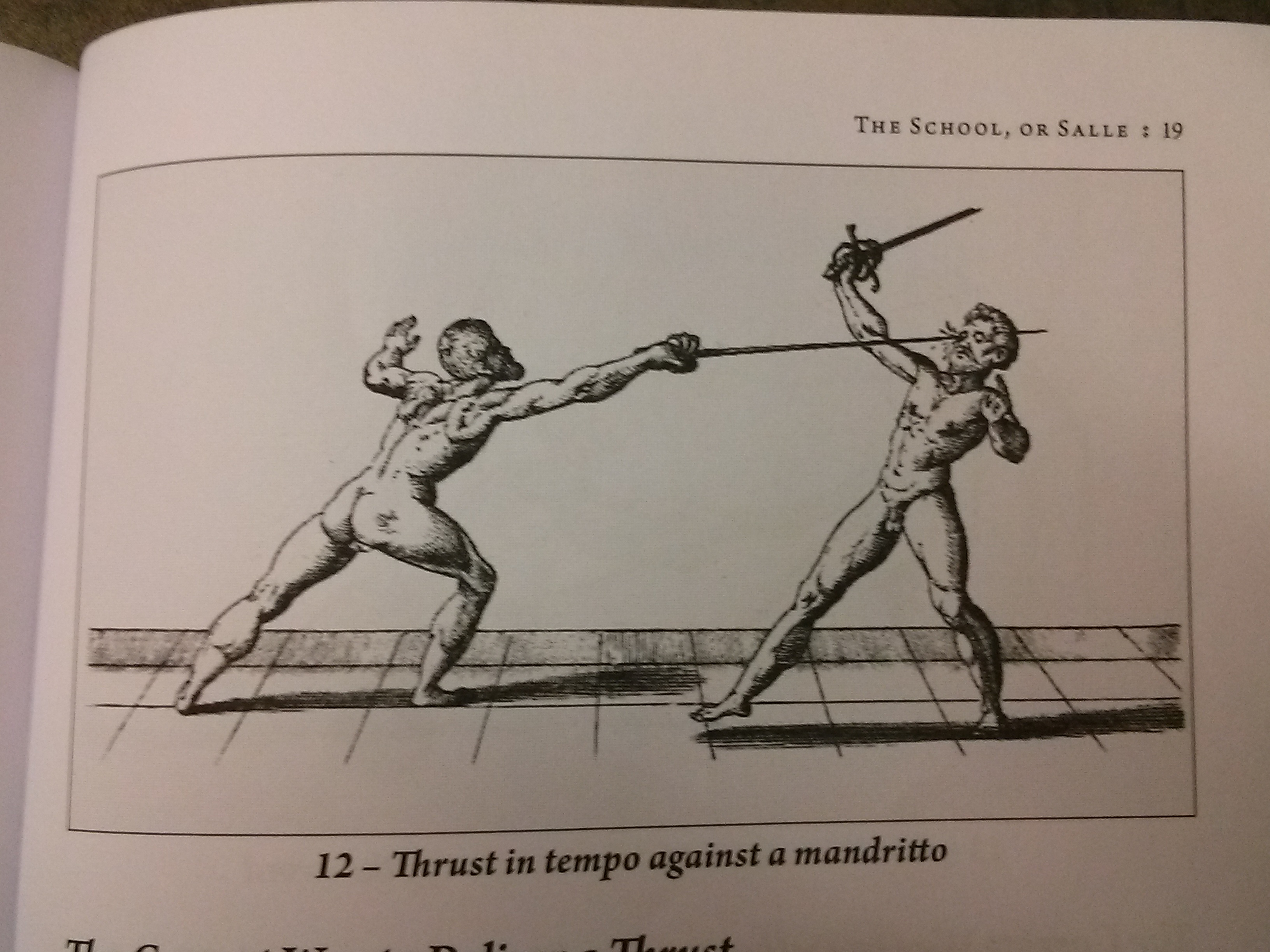
When discussing cuts it’s always worthwhile to remember Di Grassi’s (and others’) admonition that the thrust is faster than the cut. It covers less space and uses fewer muscles. This is why it eventually supplanted the cut as the primary strike in combat1.
Giganti’s guide to C&T in one picture
Countering cuts:
Thrusts are smaller tempi. In general, if you can counter a cut with a thrust, it is a good idea to do so. All rules regarding contratempo attacks apply, all the same tempi are still available. As a result, fighting cut and thrust is the same as fencing, in Italian Rapier, with the added benefit of being able to deliver a cut when positioning allows.
The primary response to a cut is to impose your forte in the way of their foible and lunge. Prima becomes especially useful here since it counters high cuts while keeping the point online. This contratempo attack-with-defense is made even easier in most C&T fights because fighters tend to start with their points off-line or bring them off-line to begin the cut. While it’s tempting to believe this makes it more difficult to gain their blade, it in fact makes it easier. Their line of attack is made clear (what direction is the edge of their blade facing?), the time required to change to a new line is even larger.
All of these counters to cuts also work against fighters who like to use beats against your blade (a beat is just a cut to the blade). The most elegant response is to lunge into the beat so they end up on your forte, and continue forward to land the kill. Here, though, since the attack is against the sword and not your person, a cavazione is the easier counter to execute.
All of the same counters against thrusts work against lunges. Cuts can be voided, though since the blade has lateral motion voids must be away from the plane of that strike, either backwards to pull the target out of measure or at an angle to duck below the cut.
Delivering cuts:
In some cases, you may end up needing to parry or counter-cut into an incoming cut. This may pull your blade out of position to deliver a thrust. If it does, tramazzone (sometimes called stramazzone), cuts made from the wrist, are about the only cut worth throwing, since they cover relatively little distance and can be directed against small openings easily. In period these were used to damage the tendons of the sword hand and forearm, or to land cuts across the face and throat, or to damage the muscles of the leg and the tendons of the knee, as these are all targets quickly reached from a neutral guard. The added benefit of a tramazzone is that it does not move your forte much out of position, maintaining the counter-guard so that you can defend against the cut while striking in contratempo
If you have successfully passed on the outside or inside and seized control of your opponent’s blade, but your point has ended up out of position to deliver a thrust, cuts are a serviceable alternative. This can also be used if you have voided a vigorous attack from an opponent (especially voids to the inside, if you have gained their blade in the process with yours above theirs, you are already in position to strike their face).
Aggressive closers are also best discouraged by beats and cuts. Giganti talks about those who charge throwing beats and thrusts without any concept of tempo and measure. His advice is to beat their blade strongly away then stab them. Even should an opponent succeed in beating your sword aside, the cut permits a one tempo attack from any position as soon as they break their engagement, and footwork and bodywork can just as easily defend against a cut during this tempo as against a thrust.
1Though even in those forms we think of as cut-centric (e.g. German longsword) thrusts were an essential element and when armor was involved, the primary killing strike. In “La Jeu de la Hache,” a Burgundian pole axe manual, most plays involve countering the opponent’s blow with a thrust. After all, a thrust to the weak spots of armor was the way to end a fight in one strike, which is always the goal. For this reason the ban on thrusting in Battle of the Nations and its kin reduces those to a sport, not a simulation of combat.
Dante, frequent contributor and goad to this blog, has been busy the past six months putting together a book.
On Historical Fencing with the Rapier and Dagger
by Darren Di Battista et al.
When old HMA practitioners gather around the campfire, they talk about the good old days when all there was was Di Grassi, Saviolo, and Silver. To this day, many fencers of that generation still “fight Di Grassi,” and it’s a very recognizable style (sword held in second in the “broad ward”, weight a little forward of center – you’ve probably seen it).
Then, in 2004 Jared Kirby published his translation of Capoferro. There had been a translation by Jherek Swanger and William Wilson available on the internet since 1999, but it suffered from low visibility. However, by the time I began paying attention in 2005 or 2006, the Kirby book was on every fencer’s bookshelf. Still, nobody had dug in, read, studied, and applied Capoferro’s teachings.
During a coincident temporary leadership vacuum in Atlantia, Dante turned to Capoferro. He devoured it obsessively. In 2005 Tom Leoni published his translation of Fabris, which Dante also consumed. In 2008 it was Leoni’s translation of Giganti. All of the teachings of these ancient masters Dante studied and applied. He fire-tested his interpretations on the list field until he found the most successful interpretations (and considering the Italians had set out to fight in a way that directly overcame the style of Di Grassi’s era, it’s been a not insignificant level of success).
The result is that he does not just possess an academic knowledge of period teaching, but a practical understanding of how to use it against opponents of all stripes. This understanding is codified in On Historical Fencing with the Rapier and Dagger.
That understanding is expressed through the voice of an experienced teacher – ten years (or was it more?) teaching high school English classes, plus at least half a decade of teaching SCAdians and non-SCAdians the Italian system (including a massive day-long track of classes which I endured exactly once). The result is a clear guide to fencing. However, the clarity of the manual does not sacrifice nuance and detail, ensuring the reader is provided a full discussion of rapier technique.
The manual is laid out as a study guide, building from the basics of form (stance, guards, and lunges) to the fundamentals of combat (time and measure) to the techniques applying the theory to combat. It’s useful for students from the rank beginner up through intermediate fencers, and even more advanced fighters will find details they may not have previously considered (for instance, the benefits of retreating at a slight angle). Also included is helpful advice for some of the scenarios we encounter on the SCA and HEMA lists, where rule structures and safety equipment permit or reward actions and strategies that would have been rapidly excised through natural selection in the 16th and 17th century.
The forms and techniques are illustrated with side-on and head-on photographs, providing a three-dimensional demonstration of the art not available in period manuals or most modern interpretations.
I’m currently working with a brand new fencer, my Student who’s been around for a little over a year, and a fencer who’s been fencing for at least six years and has earned his kingdom’s scarf and white belt. All of these students, with their wide range of experience and knowledge of combat, will benefit from this book, and I’ve told them all to get it at least once. You should, too.
My friend and teacher Iskender once described my sense of humor as “like a shotgun.” I try to hit everything. To use a different analogy, if it comes across the plate, I swing at it. Understand this is the person who is now saying: Stop using “OoD”.
To bring everybody up to speed: With the creation of the Order of Defense, there is now a tendency going around to abbreviate it as OoD, usually accompanied by a Doctor Who reference.
Leaving aside the aliens, the basic practice in acronyms is to only use the first letters of the important words. NASA (National Aeronautics and Space Administration) is not NAaSA. FBI is not FBoI. University of North Carolina is not UoNC. USA is not USoA. So, the “o” is non-standard practice, to say the least.
Yes, stretches are made to make words, sometimes, for marketing purposes. OoD is not a word we need to make.
The Order of the Laurel is not abbreviated OoL or OotL. It is OL.
Members of the Order of the Pelican are not OoPs (Most of the time. Told you I make every joke I can), or OotPs. They abbreviate it OP.
Knights of the SCA are not KoSCAs or KotSCAs. They abbreviate it KSCA.
Nor are these orders called by the abbreviation of their award.
We call Laurels ‘Laurels’, Pelicans ‘Pelicans’, and Knights ‘Knights.’
It would be jarring to keep with the standard of the Laurels and Pelicans and call members of the OD ‘Defenses.’ Calling them OoDs is still worse.
The OD is modeled after the London Masters of Defense (properly abbreviated LMD, but I’m not dying on that hill). Call them such – Masters of the Order of Defense. The Knights (the other combat peerage) already set this example – they’re called by their title, Knight, not their order, Chivalry. Masters of the Order of Defense even abbreviates to a word (MOD) for those who need to be able to pronounce it or don’t wish to say nine syllables.
The Order of the Laurel, Order of the Pelican, and Order of the Chivalry are the peers of the Order of Defense. Fencing has been recognized as the equal of these other activities in responsibility, prestige, and dignity. To then call the Order of Defense something intentionally stupid or silly is to negate all that the OD represents. It is belittling the singular achievement that is the Order of Defense, the result of decades of hard work and perseverance. This is the most important thing that has ever occurred to rapier (it is not, I’m sure, the most important thing that will ever occur to rapier). It should be granted due reverence.
So, please, no more OoDs. You make Wistric sad. Wait, not sad. Scornful. You disrespect a thing worthy of respect. You get scorn.
As with all advice relating to fencing, I should conclude with: Cardio.
In single rapier the sword divides the world into two halves, the inside and the outside. Attacks are generally described as being on the inside or outside line (with variants high and low, and at various angles). To cover these two lines, you have one weapon.
In sword and dagger you have a world divided into thirds: Outside the sword, outside the dagger, and between the two. Now there are two weapons for three lines, an improvement over one for two.
This is where standard SCA sword-and-dagger combat lets it sit – trying to guard three lines with two weapons.
Sport-style Sword and Dagger
Much of SCA dagger teaching includes a ”Don’t cross the streams” message: Don’t parry your dagger into your sword, or vice versa. This leads to a tendency to keep them separate, which results in dead space between the weapons where the dagger cannot easily guard.
The worst applications of this result in a tendency to hold the dagger extended like a buckler, with the torso very square, and try to windshield-wiper aside incoming shots, relying completely on the dagger for parries. Attacks often are a reach to pick up the opponent’s blade before launching an attack. The result is a very open guard, vulnerable on the center-line below the extended dagger, and along a line parallel with the opponent’s sword, as well as outside either weapon. If an incoming shot avoids the half-circle covered by the dagger (either by going close to the opponent’s sword, or parallel to the outside of the opponent’s dagger arm), a motion of the hand and the arm is required to make a successful defense. This is a slower motion than the attacker’s tempo of the hand to perform a cavazione – the smaller, fewer tempi will win.
Meanwhile, since the sword is not being used for defense, it’s often held out of presence so that it covers none of the fighter’s body, leaving the torso even more exposed.
Even fighters who hold the weapons closer together, but leave the center line open, must make a lateral motion from the shoulder for their parries. Said center-line is still vulnerable to angled shots that slip between the weapons or enter parallel to either (I favor a roverso squalembrato – descending offside – from guardia di testa – arm extended at shoulder height, sword angled upward and slightly forward to the left in front of the face – which drops into the dead space between the dagger and sword).
Giganti says of a guard with the center-line open they are, basically, good against less experienced fighters but “you should not use it against opponents who have an understanding of tempo and measure and who are equally skilled in the full-intent thrust and the feint.”
Joining the Weapons
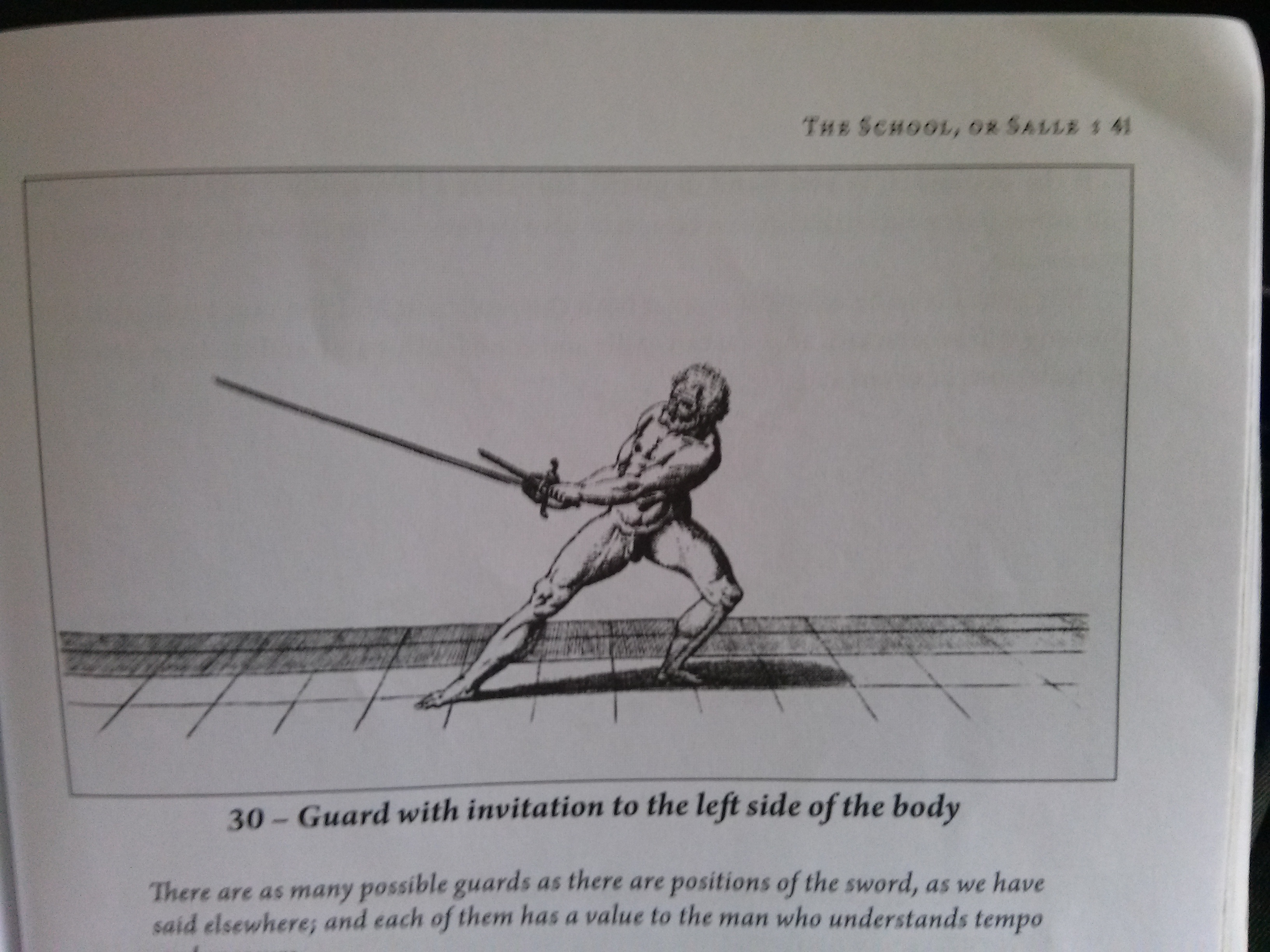
Italian sword-and-dagger includes the concept of “joining the weapons.” It is a rejection of the “don’t cross the streams”axiom in favor of a union of weapons in space and in action. To start with, by holding them next to each other and angled together, the dead space no longer exists. There is no inside line. Instead of defending three lines with two weapons, two lines are defended with two weapons, one for each. By keeping the sword pointed at the opponent’s sword shoulder, it now covers half of the fighter’s torso, with the dagger covering the other half.
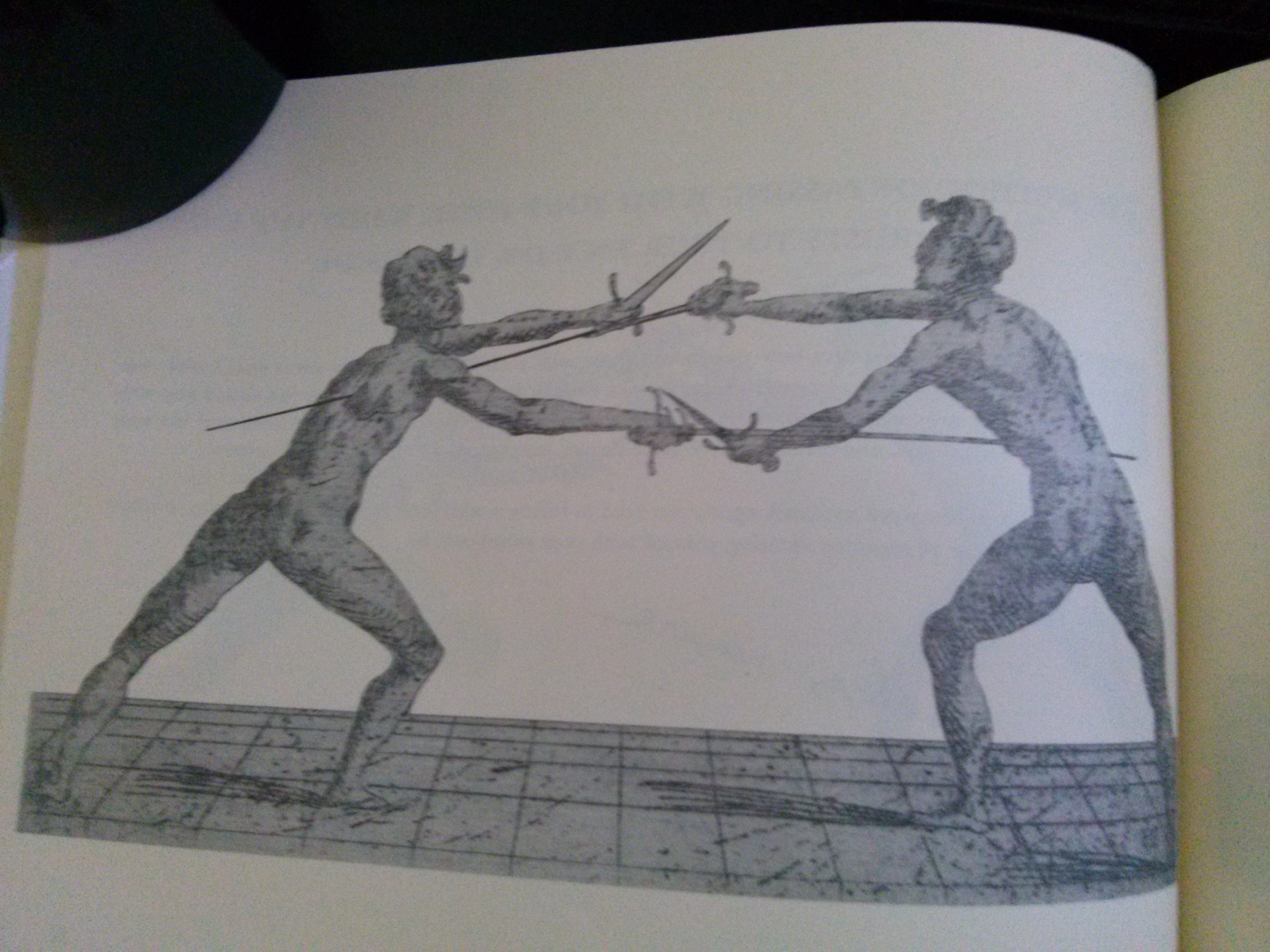
As mentioned, there is a high and low “line” on the inside and outside, so as a result the Italians have four dagger “parries” (which, since offense and defense are the same, also are the means of gaining the blade during an attack). The extension of the arms begins the motion, with the weapons and extending together. As always, the true edge is kept toward the opponent’s blade, but the sword goes to the opening (if the opponent’s blade went high, your sword goes low, and vice versa). The result is an attack parallel to the opponent’s blade and arm, and close-in, making it difficult for the opponent’s dagger to parry (at this point, if the opponent does try to cross the streams, it will actually keep the sword online for the kill). For the opponent’s sword to parry, the point must be brought off-line to cross your sword and be able to move it offline, thus stopping the attack (this attack in parallel to the opponent’s weapon or limb is called scannatura, or “throat-slitting,” by most Italian scholars).
The dagger rolls or slides either upward or downward to form a vertical barrier in the high or low line left open by the sword, ending with the wrists close together or the weapons close together. Rotating the torso away from the opponent’s sword strengthens the parry and also forms a void (see: Bodywork). The result is a wall of steel opposing the incoming shot while the sword counters into the opening. In illustrations some space is usually present between the wrists or weapons – once the parry is made the opponent’s blade is moved even further offline, resulting in this opening but only once it’s safe to create.
Any attempt to get around these defenses must take a large disengage, taking the blade off line and thereby ending the attack, or off-line step, a large motion to execute during an attack. Here’s where some more brilliance occurs: Note that in the guard pictured the arms are mostly extended, though angled downward. The remaining extension comes from lifting at the shoulders and leaning the torso forward. The dagger and sword are rotated into position from the shoulder as well. The elbows and wrists remain largely uncommitted, meaning the smallest, fastest body parts are still free to react to any possible counter action from the opponent – your counter is the smallest tempo in the fight (as opposed to the “sport” counter of significant shoulder movement).
Guards
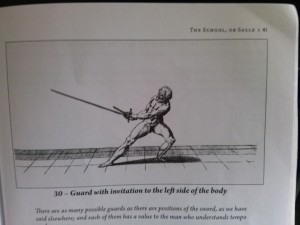
Giganti describes the above guard, the invitation to the left side, as the best – it’s one of only three actual guards in his first manual (the other two are the invitation on the center-line, and see the quote above for his thoughts on that guard, and the invitation to the right shoulder). By giving only one opening, it forces the opponent to begin his attack on a known line, and his options from there are limited – your opponent starts in obedience. As mentioned in the bodywork chapter, this guard supports strong parries combined with voids. Adding in passing steps, especially on the outside, voids further and sets up the parry and the strike with almost no arm motion
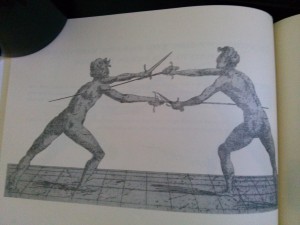
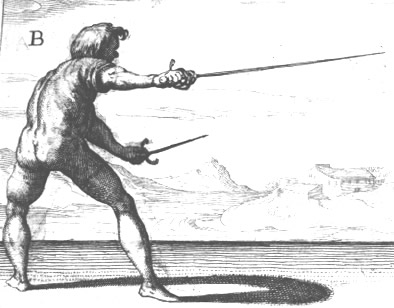
Still, Giganti’s presentation is limited (partly because he intended his second book to be the more thorough treatment of sword and dagger, and then kind of half-assed it). Fabris takes the concept of joining the weapons and moving them into defense through footwork and bodywork only to something close to beautiful, beautiful insanity.

Fabris just showing off
The opponent can attack only under your swords here. Rotating the torso brings either your dagger across to close to the outside, or your sword across to close to the inside. Your opponent can disengage around your weapons, and would take a large motion to do so. However, you have yet to commit the arms and hands to an action, freeing them to then be used to counter a disengage. (While Fabris is squared up, which I criticized in regards to “generic SCA practice,” the forward bend deprives the opponent of access to the chest and really only places the head and shoulders in range – and they are behind the blades)
In each case, these are guards where the opponent has only one option of attack (and the possibility to disengage once your counteraction has begun, but again only to one line which you are easily able to counter).
Bodywork
Most ancient masters and modern instructors discuss footwork and bladework as the means of controlling access to your target area and creating access to your opponent’s target area. “Bodywork” – the movement of your torso to achieve these same goals – is rarely addressed except in the context of the voids previously addressed (ducking and leaning to get out of the way of an attack).
However, bodywork comes into play from the moment you come into guard. Most fencers are taught to stand in one particular way, with their left shoulder back to minimize target area – a holdover from strip fencing. However, a more adaptable guard keeps the fencer safer and readily forms counterguards.
Capoferro’s neutral terza looks more or less like the body position most fencers are taught when in guard (except for the backward lean to get the head and vitals even further out of range – which is an instance of bodywork increasing the distance your opponent must travel).
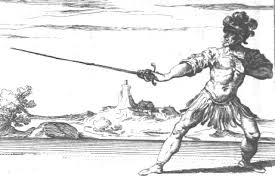
However, his guard when engaged to the outside is nothing at all like it. Instead, the torso leans inward and the left shoulder is brought forward.
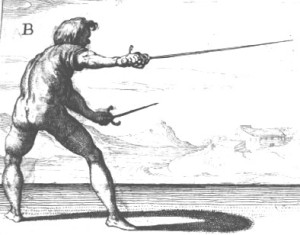
To what end? The target area is moved further away from the opponent’s blade, this time laterally rather than linearly. Also, the sword arm extends straight at the opponent’s debole, keeping all of the body united behind the strong of the blade (the ricasso, elbow, right shoulder, left shoulder, left knee, and left foot are more or less in the same plane, just as they are in the terza guard).
Remember that with the inquartata the rotation of the upper body can move your sword from being found to having found your opponent’s blade. This can happen without a void and, depending on positioning, sometimes without any footwork at all (at most a small step to the outside or inside is sufficient). Leaning slightly back or forward can also change the angle enough to give you advantage. All of these motions are a matter of inches and fractiosn of inches. These gain control of the blade without any action on the part of the arm. If, in the tempo of one of these actions of the body, the opponent should cavazione, the hand is free to contracavazione and deliver the kill. By adding in these tempi of the body, you now free up more ways to exploit tempo.
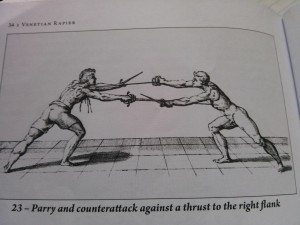
In Giganti’s sword and dagger section he presents a number of plays that essentially end the same way: The dagger driving the opponent’s blade offline to the outside and the sword inline for the opponent’s chest or face. These sword and dagger positions are achieved almost entirely through bodywork from Giganti’s basic sword and dagger guard.
The lean of the body to the inside and forward, bringing the left shoulder forward (just like Capoferro’s guard above), while holding both weapons in position relative to the shoulders, raises the sword to seconda in the high line. Meanwhile, the angle of the dagger gains the opponent’s blade (in concert with the lunge or passing step, and extension of the arms, closing measure).
The above examples show bodywork controlling measure, tempo, and line – the essence of combat. Unfortunately, the manuals don’t go into much depth on how to expand this into general principles for application during the fight (“Move your body away from the sword” and “Keep your body aligned to exert force” seem ready lessons to take away). Also, the scope of any sort of distillation is beyond a mere blog post and probably beyond my knowledge of body mechanics (bodywork is one of the things I am consciously working on at present). Most importantly I could not do nearly as good a job as Steven J. Pearlman did in “The Book of Martial Power.” It has no discussion of fencing in it. Yet, it discusses the means of aligning the body to exert the most force or cover the most distance with the least effort; of positioning the body to be essentially immovable by your opponent’s efforts; and of shifting your line of attack by small movements of the feet, hip, torso, or shoulder.
During a normal find or parry, the sword is moved laterally or vertically to close the line. During a void, the body is moved laterally or vertically from the open line to a closed line. This bodywork can also be applied without active voids, as we’ll discuss.
Voids against attacks on the inside

The Scanso della Vita of Capoferro
The most common version encountered (and the one Giganti focuses on in his first book) is the inquartata (as illustrated above in Capoferro). Called also the Volte by the English, Girata by Fabris, or Scanso della Vita (“Life” or “Waist,” both worth noting) by Capoferro (so, it was really popular), this void brings the rear foot behind the body until it is ahead of the sword foot, rotating the hips to face almost backward and pulling the target area completely out of the inside line. Meanwhile, the sword is held extended in quarta (thus the name) to form a barrier against the opponent’s blade. This void appears in a number of settings, though in each case it’s a contratempo counter to your opponent’s attack: If found on the outside, the void with a disengage forms a cavazione to close the inside line while controlling the opponent’s blade. If the opponent attacks on the inside line without finding the blade, your blade doesn’t need to move at all to deliver the kill. If the opponent should have you found on the inside line, the rotation of the body provides the angle to counter-find.
However, this motion requires moving the rear foot which, in a normal guard, holds almost all of the weight. As a result this is a relatively slow and large motion (though, just like passing, it can be achieved by essentially falling to the outside and bringing your foot around to catch yourself. Practice on a soft surface).
Capoferro and Agrippa teach another option (Capoferro calls it the “Scanso del Pie Dritto (Right Foot)”, Agrippa labels it as his guard G) achieved by moving the lead foot. The foot either turns 90 degrees to point to the inside or takes a step to the outside while performing that turn. Either way, it further rotates the hips to face to the inside, bringing the torso more into a line behind the sword. With the step, the body moves toward the outside even more.

Agrippa’s G, void by moving the right foot
Voiding backwards and downwards
Voids can also be performed backward, by leaning back and bending the rear knee even further, though this requires an exquisite control of range to cause your opponent to come up just short. From here the knee forms a powerful spring to drive your blade through the unfortunate opponent. If you want to demonstrate mastery of measure, there are few better ways.

Passata Sotto – For when merely winning isn’t enough
The most beautiful void, in my opinion, and probably the most humiliating way to kill your opponent, is the Passata Soto: Kick your rear leg backward, drop down, and catch in the three-point stance illustrated. Just as voiding backwards requires mastery of measure, this requires both a great sense of acting in counter-time and an opponent willing to attack vigorously.
Voids against attacks on the outside
In general voids to the inside are given less attention in Italian Rapier. Giganti discusses a few in his second book, but only describing briefly how they’re done: either passing the rear foot forward to the inside, or the lead foot backward to the outside. Other authors give similar short shrift: almost none bother to give names to these voids. However, as illustrated by Fabris, there’s often a downward element: Leaning down and out of the way while stepping to get the body below the blade, while rotating into prima.

Voiding to the inside
On the Vita
While “Vita” in “Scanso della Vita” can be interpreted as “Waist”, and is probably the more literal translation for that void, it can also be interpreted as “Life” (see: Curriculum Vitae – or “What Have you Done with Your Life?” Enjoy your next job search). I believe Mondschein, in his Agrippa, mentions that the Italians believed our life force was centered below our belly button. This is right where your center of mass is. So the Scanso della Vita is about moving your center of mass. Recall, also, that passing steps and most footwork is about letting gravity move “you” (really, your center of mass).
In The Book of Martial Power (which is the second book all fencers should read – Giganti being the first), Stephen J. Pearlman discusses thinking of movement as moving your center of mass. Rather than focusing on footwork, move your vita where you want it to go, and your feet will follow. This reduces the number of things to think about from two (left foot and right foot) to one, simplifying your reaction time and freeing up processing power for killing.
We naturally try to duck or get out of the way if something is coming at us. Most fencers get so focused on staying in posture and guard that they resist this urge. However, if a shot is coming at you DUCK! LEAN! Get out of the way! Just keep the sword in the way of their blade and, if your vita moves, move your feet to catch yourself.
Moving on from theory and swordplay it’s worth taking a moment to discuss the footwork Giganti employs beyond the lunge. He barely addresses advances as most fencers understand them (step the front foot forward, bring the back foot up to end in guard), and they may or may not exist in his system at all – only showing up as some variant on “advance to measure.” In contrast, Giganti goes into great detail with passes. Second to lunges, a passing step covers more distance than other any action. It takes longer than the lunge, which is why it is not preferable in general but can be useful in certain situations. There are two different types of passing step, though the types are not distinguished well within most manuals, and it is the situation that dictates which should be used.
From guard or from the completion of a lunge, passing begins with gravity. By letting the front knee buckle (stop resisting the weight bearing down on it), the fencer begins falling towards the front foot. Bringing the rear foot ahead of the front catches the fencer’s weight and redirects the momentum horizontally forward. Whether the hips rotate in this action or not dictates which of the two types of passing steps occurs.
The first type is usually just referred to as a “pass”. This is a single step, ending with the rear foot ahead of the sword foot, and including the rotation of the hips to turn the body from facing to the inside to facing to the outside. These are best used when passing to the outside. The rotation of the whole body keeps the line firmly closed by moving the body “behind” the sword (from the perspective of the enemy’s blade and his lines of attack) and brings your off-hand close to your opponent’s blade to either block a disengage or, if in range, seize their ricasso or guard and immobilize their weapon completely.

Outside pass to seize the guard

You can also half-sword during the outside pass to drive through any sort of resistance from your opponent. I highly recommend it when you need a pick-me-up.
The other type is, unfortunately, usually also called a “pass.” My habit is to call this a “full pass”. Earlier Italians called this a trapassata (“passing through”). These passes end with the sword foot forward, and include no rotation of the hips or body. This is really two steps: The rear foot is brought ahead of the sword foot, but still pointing slightly to the inside rear, so that the upper body is not forced out of alignment, and the sword foot is brought forward to return to the guard position.
At the mid-point of a trapassata on the inside.
Just as the pass is useful to the outside, this is more useful to the inside, as it keeps the rear shoulder back away from any attack on the inside line (rotating the hips here would cause a moment of squared-ness, opening the centerline to your opponent).
When in guard with the weight on the rear foot, retreats are achieved by kicking the rear foot back a few inches and falling on to it. This has limited distance. A backward trapassata can achieve a larger retreat, and, in general, trapassata control measure more smoothly.
Fabris also mentions “proceeding with natural steps,” simply walking forward – which is, after all, just falling forward and catching yourself repeatedly. This is inherently squared up, which Fabris counters with his deep forward bend to obscure target area.
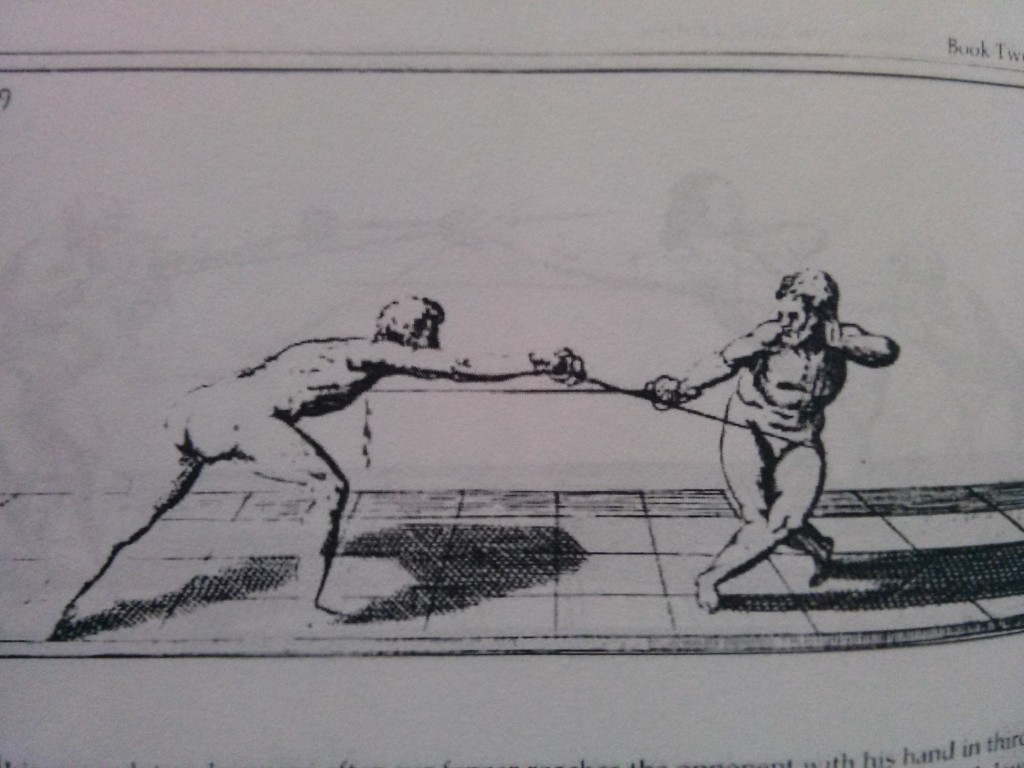
Passing steps also facilitate some excellent disarms:
Disarming when the hand is in quarta
From the outside against a sword held in quarta, the sword can simply be removed from the hand by pulling the pommel toward you. A hand held in terza or seconda from the outside can be levered back over your opponent’s sword shoulder, unbalancing them backward (not exactly a disarm, but a useful teaching aid against charging bulls). It can also be rotated, palm up, over your own sword shoulder into an armbar.
When passing on the inside, you can seize the opponent’s hand in seconda, twist it into quarta, and remove the sword by pulling on the pommel. If their hand is already in quarta you can skip the twisting step. Also, seizing the guard in any position and pulling toward you will pull them off-balance toward you, or pull the sword from their grip.
Of course, these risk breaking fingers or other bones, and should only be performed against somebody you don’t like very much or who owes you money.