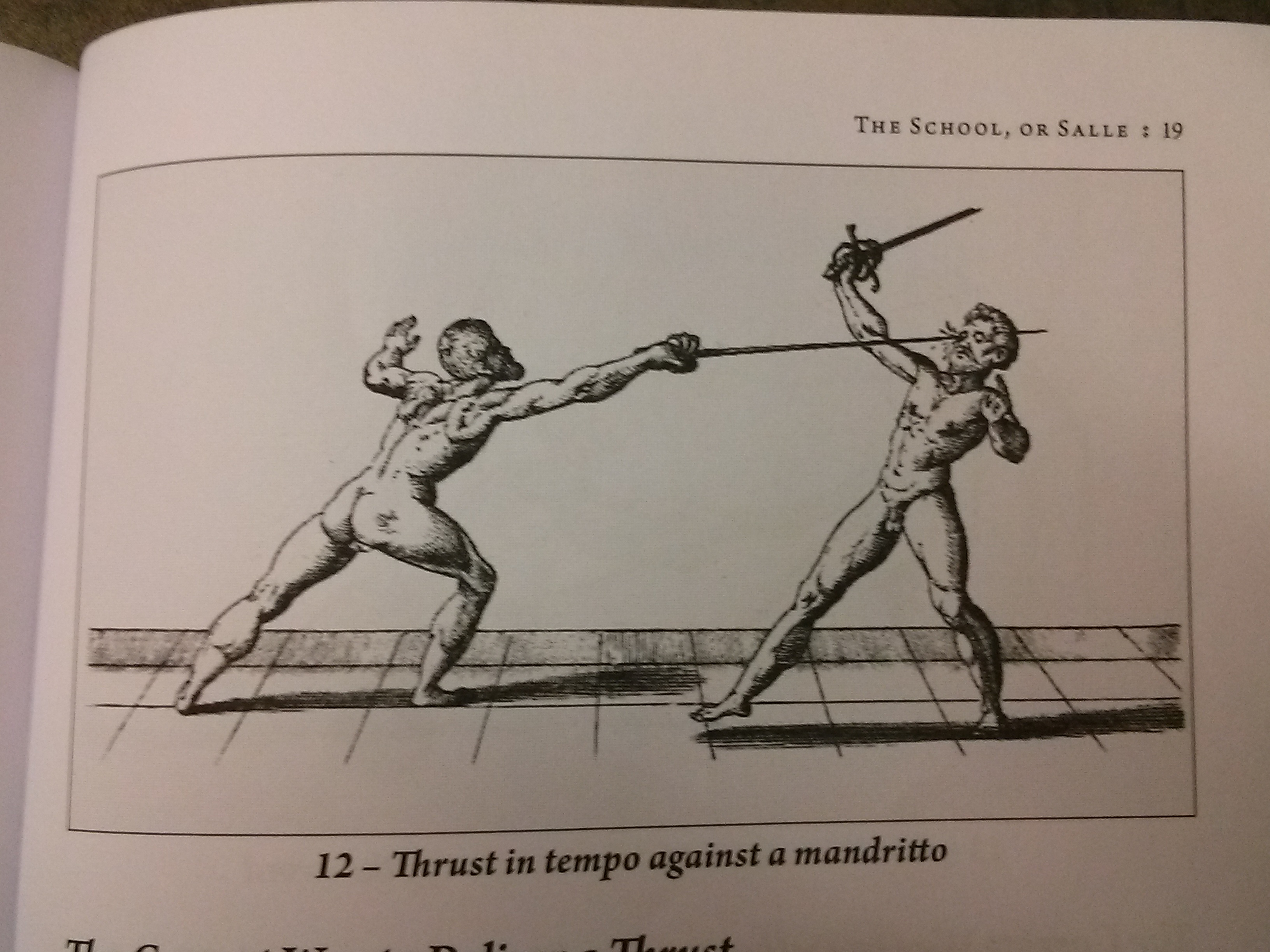
Up until now the basic tactics of Italian Rapier have been to set yourself in guard so that your opponent’s line of attack is closed (limiting their options) and, when they give you a tempo by performing a predictable action in measure (either stepping to measure, stepping laterally, performing a disengage, or attempting to beat or gain your sword), performing a lunge or cavazione in that tempo to strike them. However, all of this assumes your opponent will give you a tempo to exploit, which may not always be the case. In these instances, you must force a tempo from your opponent by performing a feint.
Giganti, along with almost all other masters, starts out teaching feints by instructing the most basic feint, and the one familiar to most fighters: the feigned attack followed by a disengage. In this, the fighter extends their blade as though initiating a lunge, stopping only at the moment when the foot should move and, when the opponent moves to parry, performs a disengage to attack on a different line. If the opponent does not attempt to parry, the foot moves to complete the lunge and land the strike.
Worth noting is that the feint begins the same way an attack begins. Too often fighters on the list just waggle their swords, thinking that’s an effective feint. Usually, though, it just commits their sword to an action neither offensive nor defensive, which can be exploited by their opponent.
The more general pattern of the feint is to pretend to perform (“feign”) an action which requires a known response by your opponent to counter. The example above is the feigned attack. However, any tempo (either of action or inaction) that prompts a specific, predictable response can be thought of as a feint.
When found, you can perform a cavazione that, depending on the measure, will draw a counter-find or parry. Reversing the direction of your cavazione mid-movement will return the blade to the original, now-open line and allow you to complete the attack. This is a “feint by cavazione.” Just as the feigned lunging attack can be realized into a true lunging attack if the opponent does not respond, the feint by cavazione can become a true cavazione attack if the opponent does not move to parry.
There is also the concept of a feint by invitation (the fancy word for “a trap”). Giganti is especially fond of these when it comes to sword and dagger (the three sword and dagger guards he shows are all invitations of one sort or another). This is, essentially, a feint by inaction – When at measure, when you should be closing the line and attacking, you instead present a specific opening for your opponent to target. When they do, you close the line and counter attack. The counter to a feint by invitation is a feigned attack – when they move to spring the trap, cavazione.
Any tempo which requires a specific response from your opponent can be a feint.
There’s a concept that Giganti also discusses, especially in the context of being out-gunned (e.g. single sword against sword and dagger, or facing a stronger opponent throwing cuts). He instructs the fighter to “show fear” to draw their opponent into an over-confident attack resulting in exposing the opponent’s weakness. Again, this is a feint, but in this case feigned weakness. The goal is the same: By pretending to do one thing (Be too scared to attack), the fighter draws a desired response from the opponent (an over-extended attack) which can then be countered effectively.
When Giganti describes masters as not exchanging blows but instead as exchanging wiles and deceits, it is feints he means.
This all becomes disconcerting when the student realizes that a feint is not actually a real thing. When training feints (and here we’ll use the example of the feint-attack), the fighter usually starts with the extension, a pause to determine whether or not the opponent is responding, and then either the continuation or the cavazione. However, by introducing that pause, the fighter breaks the attack into three distinct tempi, any of which may be countered separately (a counter-thrust during the extension or lunge, or a counter-find or contracavazione during the cavazione). The fighter then must train to respond to the counter-thrust in the tempo of the extension, by performing the cavazione (if the counter-thrust includes a find) or cavazione (if it does not) during that first tempo, eliminating the pause. The fighter must instead be trained and ready to counter in tempo any contratempo action during any action without a pause for analysis. All actions are “feints” or “real,” and the distinction becomes meaningless.
Once your opponent is responding to your actions in this predictable fashion, you have placed them in obedience (see: Tempo).
WOOOOOOOOOOOOOOOOOOOOOOOOOOOOOOOOOOOOOOOOOOOOOOOOOOOOOOOOOOOOOOOOOOOOOOOOOOOOOOO
HOOOOOOOOOOOOOOOOOOOOOOOOOOOOOOOOOOOOOOOOOOOOOOOOOOOOOOOOOOOOOOOOOOOOOOOOOOOOOOO!!!!!
We understand the trepidation of some regarding this. However, we also feel that a) The Royals will determine who will be in this order and after 50 years no set of Royals have been able to make any decision that has destroyed the SCA, so they probably won’t start now, and b) The result will be an Order of the very best, by all standards, of the Rapier Community. We have faith in their ability to navigate around the potholes.
As you may have realized, we here at the Warfare like fighting. What’s more, we strongly advocate the continued quest to improve ourselves on the fighting field and off. We view the MoD as recognition for those who push further down this path than the vast majority, standing far out ahead of the field, and call us to join them.
We also suggest familiarizing yourselves with the changes to Corpora and Corpora‘s general definitions of a peerage (VIII.A).
There are three actions that are the basic elements of the Italian Rapier decision tree: Gaining the blade, lunging, and performing a cavazione. Really, the majority of actions in Italian Rapier are going to boil down to one of these things. Gaining the blade and lunges have already been discussed, so it’s probably a good time to discuss the third.
The term “cavazione” gets used interchangeably with the modern term “disengage,” which is to circle the blade around the opponent’s to get to a position of advantage. If you are in the position of advantage, there’s no reason to perform a cavazione.
However, cavazione also has a component of footwork included (Giganti discusses almost completely in terms of disengaging while lunging; Capoferro also considers cavazione to include disengages while advancing and retreating). One of Mediema’s comments in his translation is that a potential translation of “cavare” (the verb root of “cavazione”) is “to drill.” He goes on to use “circling” for his translation. The image of a drill is a bit more instructive: With the forward motion of the lunge, the tip of the blade follows a spiraling path much like that of an auger bit.
With modern weapons, disengages are generated by a turn of the wrist. This is a result of the lightness of the blade and the balance point inside the grip. With a period rapier of appropriate length and weight, the center of mass of the blade will be in the ricasso, one to two inches away from the guard. Trying to wrestle this around by making a circle from the wrist takes extra energy and time, and fights gravity, which as we’ve seen with other actions is antithetical to Giganti’s approach to rapier.
To use gravity to advantage in this case, the fencer just relaxes their grip. By opening the hand slightly, gravity pulls the tip down. When accompanied by an angling upward of the wrist, this puts the center of rotation of the blade at the center of mass of the blade, meaning the minimal amount of effort is needed. Once the tip has passed under the opponent’s blade, tensing the hand back up presses the pommel back down to bring the blade back up on the opposite side of the opponent’s blade. A slight inside or outside element during the wrist angle, and directed pressure when restoring the grip, achieves any lateral motion necessary for the disengage. If the opponent is parrying, their motion will accomplish the lateral movement necessary for the disengage to be successful. Once complete, the wrist straightens back to form the straight line from elbow to point.
If the cavazione begins in a position of disadvantage, with the opponent’s true edge resting above the false edge of your sword, the circling motion brings your blade on top of your opponent’s blade with your true edge against their false. From a position of being found, you wind up with their blade find. And, since this is a cavazione, by performing the disengaging action during the extension of the lunge, you find your opponent’s blade and safely deliver your strike in a single tempo.
Certain “types” of cavazione are identified in Italian Rapier, though they are all basically the same action.
When performing a cavazione, if the opponent rotates their blade to oppose the new line with their true edge (a generally safe counter when just outside of measure), a second cavazione back to the other side is called a “ricavazione”.
A cavazione performed in the tempo of the opponent’s cavazione is called a “contracavazione.” This action results in the blades ending up in their starting orientation (whoever was found before the first cavazione is found at the end of the contracavazione). Contracavazione are useful (and so very pretty) at measure.
Inside measure or in concert with some voids, a full cavazione may take too long or take the point off line. In these cases, performing a cavazione that only travels through a quarter arc, dropping from a high line to a low line for instance, is called a “demicavazione”.
At a broader level, a cavazione can be thought of as a change from a closed line to an open line while attacking. With the distances between fighters in Italian Rapier, the resulting angles of attack at measure are fairly narrow. As a result a very linear style is most efficient, and the cavazione is the best means of achieving this change of lines.
However, when found, a sword can also be moved away from the find (e.g. if found on the inside, move to the outside) by motion of the hand, body, or feet, which will re-establish access to the previously closed line and create the opportunity to angle the blade back across your opponent’s, finding theirs in turn. This is called a “yield.”
Small motions of the body and feet outside or at measure are part of the contest for control of the line. Inside measure, yields are an element in some voids. For instance, when found by an opponent on the inside, an inquartata (void in quarta with the palm up while moving the body to the outside) exploits this change of angles to re-establish control of the inside line.
The seven chapters so far cover the first eight pages of Giganti’s manual. They may be the most important eight pages in any fencing manual (I may be biased). Gaining the blade, lunging, and performing a cavazione, when combined with the control of tempo and measure and the knowledge of when to perform each, are the foundation of masterful fencing.
(Because fighting can’t happen without a place to do it)
The SCA is running into an increasingly more common situation. The basics of it are that our expectations for event site costs have not kept up with the reality of event site costs, which has kept event cost inflation artificially low, and we’re approaching a point where that’s going to snap and hurt hard.
Most groups have preferred sites. They go to these wells over and over. Long-standing relationships mean that there’s little variation in price over the years. Groups get complacent, autocrats don’t want to find new sites, so they go back to the well, and inertia sets in. Right up until the well suddenly goes dry.
In the best cases when a site suddenly becomes unavailable, a scramble ensues to find a new site, usually with increased cost or diminished amenities, or both, resulting in a decrease in attendance. In the worst cases, the event gets cancelled.
I’ve had recent experience with three events losing, or almost losing, their long-preferred sites.
Ymir, 2014:
In October 2013, we were informed that Betsy-Jeff Penn 4H camp was closing, and would not be available for Ymir in 2014. I spent three weeks researching equivalent sites (cabins, kitchens, etc). And that “equivalent” is pushing it. Many had unheated cabins (for an event in February) and worse, or no, kitchens. There was another older, smaller 4H camp that we eventually were able to get a cost price on, and which became our second choice. Luckily, we received news that BJP would not be closing. “Unfortunately,” they said, “we will need to raise our rates, and could you do your event two weeks later in the future?” Their rate increase was about 10% of their fee, not 100%, which after all the site research was as painless as it could be. I still think they should be charging half again what they do and using that to fix the site up. And site fees went up $5 this year (which was more than 10%).
Castle Wars, 2014:
Over the summer the Barony of South Downs was informed that it was losing its site for its premiere event, Castle Wars, which was scheduled for the fall. The site, Lake Tobosefkee Park, had ample camping and field space, and was at a very manageable price. The county had sold it to a water park developer with no notice. An all-hands on deck scramble ensued to find alternate sites. Finally a state park was identified. It had roughly the same amenities, but with a more complicated and expensive pricing structure.
Midwinter Arts and Sciences, 2015:
Another of South Downs’s events also lost its many-years-used site last year. This year I am autocratting the event (so I spent the second October in a row looking for sites. I really am a curse on events). This is the Midwinter Arts and Sciences festival, an indoor event with feast. As with Ymir, I discovered that equivalent sites tended to be at least double the price of the previous site. The site we eventually decided on was more expensive (actually beyond the “preferred site price” stated by the barony), though not double, was smaller, and lacked a commercial kitchen. Also, it was dry. Feast has become a day board, but otherwise we are making due. This is usually the result of losing a long-term site: making due with less for more money.
From these three examples, the major drivers of future event cost and features will be land, alcohol policies, and kitchen limitations.
Land:
Land is always becoming more valuable. Land is taxed. Sites take up land. Ergo, site fees should be keeping pace with the increasing cost of land (the housing market crash may have stopped that for a bit, but it’s back in play). That’s if the site stays open. Any large chunk of land begs for development – a water park like Lake Tobosefkee, a housing development, or frakking (like Cooper’s Lake). Developer interest increases the value of the land, and site fees should be expected to spiral upward if the site will be kept.
Even urban sites are not immune: property values increase even more in cities. Buildings decay. The older a building gets, the greater its upkeep cost. As with “field sites”, development also threatens urban expansion replaces churches and rec centers with apartment buildings.
Alcohol:
Most overnight sites remaining belong to Scouting organizations, youth camps, or churches. These are rarely if ever wet sites. State parks similarly tend to have strict alcohol policies. Wet usually means at least an additional fee and usually also the cost of having a law enforcement officer on-hand at all times. I’ve found no site that accepts “We have many law enforcement officers in our organization” as a substitute for a local police officer, with you paying his hourly wage the entire time he’s there.
Kitchens:
If a site has a commercial kitchen, it is almost guaranteed that you won’t be able to use it. Commercial kitchens, after all, are inspected by the Health Department. Outside use presents a huge risk to continued certification by the Health Department. Some sites will permit outside use, but with requirements for SafeServ or other forms of certification for some or all kitchen staff. These cost money and take time. Would the local groups be willing to finance these? Even so, just showing up the day of an event and helping out in the kitchen would be impossible.
The dwindling availability of kitchens will mean the days of feasts at events will be sharply curtailed unless the SCA innovates. Portable kitchens are available for rent (or I know of some folk who have made their own), but these cost money, somewhere in the multiple hundreds of dollars, which means a multiple dollar increase in the cost of site or feast, before you even buy food.
We need to change our expectations.
The SCA as a whole, not just seneschals or autocrats, is going to very soon be forced to adjust its expectations. Events will cost more. Expect 50% increases. Feasts will be fewer and far between. There will be more day-trip events, fewer over-night events. Fewer events will permit alcohol. Events will be smaller. In my experience, these changes always make somebody unhappy. Those somebody’s never show up when it’s time to do the site research though. The more the populace understands in advance, the sooner it adjusts its expectation, the less shock there will be when the inevitable happens (and, let’s face it, ungrateful bitching to the autocrat).
The best thing a group can do to, right now, to preserve the longevity of its events is to start an annual, all-hands coordinated effort to find new sites and use them. Don’t get sedentary. Don’t let inertia take over. Have good relationships with multiple redundant sites so that when you lose one you can fall back on another. When the next annual site-quest happens, fill the gap that was opened. Don’t just let the list dwindle.
The all-hands part is the most important. It takes the load off of the autocrat working a month in advance of the event on no warning, which let’s face it means the best option will never be found, and shares it out over all the hands. Best of all, the entire canton, shire, or barony will have an understanding of the reality of the situation, not the nostalgia of the SCA ten years ago.
Ringcraft is a term that originated in the boxing world to describe, amongst other things, the use of positioning within the ring to create advantageous situations. Camillo Agrippa makes mention of this indirectly when he describes techniques for fighting when pressed up against the edge of a list fence, where contact with said fence was considered a defeat. In the SCA, we regularly fence within a constrained space and we often have inconsistent treatment of that space; as such, it behooves us to consider how the list fence can be used to our advantage depending on the situation. There are numerous articles on ringcraft in boxing and kickboxing, and I encourage everyone to seek them out as supplemental reading.
First and foremost, the single most significant factor is not the size of the list field (though that is a pretty strong second place), but rather the way in which a marshal will respond to one combatant being placed at the edge of the field. Some will demand that both fighters recenter, some will make you take a step or two back, some will simply offer a verbal warning of proximity, and some will only call for a hold after or as someone is careening through the fence. Other variations exist, but those are the main four outcomes with which you are likely to contend.
A marshal who calls to recenter the combatants presents an advantage to the fighter who is more willing to retreat, as what functionally occurs is an unlimited list field that can be fled into indefinitely. In such a situation, retreating directly backward or at an angle in response to any forward steps is a good strategy, as your opponent becomes increasingly likely to lose patience with you and become overly aggressive, offering your tempi in which to strike. Against an opponent employing this strategy, your best options are to either not press forward and wait them out, or to edge them right up to where the marshal is likely to call to recenter, pause briefly, and then act decisively when your opponent experiences an instant of hesitation in anticipation of the hold.
When the marshal moves your from the fence, but does not call for a recentering, it favors the fighter who suffers the least from having their concentration broken. It is often possible to get an essentially free attack by eventually restarting in wide measure and attacking the instant that lay-on is called; most people take a second to reset their minds, and this offers a moment where their defenses are weak. The best way to take advantage of this is to establish a pattern of retreat or passivity, and then to break it after 1 or 4+ cycles; breaking a pattern on the 3rd instance is too commonplace, and going only one extra is too predictable a gambit. It is important to make sure your pattern is a safe one that can’t be reliably exploited.
The marshal who offers a verbal warning creates an unintentional tempo that either fighter may use to strike their opponent. If one fighter is processing the sentence they are hearing, and the other attacks, it is likely that the defending fighter will not be fully prepared. From a processing perspective, striking on the second word of the warning is best because your opponent’s brain will have begun to pay more attention after realizing that something is being said; e.g. “the” becomes your tempo of action in “Beware the edge.”
Finally, if you have a marshal who won’t intervene until someone is physically pushed up against the fence or is falling through it, exercise better judgment than them and don’t push someone through the list fence. If there’s no actual physical obstruction, that’s one thing, but if you run the risk of injuring your opponent, bystanders, or damaging the fence through your next action, don’t do it. There are numerous ways to exploit someone’s fear of genuine injury, but none of them are acceptable in our competitions.
Now, if you get the opportunity to play at the edge of the list, especially if there is an actual obstruction, there are several things which you can do to find an advantage where one might not otherwise exist. One of my favorites is to maneuver the fight so that the fence is to my dagger-side. This means that I can edge forward and to my right, circling to a better angle of attack against an opponent who cannot fully circle to meet me. In such a circumstance, I would keep my sword forward to act as a sort of prod to eventually push them into a corner or strike after hiding that I have entered wide measure (this can be done with visual tricks such as leaving your dagger in the same space but moving your body around it). Were the situation reversed, without changing my feet, I would form a guard with the dagger forward and the sword refused so that I would be better situation to find my opponent’s sword with my dagger and strike in fourth or second with my sword in the tempo of their step.
Putting your opponent in the corner of the fence enhances all of the advantages of having them up against the fence, but severely limits their ability to escape from this situation. Once cornered, so much of their awareness becomes attached to a sense of being trapped that they are unlikely to be operating at their best.
It is also worth noting that angling your opponent so that the list fence is present in his or her peripheral vision can be useful since that occupies their attention. It is possible to note the moment the fence enters their field of view, as most people will dart their eyes over to confirm the presence of the fence. This can be detected and, failing that, they may also turn their head slightly; if you can see this happen, you can strike in that tempo.
This is far from an exhaustive take on the use of the list fence or other kinds of terrain, but I think it serves as a good example of what can be learned from other combat sports and applied to ours. Surely, anything we can glean from sports where millions of dollars are on the line each year will be of use to us, as decades of evolution and thought will have produced excellent strategy.
After teaching guards and counter-guards and the basics of theory, the first action Giganti moves to instructing is the lunge. There’s a good reason for this: If your entire plan is to take a single tempo and strike, the lunge is the best option. It covers the most distance with the fewest moving parts. Since your measure is defined by your lunge, any other footwork in measure is necessarily going to not cover the same distance, requiring more tempi to get to your opponent, thereby wasting tempi.
Many fencers in the SCA are familiar with the foil/epee lunge or some variant of it. Much of our fencing pedigree is rooted in modern sport fencing and the selection pressures that have guided change to the Society’s norms are for the most part slow and gradual (the most notable exceptions being the introduction and eventual dominance of schlager blades fifteen(??) years ago and the increasing availability in the past decade of period manuals on rapier combat). The fencer who was fast and agile with a foil or epee could, for the better part of twenty years, completely transfer those skills to the rapier list field. Even after the introduction of schlager blades, not much changed. As a result, thirty years after the start of rapier, most people are still taught to stand with their weight evenly distributed to enable them to move in any direction. They are taught to extend their hand and spring off their back foot. The result, which actually has to begin by pushing the weight off the front foot (meaning backwards onto your rear foot), is interchangeable with the modern fencing lunge and based on physicality, not efficiency.
This is not the lunge of Italian rapier. Giganti, after all, is efficient, or lazy, depending on how you wish to look at
The Italian Lunge
In Italian rapier, the lunge also begins by extending the hand. If you have formed counterguard (and a proper cavazione ends in a counterguard) your sword crosses your opponent’s in their debole. Your extension should be towards this crossing point. This moves your point closer to your target and the strong of your blade to the weak of theirs. Since this action occurs first, you’ve gained solid control of your opponent’s blade before they have an opportunity to parry. In some cases you will find extending through the crossing point moves your point off-line. This is resolved by angling your wrist at the end of your extension to bring your point back on-line (and well away from your opponent’s guard).
When the hand does not extend first before the rest of your lunge, your debole will end up on their forte. This makes extending the hand generally a good idea before doing anything (advancing, retreating, passing steps, breathing, sitting down, scratching an itch, etc).
With your sword extended, your forte and guard are your entire defense. Getting your target area behind them is therefore a good idea. Rotating the shoulders so they fall in line behind your guard, placing your body in profile, then bowing at the waist towards your opponent, to minimize your cross-section, accomplishes this and extends your blade even further. Tensing your lower left back muscles (your latissimus dorsi) will further extend your sword.
At this point there is some disagreement between Capoferro and Giganti. Capoferro has the head bowed down to get behind the guard as well. Giganti says the head should move last. Capoferro’s technique defends the head with the guard while Giganti’s defends it with distance. Since this is discussion of Giganti’s teachings of the Italian rapier system, we’ll follow his instructions as we work through the process.
As discussed in the guard chapter, holding your weight mostly on your back leg allows you to move the front leg freely. Even though you have bent your torso forward, the weight should still be held over your back foot. This is the difference between the Italian technique and the bad form of leaning forward demonstrated by many fencers – leaning forward is usually accompanied by putting more weight on the front foot, thereby preventing or slowing a lunge. With the weight held back, no energy or time is needed to move weight off the front leg before it can go forward. This is what Giganti calls “a stance that can be extended.” As simply as that, one of the largest tells of the modern lunge is removed, replaced with a simple movement of the foot away from the ground (either by lifting the knee at the hip or lifting the foot up and forward from the knee).
Once the lead foot is off the ground, gravity does all the work for you. The Earth pulls you down and forward (since your center of mass is forward) and you fall onto your front foot, now having extended your step into a lunge. This does not need to be the massive lunging step of sport fencing; a step of a foot-length will do. Explosivity is gained by straightening your back knee. This is different from springing off your back foot, which is the more common practice. Instead imagine standing with your heels flat on the ground and your knees bent, and then just standing straight up. This is also known as a “squat” in exercise circles. Now imagine doing that with just your back leg (a “pistol squat”, which is an impressive feat of strength and balance I cannot yet perform). It not only pushes your body forward, it also drives more force into your heel, firmly planting your rear foot in place.
At this point Giganti would have you bring your head forward. In my experience this compresses everything downward, pushing it more forward for another couple of inches of extension.
The Recovery
Just as the the head is the last thing to go forward in Giganti’s lunge, it’s the first thing to go back in the recovery. He is a fan of not getting stabbed in the face.
As the head comes back past the rear shoulder, and the shoulder therefore follows, the center of mass moves passed the rear hip. At this point, letting the back knee break will allow you to essentially fall backwards onto your back hip. Just like in the step of the lunge, where gravity did the bulk of the work, so gravity does the work for the recovery. Also as the back leg could accelerate the lunge, in the recovery contracting the back leg’s muscles will help to pull you backward. A very little push off of the front foot (peeling the toes back and pushing through the heel) can be helpful, but not necessary. As the torso comes back upright and into guard, the hand remains extended, with your sword above your opponent’s blade. It should remain that way until you have withdrawn completely out of measure.
First of all, let us make one thing clear up front: “discombobulate” is a great word and tremendously fun to say. It is one of those rare words that does exactly what it means if you say it too fast or too often.
It is also a pretty terrific thing to do to your opponent. In fact, I would go so far as to say that if I could discombobulate my opponent with an action that it would be a clearly superior action to anything that did not discombobulate. Can anyone argue with this? Will anyone say in the comments below, “No, I would not want my opponent to be uneasy, confused, distressed, and off balance”? I imagine not. It seems irrefutably obvious.
I use this particular word because it exemplifies a problem in thinking that comes up entirely too often: we get attached to an idea, and then we interpret our experiences in such a way as to support that original idea. We should, instead, be constantly examining and reexamining our ideas upon the introduction of new evidence, lest we go too far down the wrong path.
Somewhere, there is a fencer named Wayne who is studying the works of Nicoletto Giganti. I know this because he is mentioned, by first name only, in the Mediema translation/interpretation of Giganti that came out earlier this year. I bought a copy as soon as it was available, and sat down and read it in an afternoon. The case study of Wayne, I think, serves as a microcosm for the entire book.
A book which, by the way, I am glad exists and am glad to own. Differing versions can often make some passages more clear, even if only because a translation is inherently imperfect and sometimes we read things as other than they were intended. My favorite example of this is Thibault’s use of “two feet” of distance (hint: it is not 24 inches) that vexed me for two hours while I tried in vain to construct a circle. Had it been translated as “two shoe-lengths”, much frustration could have been avoided. In any case, creating a work and making it public does open one up to criticism, but a critic need not be excoriating in the process.
Mediema talks about a stesso-tempo response to a lunge as “splitting” their tempo, and interprets this to mean attacking during their recovery. That is certainly a tempo, and it certainly works. I’ve done it. You probably have, too. It is, however, inconsistent with (to my current knowledge) every single other person working from this manual or any other in the Italian traditions. Everyone else, including me, understands a single time counter to a lunge to mean that you should lunge into their lunge, displacing their sword and hitting them while they are fully committed to a forward action.
Maybe everyone else is wrong, and so am I. This is a possibility. Sometimes that happens. In the interest of fairness (and also, in the interest of not being wrong), I did consider this possibility, but was able to discard it for the time being based on reason. First, a parry and then a lunge during my opponent’s recovery is a dui tempi response, and second, it means that my opponent essentially gets a free attack on me before being threatened. This is contrary to good theory, where it is obvious that the best thing would be to offend and defend with one action, preferably as small of one as possible. This is irrefutable: achieving the same goals with fewer actions and less effort is better. In this case, it’s even safer!
But, in all the time it took to translate a work and practice it to the point of confidence, that seems to have not come up. That may very well be the case; numerous groups of people work in relative isolation to outside influences, and I am sure that I have some weird habits that probably evolved from the context of my fencing. I’m good at avoiding shots aimed at my toes, for example, even though such an attack would be absurd to even consider in a sword fight.
Here’s the thing: even if Mediema did not have outside influences, one of his students figured it out: his name is Wayne, and he lunges during your lunge. It is described in the book as being very “discombobulating”! (pg. 35) Here we have a clear case of a misinterpretation that is still good enough an idea to get positive reinforcement being met by a correct interpretation that should be immediately recognized as superior, yet is not. It’s even acknowledged, with language that conveys its superiority, and is then discarded! I can only theorize, but it seems to be a case of someone becoming too attached to being “different”; the sheer volume of anti-Leoni remarks in the work suggest this.
If nothing else, take this with you: never become so convinced of something that you ignore new evidence. It may not be compelling evidence, and it may prove to be unimportant, but it all warrants consideration.
Be like Wayne.
Since you have a human brain, you should know that it does not really work all that well most of the time. Sure, it’s amazing and wondrous and a genuine marvel of evolution, but it is nonetheless marred by all sorts of biases that are very useful for keeping a hunter-gatherer alive and are less useful for objective reasoning. If you think that these don’t apply to you, well, there’s a name for that: the blind spot bias.
The exhaustive list of biases and fallacies would take ages to explore, so I will be looking at some of the most common ones, organizing them by subject, and discussing how they can negatively affect your performance and training. Remember, it is impossible to do away with cognitive biases, but by being aware of them we can reduce their impact on our lives.
1) Negative Predictions, Underestimating Coping Ability, Catastrophizing.
It is apparent where these sorts of biases arise: in general, pessimism is a good survival tool. “I don’t have enough food, so I should work more” is going to be a better option than, “I am sure I have enough food, so I can take it easy” since something unexpected might go wrong.
This sort of thinking, however, has a significant impact on tournament performance. These biases are what create the downward spiral of: “I can’t do this. I’ll lose, and everyone will judge me. I’m too nervous to compete! I suck, and this is the worst thing ever!” If that is going on in your brain, then you are in for an uphill climb in the next round.
If I may, here are some realities that may be useful to remember:
You can do as well at any given moment as you’ve ever done at any previous moment. Your best fight ever is a thing you can repeat right now, here, today.
Maybe you’ll lose anyway. It’s really easy to lose, so everyone does it a lot, even the really good people.
No one cares if you lose. No one will judge you because it’s not worth the time or energy to them to bother. OR, someone will judge you, it will have zero actual ramifications, and you have no reason to care. If you have reached the level where people do care if you lose, like a war point, then accept that your opponent is probably in the same situation and you’ve signed up for a zero-sum game.
Being nervous should only happen when there’s something on the line. By the time you’re fighting for “something”, you’re hopefully experienced enough to remain calm throughout. If not, you might have been pushed too far, too fast.
It’s not the worst thing ever because the swords aren’t sharp; no one’s health or finances will be harmed through your defeat or enhanced by your victory.
2) Negatively Biased Recall, Self-Criticism, Expecting Too Much Enthusiasm.
These are some terrible little habits that we can get into to undermine our improvement. I am especially guilty of self-criticism and negative recall: when I do something poorly, I tend to fixate on that, even if I did well otherwise. In fact, I’m so bad about this that I focus on my losses in tournaments I ended up winning, and mistakes I made in fights I where I was the victor. I think my only saving grace is that I have an odd mix of characteristics where my ego is sufficiently strong that I can be utterly merciless, obsessively so, with the negative aspects of my performance without it making me feel bad about myself. I don’t really know how that happens, but I can probably blame my parents for being unconditionally loving and supportive. Thanks, Mom and Dad! I’ve also had enough failure and success to realize that one setback is only a single data point out of thousands.
These sorts of things are what gnaw at us the day after the tournament: we remember the one fight where we got put down on the first action after lay on was called because we started in wide measure, and we forget the 5 people we defeated when the previous year it was only 3. When I was new, one of the ways I got around this problem was to keep a journal after every event; the act of narrating the day helped me keep perspective on my performance and gave me a month-to-month, year-to-year sense of progress. I still do that, but not in written form.
Oddly, a large number of people actively resist that sort of things because they confuse it with competitiveness, which is frequently verboten (and shouldn’t be, because challenging each other is where a lot of the fun originates!), but trying to improve is essentially competing with your past self. Our game happens to be one where in order to improve, you have to defeat other people. It’s inherently competitive. Help yourself see how you’re improving by caring enough to attend to your improvement.
Self-criticism is ultimately self-defeating. I do this one a lot, but I will also admit to getting better results without it. “I need to lunge faster,” is worse than “I will lunge fast,” which is in turn weaker than, “I lunge fast.” Our thoughts create our performance in substantial ways. Pay attention to your thoughts and rephrase them into positives.
Finally, we cannot expect others to match our enthusiasm about ourselves. You are the center of your world, but no one else’s. Often, we do what we consider to be a fantastic job, and we receive praise for it, but if the praise isn’t *enough* we discount it or focus on how it was inadequate. “Good job” sounds disappointing if you expect to hear, “Great job.”
The paradox thus far is that a lot of the things that undermine our confidence are by-products of a warped form of egotism. We are the most important people in our own lives, and we have a tendency to overestimate our importance to others, which in turn amplifies our perception of our failures.
3) Entitlement, Moral Licensing, Faulty Cause and Effect, Self-Serving Bias, Doubling-Down, Underestimating Time.
These are all behavioral or habitual problems that lead us astray. Entitlement lets us think that we are special (hint: you are not) and that things that are true for everyone else will somehow not be true for us. This is what lets us think that shortcuts will work, or that a habit we have is really OK even when it’s plainly not. We’re told we’re special from infancy, but the reality is that it’s a very narrow definition of special, and when it comes to general things like a learning process or what constitutes good technique there are limited viable options if you want to achieve your maximum performance.
And you won’t do that if you commit moral licensing, which is the little voice in your head that tells you that since you are partway to a goal that you can do things that are contrary to that goal. This is why people who have lost 20 pounds can eat 3 pieces of cheesecake: they’ve made so much progress that they can reward themselves… by undermining a week of effort in one sitting.
Of course, our failure to recognize the effect our actions have on us, and to see the reciprocal nature of the excuses we make for ourselves, can cause stagnation for months or even years. If your form is off, and you drill 2 days a week but take the other 5 days off entirely because lunging makes your leg tired, it might be a long time before your lunge improves. It’s also possible that your leg wouldn’t be so tired if you lunged more often. How many of us skip exercise because we lack the energy we would have if only we exercised more? How many of us stick to a habit for a month or two, see modest gains, and then quit because it was taking too long?
How many of us then, having given ourselves an excuse to escape the effort of improving, will continue to spend our time on what we know is comfortable and familiar, but only got us to a place where we don’t necessarily want to be in the first place? I have known many fighters who mistakenly believe that because they had a trick work 10% of the time that they could make it work 20% of the time if they did it twice as fast. 30% with more practice. 40% with still more. It may well be that 10% is all that trick can get, and all of that time will be wasted.
On the bright side, we will often attribute our successes to things we did and our failures to things other people did. You’ll win a fight because you were more skilled, stronger, faster, smarter than your opponent, but you will lose because you slept poorly, missed breakfast, had a tall opponent, or caught a sleeve. You will do all you can to feel good rather than be good.
If you don’t accept that your performance is fully your responsibility, you will never take full responsibility for your performance. Cheesey, I know, but true.
4) Unrelenting Standards, All or Nothing Thinking, Shoulds and Musts, Sunk Costs, Overthinking.
In addition to being lazy, not admitting we’re lazy, and then coming up with excuses why it’s OK that we’re lazy and/or not really lazy at all, we’re also unrealistically hard on ourselves. Yay?
There are many fencers out there who fall to pieces because they see anything other than perfection as failure. They don’t feel satisfied with success if the success isn’t exactly as they want it (remember that line about warped egotism?), and become trapped by what they perceive as inadequate success. This can combine with things like underestimating time and self-criticism in particularly insidious ways. Everyone has bad days, even you. You’re not special (if hearing that bothers you, it’s because of your entitlement bias).
That doesn’t mean that you can’t accomplish great things, though. Nor does it mean that not accomplishing great things makes you a failure. If you ever hear anyone say, “Second place is the first loser,” you should feel free to defenestrate them immediately. Silver medals are *made of silver*. The only real binary we need to worry about is whether or not the thing we just tried worked. “Good enough to work” is all the matters in the moment; we can aim for perfection in laboratory conditions, where it is absurd to always give 100%. Thinking that you should always do your very best or try your hardest is sometimes damaging, and often inefficient. Sometimes an adequate job is all that is necessary, and going beyond that is wasteful. Do you need to be in good enough shape to run throughout a melee, or do you need to be able to maintain a 5 minute mile for an entire marathon? Allocate your time wisely.
If you are training enough and trying as hard as you need to when you’re training and you still aren’t getting the results you want, you’ll be pretty tempted to stick with that training plan and keep all of your bad habits, even though that time spent is gone forever and cannot be regained. Ideally, you’ll be willing to accept the need for change and take action to bring it about. I’ve done it. It is not easy. I gave up about 6 years of practice to start studying Capoferro, and it was worth it… but I had to give myself permission to start all over again, and to accept that I would take 2 steps back to take 3 forward.
When you do practice, though, do not go into too much detail about every little nuance. You do not need to think about the names of the muscles in your arm; you just need to make it extend. Standing in guard with a narrow profile may have 30 different components to it, but you can shorthand all of that into “stand in guard”. The word “set” has a 60,000 word definition in the online OED, and you do not need to know it all at once. Just say the word, look to context for clues, and hash it out with 3 letters. Have one key phrase and add to its meaning over time. I often describe good fencing as “control measure; close the line; find the sword; take tempi”, which ended up condensing even further into the advice I *actually* give myself before a fight: fence well.
“Fence well” covers a lot of things, but it takes half a second and only 9 letters to remember.
5) Ignorance of Knowledge Gaps.
This is why it is good to fence against a variety of opponents: you do not know what you do not know.
There are three types of knowledge: things you know you know, things you know you don’t know, and things you don’t know you don’t know. The third type is what will kill you.
Consider this hypothetical: you are lost in the forest, and you are extremely hungry. You find some mushrooms. Do you eat them? Maybe.
If you know they are edible, you do. If you know they are poisonous, you don’t.
If you know that some mushrooms are poisonous, but you don’t know about these particular mushrooms, you don’t eat them.
If you don’t know that some mushrooms are poisonous, you eat them. Maybe you die, maybe you live.
No matter how much we practice, if it is with the same people and in the same way every time, we eventually become exceptionally good at what we are practicing, but maybe not anything else. The people out there fencing according to internal priorities we haven’t encountered will operate outside our expectations and possibly defeat us. Some opponents are just bad enough to be more dangerous than a better educated one. Diversity prepares us for anything (that I know about).
6) Delusions
Counterfactual thinking is possibly the worst of all, because once you divorce yourself from reality, there’s not much anyone can do for you or say to you that will be of any good. If you’re going headfirst into the Dunning-Kruger Effect, it will be up to you to dig your way back out.
Look to the *evidence*, look to the *facts*, look to your *reason*, constantly check for biases and fallacies (but not so much that you fall victim to overthinking everything!), and, most importantly of all: HAVE FRIENDS WHO ARE WILLING AND ABLE TO CALL YOU OUT ON YOUR DELUSIONS. Listen to them when they do.
Though positive thinking and talk are absolutely and inarguably necessary, it is important that all praise be true. One of the worst things your training partners can do is praise you beyond reality; it is very difficult to make any progress when you come to believe that you are much better than you are.
But, in the end, you shouldn’t worry too much. Everything will work out!*
*http://en.wikipedia.org/wiki/Pollyanna_principle
Many sport fencers and SCA fencers who’ve inherited the traditions of sport fencing talk about “the tempo of the fight,” meaning the speed of actions and the rhythm of actions and counter-actions. This works for the weapons and style of strip fencing – light, whippy, and able to land valid touches without actually having your sword pointed at your opponent. Rapiers aren’t like that. They’re big and comparatively ponderous swords of limited flexibility and mobility which means that tempo is going to be a different concept for rapier.
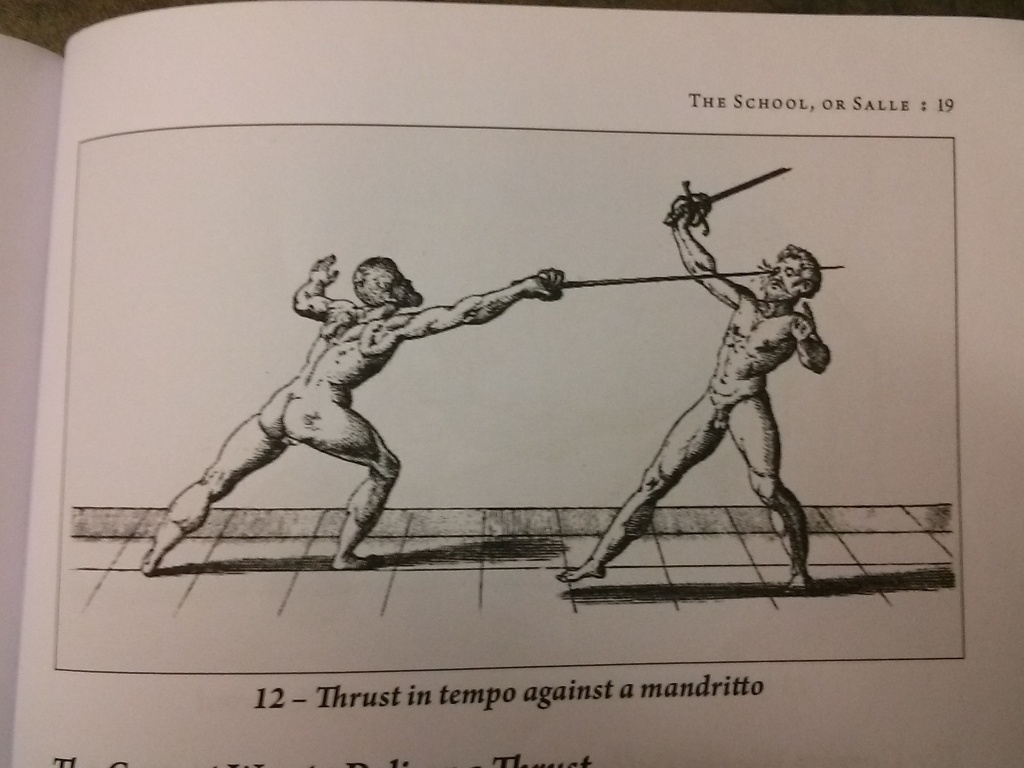
Giganti’s guide to C&T in one picture
Basic Concepts and Terms
In the case of rapier a tempo is the duration of an action. Any action. Since some action take longer than others, tempi (plural of tempo) are spoken of as having size — being smaller (shorter) or larger (longer). Giganti gives a list of examples of tempi, but it boils down to any of the actions if rapier fighting are tempi, including not moving.
An attack that takes a single action is called a single tempo (stesso tempo) attack. A lunge, being a single continuous movement, is the basic stesso tempo attack.
An attack that takes two separate, distinct actions is a two tempo (duo tempi) attack. The most common example of this is the parry-riposte counter-attack, which requires two discrete movements of the sword (one for the parry, moving to one side or the other, the other for the riposte moving towards the opponent).
The size of a tempo expresses how long it takes, which in turn is a function of how large of a motion is required. A movement just of the hand (a tempo of the hand) is small (think about how fast a disengage is). A movement of the whole arm (for instance a parry) is larger. A movement of the foot is the largest tempo. Any motion of any body part takes a certain amount of time and in general the more massive the body part and the more weight that it supports, the larger the tempo of that body part.
An action performed during an opponent’s tempo is called a contratempo action. This usually most commonly encountered in the context of a contratempo attack, delivered during your opponent’s disengage, parry, advance, lunge, or other action.
Contratempo Actions
The whole point of Giganti’s system is to deliver contratempo attacks. Let your opponent perform an action or force them to perform an action and take the tempo to attack. Remember that the reason for taking a counterguard (which all good fencers do instead of just forming a guard) is to require your opponent to move before they can attack you (a disengage or other change of position), giving you a tempo to take. Since the fighter should always be in a counterguard (even when lunging – the properly performed cavazione disengages from the opponent’s counterguard to form a counterguard on the opposite side of the blade) the opponent must always be responding with a larger tempo.
The other side of the coin is to give your opponent no tempi to exploit. If your opponent moves twice, move once. If your opponent moves small, move smaller. Giganti’s stance enables a lunge to be delivered with as little motion as possible, and the Italian lunge itself has no wasted motion. The first play illustrating a contratempo attack in Giganti’s manual, the attack in the tempo of a cavazione, works because the cavazione adds a tempo of the hand to the lunge, whereas the contratempo attack is a lunge with a rotation of the hand to keep the line closed (which is a slightly smaller tempo of the hand than the cavazione).
One of my big disagreements with the Mediema interpretation of Giganti is that he describes a contratempo counterattack as lunging during the opponent’s recovery after a lunge [p35]. In fact what Mediema describes as a contratempo attack is described as a duo tempi action by Giganti. Mediema also describes one of his student’s “jarring habit” of counter-lunging during his opponent’s lunge. He describes this as “somewhat discombobulating” to receive, and says this technique works “just as well”. It works better because it is an attack in the tempo of the opponent’s lunge, not after the tempo of the opponent’s lunge, and therefore an actual defense against the lunge. And it is discombobulating as hell. It’s a pretty big misconception for an interpretation of Giganti to contain and not at all consistent with application in a fight.
Developing the ability to deliver these contratempo attacks leads to people believing you’re fast. Part of that is the fact that you’re moving towards each other simultaneously, so what they’re perceiving as your speed moving toward them is actually the sum of both fighters’ speed. Really, though, fighter’s “being fast” is a myth (past a certain point of neuromuscular training: muscles can only twitch so quickly, nerve signals still take the same amount of time to travel up the brainstem). You’re just moving smaller than your opponent and they’re already committed mentally and physically to the action they’ve begun. It also helps to have limited where they can move so that, when they begin their motion, you already know where they’ll be and can be waiting for them when they get there. Most fencers have received a contratempo attack. When done properly, the victim feels like they could see the events as they unfolded and could do nothing to stop them.
A note for the student: contratempo lunges result in the full mass of both fighters moving towards each other until an impact concentrated on a spot roughly half an inch wide. When I was practicing this, it hurt me a lot. Then it hurt my opponents a lot. Then I learned to relax my arm until it was just tense enough to give way after the strike landed. The upside of this was that, since most of my arm wasn’t committed to locking out the extension in the lunge, it was now able to adjust to counter my opponent’s actions.
Obedience
If you’ve set yourself in a good counterguard, not only can your opponent not attack you without taking two actions, you already know what those actions have to be. That means the next time your opponent moves, you have dictated what the movement will be, and in the tempo of their movement you can move to counter this new action so that, again, you have control over where they are and where they can go. The result is maneuvering your opponent through a series of predictable, and counter-able reactions. So long as you continue to take fewer, smaller tempi than them, and your actions result in counterguards against their line of attack, you can act with freedom and they are constrained to what you permit them to do.
Giganti doesn’t name this, though it’s readily observed in some of his more complicated plays, but other masters refer to this as “having your opponent in obedience.” Anytime you act in such a way as to limit your opponent’s responses and make their reactions predictable you have placed your opponent in obedience.
The ways you can let your opponent out of obedience are pretty straight forward:
- Break or fail to form your counterguard.
- Take a larger tempo than they take giving them a chance to catch back up to a neutral point.
- Waste a tempo that they can exploit. This includes failing to move when you should.
Barring any of these you have your opponent in obedience and can proceed to strike at will. Or play with your food.
If you should find that you have been placed in obedience, run away. Retreat to well outside of measure, re-assume a counterguard, and approach to start the fight anew.
Instances of Duo Tempi Actions
Instances where you might need to take two actions do show up in this system. The first is against opponents who charge forward, throwing attacks “without regard to tempo.” Other masters call these fighters “bestial” or “artless”. We find a lot of them in the SCA. Against these he acknowledges you’ll need to beat their sword aside with your forte, and then lunge. He warns they might perform a cavazione, but that you can thwart this by turning your hand to follow it with the true edge during your lunge (which, again, you can do if your arm is not locked into place with all your muscles tensed). Since they disregard tempo, though, you should be safe taking an extra one.
The other example is in his discussion of sword and dagger play when voiding backwards from a lunge: As the opponent thrusts, the fighter leans backward so that it comes up short, at the same time parrying the blade to one side or the other with the dagger. Then he follows with a counter-attack after the opponent’s lunge. Here a movement to take yourself out of measure negates the need for control of tempo (the same as a full retreat would). While he does include this in his instructions, his next plate is how to do the same thing in a single tempo (pulling the body back, parrying with the dagger, and extending a stop-thrust into the opponent’s face) which is inherently preferable.
Complex Stesso Tempo Actions
There are actions and plays which by everything we’ve discussed so far should be considered duo tempi actions. However, Giganti refers to them as stesso tempo. The first example encountered is “If you advance into measure and immediately deliver your attack into his opening, this is a tempo” – an advance followed by a lunge. What makes this a single tempo is the continuous forward motion of the blade. So, too, a cavazione followed by a contra-contra-cavazione (to counter the opponent’s contra-cavazione) keeps the blade in a continuous motion and can therefore be thought of as a single continuous tempo, even though there are smaller tempi contained within it which your opponent could exploit if they were not in obedience.
This starts to resemble Fabris’s instructions on proceeding with resolution. If you keep your opponent in obedience, so long as your sword moves steadily towards them it is a single continuous motion. Keeping your feet moving steadily forward (with natural steps) becomes a long single tempo of the feet the same way that having your feet motionless would also be a single tempo of the feet. The same combinations of the basic actions of the hands that we drill with our feet stationary can be drilled with the feet moving constantly in the same direction. The ability to do this is an essential requirement for pursuing those fleeing opponents I mentioned in the Measure chapter. And it’s really satisfying to have your opponent running before you, completely in obedience, until they die or hit the list fence (which, as mentioned previously, was the same as defeat in Italian Rapier).
We are now at the stage of the rapier peerage where the language for the changes to Corpora has been made public for further comments. Honestly, this feels like it is a done deal, but given the time spent getting here, it is worthy of our attention and consideration. This is a Big Deal, and, to repeat myself on the topic: “Wooooohhhhhooooooooo!”
Everything herein is speculative, of course, but speculating on future events is an entertaining endeavor. I might be wildly mistaken on how things actually play out, but that’s the risk we all take when thinking about what might be. Whatever happens is going to turn out fine in the end.
Glossary, page 9.
DELETE
[• Peerage: Collectively, the members of the Order of Chivalry, the Order of the Laurel, and the Order of the Pelican, are referred to as the Peerage. A member of any of these Orders is a Peer.]
ADD
• Peerage: Collectively, the members of the Order of Chivalry, the Order of the Laurel, and the Order of the Pelican, and the Order of Defense are referred to as the Peerage. A member of any of these Orders is a Peer.
The thing of note here is the name of the peerage, from Order of the Masters of Defense. I actually prefer the truncated name, as before one might be correctly styled a Master of the Masters of Defense, which begins to sound like a character from Catch-22.
VIII. PERSONAL AWARDS AND TITLES
A. Patents of Arms
2. Order of Precedence Within the Peerage
DELETE
[The Crown may establish the order of precedence within the peerage according to the laws and customs of the kingdom. However, the Chivalry, the Laurel, and the Pelican, and Defense are of equal precedence and must be considered as one group.]
ADD
The Crown may establish the order of precedence within the peerage according to the laws and customs of the kingdom. However, the orders of the Chivalry, the Laurel, and the Pelican, and Defense are of equal precedence and must be considered as one group.
This is a simply change to include the Order, but read it over a few times. Say it out loud. That is pretty fantastic.
4. Patent Orders:
ADD
d. The Order of Defense:
(i) Members of the Order of Defense may choose to swear fealty, but are not required to do so. The candidate must be considered the equal of his or her prospective peers with the basic weapons of rapier and/or cut-and-thrust combat. The candidate must have applied this skill and/or knowledge for the instruction of members and service to the kingdom to an extent above and beyond that normally expected of members of the Society.
This is where things become most interesting, as we begin to get a direct sense of what the Order of Defense entails. I have no doubt that the actual practice will be much more complex, but the description provided in Corpora will serve as the guiding light.
First, the fealty option is standard. Only the Order of Chivalry adopts different titles and regalia depending on whether or not one has taken an oath of fealty. I would guess that most Masters of Defense will opt to swear fealty, and that most places will culturally encourage that. A lot of people do not realize that they can customize their fealty oath (I had about 15 minutes of notice to write mine; when fealty was presented as an optional thing, I froze up for a moment, stunned that I could have gone without it. It had always been a foregone conclusion in my mind, but I didn’t know that they weren’t all the same like our Academie oaths.), so you can make it what it needs to be for you.
Second, it addresses the skill level needed to be elevated. “Equal” is actually pretty clear (eventually), in that it is not too difficult to answer whether or not someone is of approximately the same skill as you: you fight them a whole bunch and look at the results. More goes into “equal” than just that, but it is also a irrefutable starting point. If you lose to someone 70% of the time, you are not their equal. Styles and matchups create some leeway in the 60-40 to 40-60 range, but much more than that is a skill discrepancy or some other deficit in most cases.
This item will be a bit odd at first as the initial group made will not have any prospective peers to be the equal of, but realistically I would say that each kingdom probably has between 10-15 fighters who really stand out, and maybe half of those are the consistent tournament winners and high performers. Many try to discount the importance of tournament success as an indicator of skill, but it seems odd to make the statement, “Lord/Lady XYZ is one of the very best fencers we have, but also never makes it past the quarterfinals and also only sometimes gets that far.” That fencer might be quite good, but is far from “the very best” by any authentic definition of “best”.
I strongly suspect that the initial group elevated in most kingdoms will be those of that top 10-15 who are already peers, because they will have to poll for future peers and that guarantees legitimacy in those pollings. It stands to reason that it will be established peers who advise the Crown on who will be the first Masters of Defense to sit vigil.
Third, we get a final sentence with two main ideas and a clarifying clause: it says that a Master of Defense must have applied their skill with and/or knowledge of fencing weapons for instruction or service above and beyond what is normally expected for Society members. I read that to mean that a Master of Defense has an expert level of skill and knowledge, and uses that expertise to make others better and to benefit the kingdom. It is noteworthy that the language specifies that the service to the kingdom must be related to their fencing skill and knowledge. It is also noteworthy that it must be done in a way that exceeds normal expectations; while it certainly warrants discussion, I would think of this as someone who is especially active and involved in growing and improving rapier even when compared to other White Scarves (or equivalent).
(2) The duties of the members of the order are as follows:
(a) To set an example of courtesy and chivalrous conduct on and off the field of honor.
(b) To respect the Crown of the kingdom; to support and uphold the laws of the kingdom and Corpora.
(c) If in fealty, to support and uphold the Crown of his or her kingdom.
(d) To enrich the kingdom by sharing his or her knowledge and skills.
(e) To enhance the renown and defend the honor of the peer’s Lady or Lord.
(f) To advise the Crown on the advancement of candidates for the Order of Defense
(The section on royal peerage becomes section e, etc.)
Nothing here is unusual or outlandish. Ultimately, several of the peerage requirements condense (as I see it; more experienced peers may have a different view) down to the imperative to be someone who makes the experience of the Society better for others by virtue of his or her presence and involvement. That final line about advising is typical for any polling order, and nearly everyone under consideration for a peerage has probably entered into another polling order beforehand.
D. Titles
4. The titles listed here are considered standard, and may be used by those who have earned or been granted the appropriate rank or award within the Society. The College of Arms publishes a more extensive list of titles and alternative forms, which may also be used freely by qualified persons. In addition, the College of Arms has full approval authority over new alternative titles, which must be added to their list before being released for use in the Society.
DELETE
[TITLE
Master/Mistress
Members of the Orders of the Laurel, the Pelican, and Mastery of Arms.]
ADD
TITLE
Master/Mistress
Members of the Orders of the Laurel, the Pelican, Mastery of Arms, and Defense.
This is more straightforward incorporation.
IX. Society Combat
DELETE:
[C. Rapier Fighting in the Society
The Board acknowledges rapier combat as an ancillary activity of the Society when properly supervised by the Marshals and when approved by individual kingdoms. Rapier combat may take place within a kingdom only by rules established by the Marshallate of that kingdom and after the approval of those rules by the Marshal of the Society. The Marshal of the Society will maintain guidelines for rapier combat within the Society. Rapier combat, not having been part of formal tournament combat in the Middle Ages, shall not be a part of formal tournament lists for royal ranks and armigerous titles. ]
THIS. IS. HUGE. This, as much and maybe more than anything, is wonderful: the removal of the passage about rapier as an ancillary activity means that fencing is an integral part of the organization in the same way that researching the Middle Ages is integral. If you learn the history of fencing in various kingdoms, you can see why this matters.
ADD
C. Royal Lists
Only Chivalric (rattan) combat shall be used for formal tournament lists for royal ranks.
[This last might need some explanation. The current Section IX.C is a holdover from a Governing and Policy decision from October 1979, when the Board decided that rapier combat would be allowed in the SCA as an ancillary activity. Rapier combat is no longer considered an ancillary activity and has not been for many years. Also, the duties of the Society Earl Marshal are properly defined in section VI.D. So this section is reduced to a single clear, unambiguous rule.]
No kings and queens from fencing tournaments. No one was expecting rapier crowns, and I doubt too many are willing to die on that hill. Rapiers don’t really fit the Arthurian image of royalty that we have, so I’ve no argument to make against this.
There we have it. I think the language works as is, and I like the focus the language gives to aspects specifically rapier-related. As I see it, all we have left to ask is: “If I want to be this, what do I need to do to get there?”